Pulmonary Medicine
Medically reviewed by Varun Halani, MD · August 13, 2026
Asthma
A chronic inflammatory condition of the airways that causes variable, often reversible airflow limitation, producing symptoms such as wheezing, chest tightness, cough, and shortness of breath that come and go with triggers.
In short
Asthma is a chronic inflammatory condition of the airways that causes variable, often reversible narrowing, producing wheezing, chest tightness, cough, and shortness of breath that tend to come and go with triggers such as allergens, infections, exercise, and irritants. It is diagnosed through a symptom history combined with objective testing, most often spirometry with bronchodilator response and, in some cases, FeNO testing, and treated primarily with inhaled anti-inflammatory therapy, with biologic medications available for more severe, specific phenotypes. Severity, how much treatment a person's asthma requires, and control, how well symptoms are currently managed, are related but distinct concepts that guide ongoing care.
Asthma at a Glance
What Happens
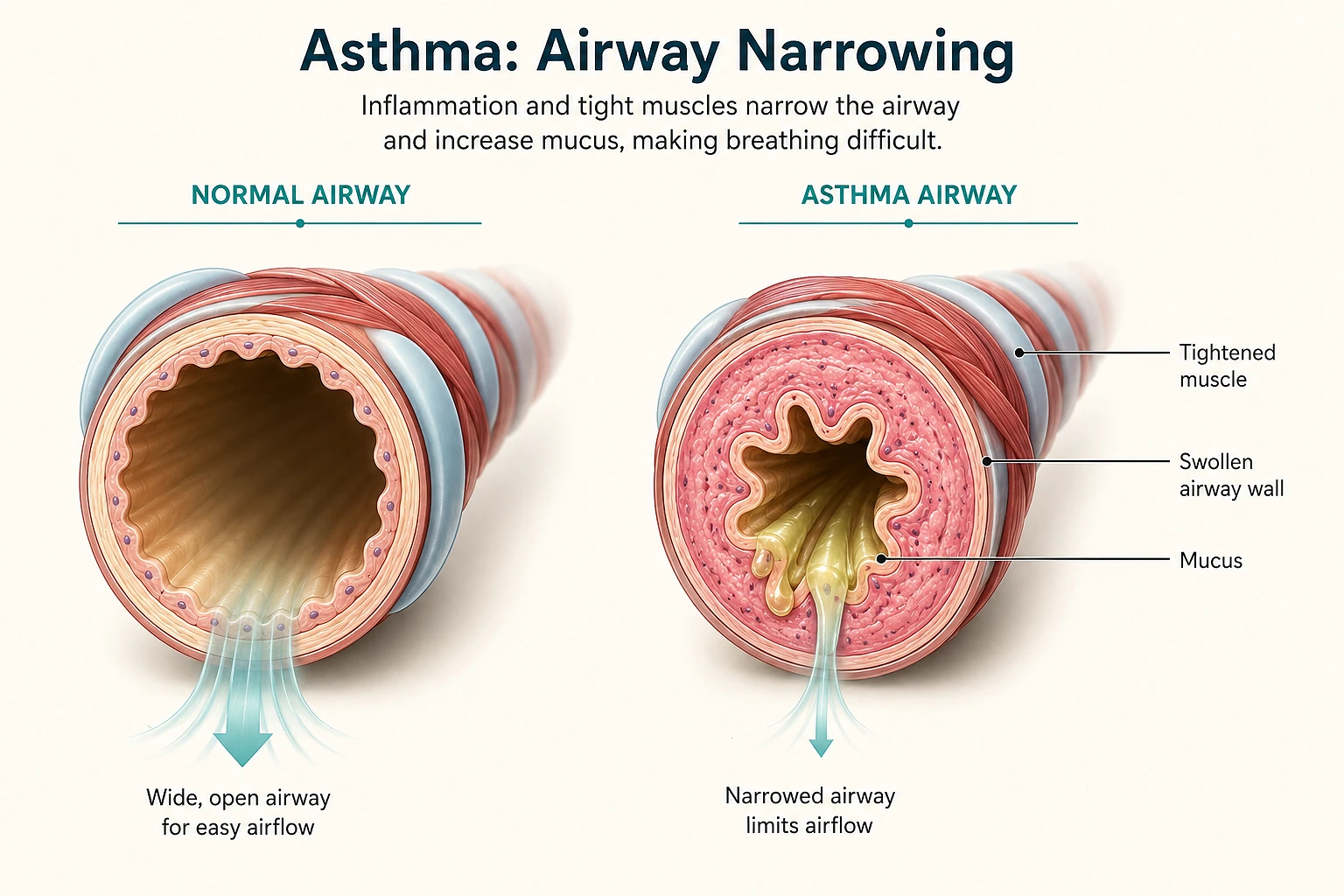
The airways become inflamed and irritable, and in response to triggers, narrow through a combination of airway swelling, tightened muscle around the airway, and increased mucus.
Common Symptoms
Wheezing, chest tightness, cough that is often worse at night or with exercise, and shortness of breath that vary over time and by trigger rather than staying constant.
How It Is Diagnosed
A detailed symptom history, followed by objective testing, most often spirometry with bronchodilator response, and sometimes FeNO testing to assess airway inflammation.
How It Is Treated
Inhaled anti-inflammatory therapy is the foundation for most patients, with biologic medications available for more severe, specific phenotypes that remain poorly controlled.
Key Takeaways
- Asthma causes variable, often reversible airway narrowing driven by inflammation, tightened airway muscle, and mucus, which is conceptually different from the more fixed airflow limitation seen in conditions like COPD.
- Common triggers include allergens, respiratory infections, exercise, cold air, irritants such as smoke, certain medications, and occupational exposures.
- Diagnosis relies first on a careful symptom history, then objective testing such as spirometry with bronchodilator response, with FeNO testing available as one additional piece of the diagnostic and monitoring picture.
- Severity and control are different concepts. Severity reflects how much treatment is needed to manage the disease, while control reflects how well symptoms are currently managed on that treatment.
- Inhaled corticosteroids are the anti-inflammatory foundation of treatment for most patients, and biologic therapy is a guideline-supported option for more severe, specific phenotypes.
- Recognizing a phenotype, such as allergic or eosinophilic asthma, and tracking exacerbation frequency can help identify when additional or more specialized treatment is worth discussing.
Symptoms
Core Symptoms
- Wheezing, a whistling sound when breathing, especially on exhaling
- Chest tightness
- Cough, particularly at night or in the early morning
- Shortness of breath
- A sense that breathing takes more effort than usual
Patterns Worth Noticing
- Symptoms that come and go rather than staying constant
- Symptoms that are clearly worse with a specific trigger
- Nighttime or early morning cough or wheeze that disrupts sleep
- Symptoms that flare with exercise or exertion
- Periods of feeling completely normal between symptomatic episodes
Could I Have Asthma?
Can asthma develop for the first time in adulthood?
Yes. Asthma often begins in childhood, but it can start at any age, including well into adulthood, sometimes without any childhood history of wheezing or allergies.
Why do my symptoms come and go instead of staying the same?
This variability is a defining feature of asthma. Because airway narrowing is driven by inflammation reacting to specific triggers, symptoms often flare in certain conditions and settle in others, rather than remaining constant.
Could my nighttime cough be asthma?
It's possible. A cough that is worse at night or in the early morning, particularly without other signs of a cold, is a recognized asthma pattern worth mentioning to a physician, especially alongside symptoms like wheeze or chest tightness.
Is it just being out of shape, or could it be asthma, when I get unusually breathless exercising?
Not necessarily out of shape. Breathlessness with exercise that seems disproportionate to effort, or that comes with coughing, wheezing, or chest tightness, can reflect exercise-related airway narrowing rather than fitness alone, and it's worth evaluating rather than assuming.
Does having allergies mean I'm more likely to have asthma?
Allergic conditions, including allergic rhinitis and eczema, are associated with a higher likelihood of asthma, and allergic triggers are common in many patients, though not everyone with asthma has a clear allergic component.
If my breathing test is normal, does that rule out asthma?
Not necessarily. Because airflow can look normal between symptomatic periods, a single normal spirometry result does not fully rule out asthma when the symptom pattern is otherwise convincing, and repeat or additional testing may be reasonable.
Can asthma be outgrown or cured?
Asthma is generally considered a long-term condition rather than one that is cured, although symptoms can become much less frequent, or even seem to disappear for periods of time, particularly in some children as they get older. Underlying airway inflammation can persist even when symptoms are quiet.
What Triggers Asthma Symptoms?
Allergens
Pollen, dust mites, pet dander, mold, and cockroach exposure are common triggers, particularly for patients with an allergic asthma pattern.
Respiratory Infections
Colds and other upper respiratory infections are among the most common triggers of asthma symptoms and exacerbations, at any age.
Exercise
Physical exertion, especially in cold or dry air, can trigger airway narrowing in many patients, a pattern significant enough that it warrants its own evaluation.
Cold Air
Breathing cold, dry air can irritate the airways directly, independent of exercise.
Irritants and Smoke
Tobacco smoke, wood smoke, strong fumes, and air pollution can each irritate sensitive airways and trigger symptoms.
Certain Medications
Some medications, including nonsteroidal anti-inflammatory drugs and certain beta-blockers, can trigger or worsen asthma symptoms in susceptible patients.
Occupational Exposures
Workplace exposure to dust, chemical fumes, or other airborne irritants can trigger asthma symptoms or, in some cases, contribute to asthma that develops specifically because of that exposure.
Risk Factors
- A personal or family history of allergic conditionsIncluding eczema, allergic rhinitis, or food allergies, reflecting a shared underlying tendency toward type 2 immune responses
- A family history of asthmaSuggests a genetic contribution to airway reactivity
- Certain respiratory infections in early childhoodAssociated with a higher likelihood of developing asthma later
- Obesity
- Exposure to tobacco smokeIncluding secondhand smoke exposure in childhood
- Certain occupational exposuresSome workplace exposures are associated with asthma that develops specifically due to that exposure, sometimes called occupational asthma
- Early life environmental exposuresAir pollution and some early childhood exposures remain areas of active research as contributing factors
Why Uncontrolled Asthma Matters
Exacerbation Risk
Poorly controlled asthma is associated with a higher risk of exacerbations, including some significant enough to require urgent or emergency care.
Sleep Disruption
Nighttime symptoms are common in poorly controlled asthma and can meaningfully affect sleep quality.
Activity Limitation
Ongoing symptoms can limit exercise, physical activity, and participation in everyday activities.
Work and School Impact
Uncontrolled asthma is associated with missed work and school days and reduced overall performance.
Airway Changes Over Time
Ongoing, poorly controlled inflammation is thought to contribute to longer-term airway changes in some patients, part of why current guidance emphasizes treating underlying inflammation rather than only relieving symptoms in the moment.
Quality of Life
Consistent control is strongly associated with better day-to-day quality of life, independent of how severe the underlying disease is.
When Should I Talk to a Pulmonary Specialist?
- Asthma symptoms that remain poorly controlled despite consistent use of standard inhaled therapy
- Diagnostic uncertainty, including symptoms that don't fully fit a typical asthma pattern
- Frequent exacerbations, including any requiring oral steroids, urgent care, or emergency treatment
- Suspicion of a specific phenotype, such as significant eosinophilic or allergic asthma, that may benefit from biologic therapy
- Asthma symptoms that started or significantly worsened in adulthood
- Possible occupational asthma related to a specific workplace exposure
- A need to confirm the diagnosis with more detailed pulmonary function testing
Overview: What Is Asthma?
Asthma is a chronic inflammatory condition of the airways that produces variable, and often reversible, airflow limitation. Underneath that clinical description is something more concrete: the airways, the tubes that carry air into and out of the lungs, become inflamed and irritable, and in response to certain triggers, react by narrowing.
How the Airways Narrow
Three things typically happen together when asthma symptoms flare, building on each other rather than occurring in isolation:
- Airway swelling: inflammation causes the lining of the airway to swell
- Bronchoconstriction: the smooth muscle wrapped around the airway tightens
- Increased mucus: the airway produces more mucus than usual
Together, these narrow the space available for air to move, producing the wheeze, tightness, and breathlessness recognized as asthma symptoms.
Why 'Variable' Is the Key Word
What distinguishes asthma from many other chronic lung conditions is that this narrowing is variable. It comes and goes, often in response to identifiable triggers, and is frequently, though not always completely, reversible, either on its own, with treatment, or both. A person can have significant airflow limitation on a bad day and near-normal airflow a week later.
This variability is itself a diagnostic clue. It is part of what separates asthma, conceptually, from chronic obstructive pulmonary disease (COPD), whose airflow limitation is typically more fixed and progressive over time, even though the two conditions can overlap and even coexist in the same patient.
Symptoms vary in this same way, as the patterns above suggest: a person’s asthma can feel quiet for weeks and then flare noticeably after a cold, a workout in cold air, or exposure to an allergen. That pattern of variability is often as clinically informative as any single symptom on its own.
Airway Inflammation: The Underlying Driver
While the narrowing described above is what produces symptoms, inflammation is the process driving it, and understanding that distinction matters for both diagnosis and treatment. In a large share of people with asthma, this inflammation follows a recognizable immune pattern, often called type 2 inflammation, in which specific immune signals recruit eosinophils, a type of white blood cell, into the airway lining.
Eosinophilic, type 2 inflammation is the most extensively studied and most directly treatable pattern in asthma, which is part of why it plays a central role in current diagnostic testing, including FeNO testing discussed below, and in the newer biologic therapies discussed later in this article. Not every case of asthma follows this exact pattern; a smaller share of patients have inflammation that is not primarily eosinophilic.
This distinction, along with the broader idea of asthma phenotypes, is significant enough to deserve its own dedicated discussion. What matters at this level is recognizing that asthma is not a single, uniform inflammatory process in every patient.
Diagnosis: Pattern Recognition First
A confident asthma diagnosis begins with a careful history, not a single test. A physician typically asks about the pattern of symptoms (wheeze, chest tightness, cough, or shortness of breath) that recur, that vary over time and by trigger, and that are often worse at night, early in the morning, or with exercise.
A history that fits this pattern, especially alongside a personal or family history of allergic conditions such as eczema or allergic rhinitis, raises suspicion for asthma well before any test is performed.
Symptoms alone are not sufficient for a confident diagnosis, however, since several other conditions, including vocal cord dysfunction, COPD, and even a chronic cough from an unrelated cause, can resemble asthma in isolated features. Objective testing helps confirm the diagnosis and, importantly, helps identify or rule out other explanations.
How an Asthma Diagnosis Typically Comes Together
- 01Symptom HistoryA physician reviews the pattern, timing, and triggers of symptoms such as wheeze, chest tightness, cough, and shortness of breath.
- 02Physical ExamAn exam looks for findings consistent with asthma and for clues pointing toward a different or additional explanation.
- 03SpirometryPulmonary function testing measures airflow and, with a bronchodilator, whether that airflow improves meaningfully.
- 04Additional Testing as NeededFeNO testing, allergy testing, or repeat spirometry may add useful information, particularly when the initial picture is not fully clear.
- 05Diagnosis and Phenotype ConsiderationA physician confirms the diagnosis and considers whether a specific phenotype, such as allergic or eosinophilic asthma, is apparent.
Spirometry and Bronchodilator Response
Pulmonary function testing, most commonly spirometry, is the primary objective test used to evaluate suspected asthma. Spirometry measures how much air a person can forcefully exhale and how quickly, comparing the results to expected values for that person’s age, sex, and height. In asthma, spirometry often, though not always, shows a pattern of airflow limitation.
What makes spirometry particularly useful for asthma, rather than for airflow limitation generally, is testing before and after a bronchodilator, a medication that relaxes airway muscle. A meaningful improvement in airflow afterward, known as bronchodilator reversibility, supports an asthma diagnosis by demonstrating that at least part of the airflow limitation is reversible, a hallmark of the condition rather than a fixed, structural narrowing.
The exact threshold for a meaningful improvement is a technical detail set by the interpreting physician and current testing standards, not one fixed number applied identically in every scenario; what matters conceptually is that the airway responds to treatment.
Spirometry performed between symptomatic periods can be entirely normal, since asthma’s hallmark variability means airflow can look normal on a good day. A normal result on a single visit does not, by itself, rule out asthma, particularly when the clinical history is convincing; repeat testing, additional testing, or a closely monitored trial of treatment may be reasonable next steps.
FeNO Testing
Fractional exhaled nitric oxide, or FeNO, is a non-invasive breath test that measures nitric oxide in exhaled air, a marker correlated with the type 2, eosinophilic airway inflammation described earlier. FeNO is a useful piece of the diagnostic and monitoring picture, but it is not, on its own, a standalone diagnostic test for asthma.
It is most valuably interpreted alongside symptoms, spirometry, and clinical judgment, and it can be particularly helpful for identifying patients whose inflammation follows the type 2 pattern, information that becomes relevant if a biologic therapy is ever considered.
FeNO carries enough nuance of its own, particularly around interpretation, that it is addressed in more detail elsewhere; what matters here is understanding where it fits into the broader picture.
Asthma Phenotypes: Not One Uniform Disease
Two patients can carry the same asthma diagnosis and have meaningfully different underlying disease. Recognizing this is one of the more important shifts in how asthma is understood clinically today.
Rather than treating asthma as a single, uniform condition, current guidance encourages identifying, where possible, which broad pattern, or phenotype, best describes a given patient’s disease, since this can meaningfully influence treatment choices, particularly for asthma that is harder to control.
Allergic Asthma
Symptoms are triggered predominantly by specific allergens, often alongside other allergic conditions such as allergic rhinitis or eczema, and often beginning in childhood.
Eosinophilic Asthma
A pattern of type 2 airway inflammation identified through blood eosinophil counts, FeNO, or airway sampling, which can occur with or without an obvious allergic trigger and is often more prominent in adult-onset asthma.
These two categories are not mutually exclusive; many patients have features of both, and a meaningful share of asthma does not fit neatly into either pattern.
This page introduces phenotypes at a foundational level. Allergic asthma and eosinophilic asthma each involve enough diagnostic and treatment nuance to warrant their own more detailed discussion, alongside related patterns such as exercise-induced bronchoconstriction and severe, difficult-to-control asthma specifically.
Severity Versus Control: Two Different Concepts
Severity
Asthma severity describes an inherent property of the disease, essentially how much treatment is required to keep it controlled. A patient whose symptoms stay well managed on a low dose of inhaled therapy is generally considered to have milder disease than a patient who needs multiple medications, including higher doses or additional therapy classes, to reach that same level of symptom control.
Severity is typically assessed retrospectively, based on the treatment intensity required over time, rather than judged from a single visit.
Control
Asthma control, in contrast, describes how well symptoms are currently being managed on whatever treatment a patient happens to be taking right now, regardless of how severe the underlying disease is. A patient with severe asthma can have excellent day-to-day control on appropriate treatment, while a patient with comparatively mild underlying disease can have poor control if treatment is inadequate, inconsistently used, or triggers are not being managed.
Control is reassessed at essentially every visit, using factors such as how often symptoms occur, how often reliever medication is needed, how much daily activity is limited, and how many exacerbations have occurred recently.
This distinction, summarized in the comparison above, is one of the most common points of confusion for patients: mild asthma is not a synonym for well controlled, and well controlled does not mean the underlying disease is mild. Current international guidance treats severity and control as related but distinct concepts, with control reassessed on an ongoing basis and treatment adjusted, stepped up or stepped down, as that assessment changes.
Inhaled Therapy: The Foundation of Modern Treatment
For most patients, effective asthma treatment starts with inhaled therapy, delivered directly to the airways for effect precisely where inflammation and narrowing occur, generally with a lower risk of the broader body-wide effects associated with oral or systemic medications.
Inhaled corticosteroids are the anti-inflammatory foundation of modern asthma treatment. Rather than only relieving symptoms in the moment, they work by reducing the underlying airway inflammation described earlier, which over time lowers symptom frequency and severity and reduces exacerbation risk.
They are frequently combined with a bronchodilator, a medication that relaxes airway muscle and opens the airway more immediately, in a single combination inhaler. This pairing addresses both the underlying inflammation and moment-to-moment narrowing together, and now factors into how both maintenance and as-needed reliever therapy are approached under current international guidance.
The specific medication, dose, and combination that suit an individual patient are set by a physician based on severity, current control, and response over time, and adjusted at follow-up visits rather than fixed at diagnosis. This overview describes the general treatment concept, not an individualized regimen.
Biologic Therapy for More Severe, Specific Phenotypes
Biologic medications, given by injection or infusion, are part of current guideline-supported care for the smaller group of patients whose more severe asthma remains poorly controlled despite appropriately used inhaled therapy (see Treatment Options below).
Unlike inhaled therapy, which acts broadly on airway inflammation, each currently available biologic targets one specific inflammatory pathway, most commonly related to type 2, eosinophilic inflammation.
Because of this targeted mechanism, biologic therapy is generally most appropriate for patients whose phenotype has been specifically identified, using tools that can include FeNO, blood eosinophil counts, and allergy testing, alongside clinical severity and control.
Biologic therapy is a substantial enough topic, spanning several distinct medications, mechanisms, and eligibility considerations, that it warrants its own dedicated discussion. What is worth understanding at this level is that biologic therapy exists as a legitimate, guideline-supported option for appropriate patients, and that being a candidate depends on a more detailed evaluation than this overview can provide.
Exacerbations: When Asthma Worsens
An asthma exacerbation, sometimes called a flare or attack, is a period during which symptoms and airflow limitation meaningfully worsen beyond a patient’s usual baseline, often triggered by a respiratory infection, an allergen exposure, or another identifiable trigger, though not always. Warning signs can include:
- Increasing shortness of breath
- More frequent use of reliever medication than usual
- Symptoms that interfere with sleep or activity
- A subjective sense that breathing is becoming more difficult or less responsive to usual treatment
Exacerbations exist on a spectrum. Milder episodes may be manageable with adjustments to usual treatment, guided in advance by a physician. More significant exacerbations, particularly those involving significant breathlessness, difficulty speaking in full sentences, or a poor or worsening response to reliever medication, warrant urgent evaluation, sometimes in an emergency setting.
Recognizing early warning signs and knowing when an exacerbation has crossed from manageable at home into needing urgent care is something every asthma patient benefits from discussing directly with their physician. This general description is not a substitute for a personalized, physician-directed plan.
Frequent exacerbations, even when a patient feels reasonably well between them, are themselves a clinically significant finding. They suggest that current treatment may not be adequately controlling underlying inflammation, and they are one of the more common reasons care is escalated, including toward the phenotype evaluation and biologic therapy discussion above.
Living With Asthma
Asthma is, for most patients, a manageable, long-term condition rather than one that resolves permanently, though the degree of ongoing treatment required varies considerably from person to person and can change over time.
Ongoing care typically includes periodic reassessment of control, occasional repeat pulmonary function testing to track how the airways are responding over time, and adjustment of treatment intensity as symptoms, triggers, and life circumstances change.
For patients experiencing recurring wheeze, chest tightness, unexplained shortness of breath, or a persistent cough without a clear diagnosis, pulmonary evaluation is a reasonable next step, whether asthma has never been formally diagnosed or a prior diagnosis has never quite felt adequately controlled.
VitalAir Sleep & Lung Center evaluates and manages asthma for patients across Frisco and the broader North Dallas–Fort Worth area, from initial diagnostic evaluation, including spirometry, through ongoing treatment adjustment as control and circumstances change. The clinical information on this page applies wherever you’re reading it from; what differs locally is simply where that evaluation and follow-up care happens.
Related Health Connections
Sleep + Lungs
Sleep and lungs & breathing often influence each other — care that considers both tends to work better than treating either in isolation.
Weight + Lungs
Weight & Metabolic Health and lungs & breathing often influence each other — care that considers both tends to work better than treating either in isolation.
Asthma Care in Frisco, Texas
VitalAir Sleep & Lung Center evaluates and manages asthma for patients across Frisco, Texas, and the broader North Dallas area, from initial diagnosis and spirometry through ongoing control and step-up therapy when needed. The clinical information on this page applies to patients everywhere; what differs locally is simply where that evaluation and follow-up care happens.
Patient Questions
What is the difference between asthma severity and asthma control?
Severity is an inherent property of the disease, essentially how much treatment is required to keep it managed, and is typically judged over time rather than at a single visit. Control describes how well symptoms are currently being managed on whatever treatment a patient is taking right now, regardless of how severe the underlying disease is. A patient with severe asthma can have excellent control on the right treatment, while a patient with milder underlying disease can have poor control if treatment is inadequate or inconsistently used.
What is variable airflow limitation, and why does it matter for diagnosis?
It refers to airway narrowing that comes and goes, often in response to triggers, and is frequently, though not always completely, reversible. This variability is a hallmark of asthma and part of why a single test on a single day is not always sufficient to confirm or rule out the diagnosis.
Can I have asthma even if my breathing test result is normal?
Yes. Spirometry performed between symptomatic periods can look entirely normal, since airflow limitation in asthma is variable rather than constant. A normal result on one visit does not automatically rule out asthma when the symptom history is otherwise convincing.
What is FeNO testing, and do I need it to be diagnosed with asthma?
FeNO measures nitric oxide in exhaled breath as a marker of type 2, eosinophilic airway inflammation. It is a useful piece of the diagnostic and monitoring picture, interpreted alongside symptoms and spirometry, but it is not required for every patient and is not a standalone diagnostic test on its own.
What is the difference between allergic asthma and eosinophilic asthma?
Both describe recognizable asthma phenotypes rather than separate diseases, and they can overlap. Allergic asthma is triggered predominantly by specific allergens and often accompanies other allergic conditions. Eosinophilic asthma refers to a pattern of type 2 airway inflammation identified through blood or airway testing, which can occur with or without an obvious allergic trigger. Each phenotype has enough nuance to warrant its own more detailed discussion.
How is asthma different from COPD?
Both are chronic conditions that affect airflow, but asthma's airflow limitation is typically variable and often substantially reversible, while COPD's airflow limitation is generally more fixed and progressive over time. The two conditions can coexist in the same patient, which is part of why an accurate individual diagnosis matters.
What triggers asthma symptoms?
Common triggers include allergens such as pollen and dust mites, respiratory infections, exercise, cold air, irritants such as smoke and air pollution, certain medications, and occupational exposures. Individual patients often notice a distinct, personal pattern among these.
What are inhaled corticosteroids, and why are they used for asthma?
Inhaled corticosteroids are anti-inflammatory medications delivered directly to the airways. They work by reducing the underlying inflammation driving asthma, which lowers symptom frequency and exacerbation risk over time, rather than only relieving symptoms in the moment the way a fast-acting bronchodilator does.
What is biologic therapy for asthma, and who is it for?
Biologic therapies are injectable or infused medications that target a specific inflammatory pathway, most often related to type 2/eosinophilic inflammation. They are generally considered for patients with more severe asthma that remains poorly controlled despite appropriately used inhaled therapy, and candidacy depends on identifying a specific phenotype through further evaluation.
What counts as an asthma exacerbation, and when is it an emergency?
An exacerbation is a period of meaningfully worsened symptoms and airflow limitation beyond a patient's usual baseline. Warning signs include increasing shortness of breath, needing rescue medication more often than usual, and symptoms interfering with sleep or activity. Significant breathlessness, difficulty speaking in full sentences, or a poor response to rescue medication warrant urgent evaluation.
Can asthma be cured?
Asthma is generally considered a long-term condition rather than one that is cured, though many patients achieve very good, long-standing control with appropriate treatment, and some children see symptoms become much less frequent as they get older.
When should I see a pulmonologist for asthma?
Reasonable reasons include asthma that remains poorly controlled despite standard inhaled therapy, uncertainty about the diagnosis itself, frequent exacerbations, or a suspected phenotype that might benefit from biologic therapy. Asthma that started or clearly worsened in adulthood is also worth a specialist evaluation.
Sources
Guidelines and Professional Societies
- Global Initiative for Asthma (GINA). Global Strategy for Asthma Management and Prevention, 2026 Update.View source
- Global Initiative for Asthma (GINA). GINA Severe Asthma Guide, 2026.View source
- Dweik RA, Boggs PB, Erzurum SC, et al. An Official ATS Clinical Practice Guideline, Interpretation of Exhaled Nitric Oxide Levels (FeNO) for Clinical Applications. American Journal of Respiratory and Critical Care Medicine, 2011.View source
- American College of Chest Physicians. Asthma, Topic Collection.View source
Government and Regulatory Sources
- National Heart, Lung, and Blood Institute. Asthma.View source