Testing & Diagnosis
Medically reviewed by Varun Halani, MD · August 13, 2026
6-Minute Walk Test
The 6-minute walk test measures how far a person can walk in six minutes on a flat surface, a simple, practical way to assess functional exercise capacity and detect exertional oxygen desaturation.
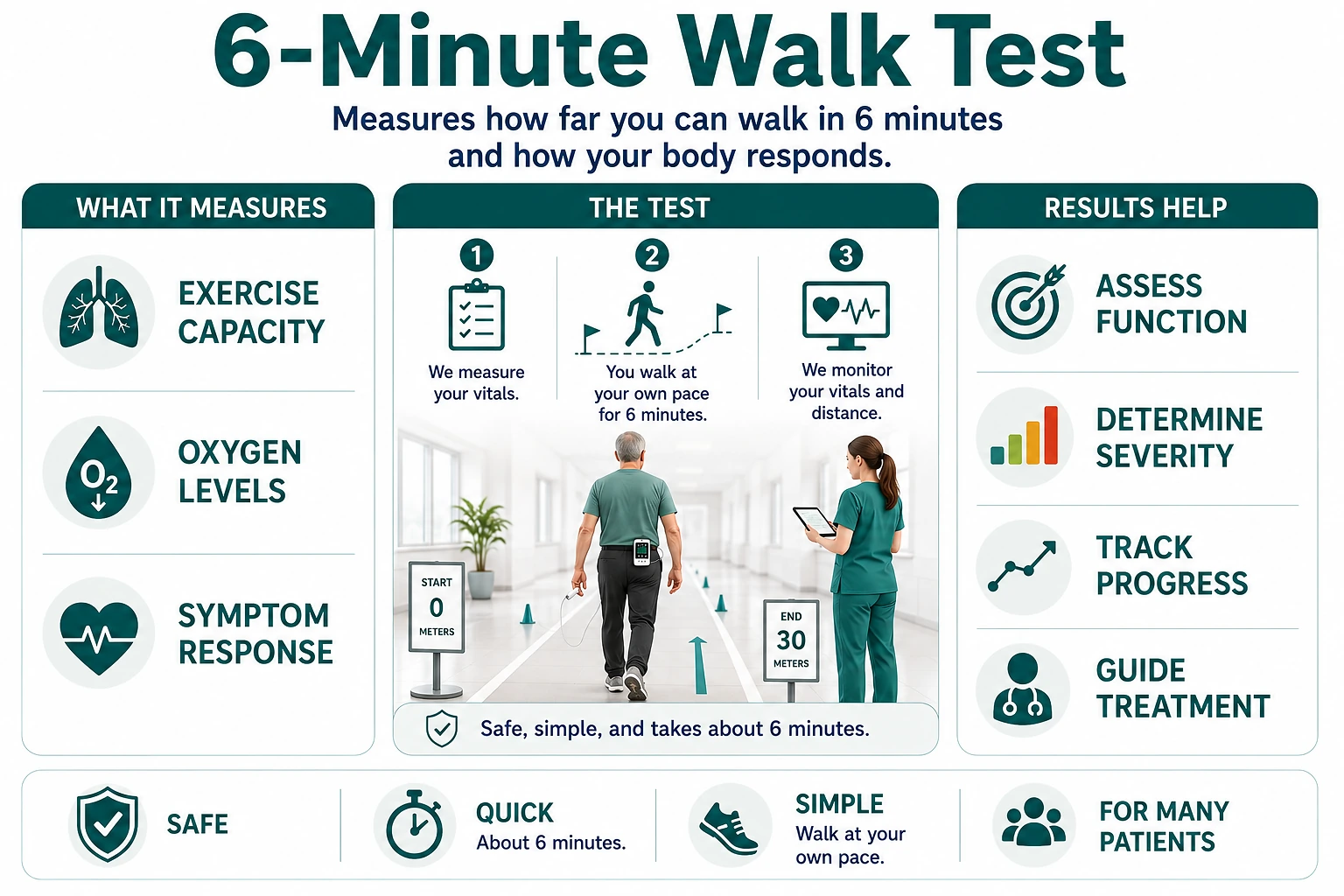
In short
The 6-minute walk test measures how far you can walk in six minutes on a flat, hard surface, at your own pace. It is a simple, practical way to assess functional exercise capacity, and it typically includes monitoring of oxygen saturation and heart rate before, during, and after the walk to see how your body responds to exertion.
At a Glance
What It Measures
Distance walked in six minutes, along with oxygen saturation, heart rate, and perceived breathlessness during exertion.
Why It Is Ordered
To assess functional exercise capacity, detect exercise-induced oxygen desaturation, and track change over time in conditions like COPD, ILD, and pulmonary hypertension.
What to Expect
Walking back and forth along a marked, flat corridor at your own pace for six minutes, with breaks allowed if needed.
What Results May Mean
Distance and oxygen levels are compared with reference values and, when repeated, with your own prior results to track functional status.
Key Takeaways
- The 6-minute walk test (6MWT) measures the distance a person can walk in six minutes on a flat, hard surface, at a self-selected pace.
- Walking distance is the primary outcome, typically reported in meters and compared with reference values or with a patient's own prior results.
- Pulse oximetry and heart rate are usually monitored before, during, and after the walk to assess the cardiopulmonary response to exertion and detect exercise-induced oxygen desaturation.
- Perceived breathlessness and fatigue are also rated by the patient, often using a standardized breathlessness scale, alongside the objective measurements.
- The test reflects the combined effect of the heart, lungs, muscles, and other systems on real-world walking ability, which is different from what a single-organ-system test like spirometry measures.
- Results can be affected by motivation, day-to-day variability, and unrelated conditions such as joint or mobility problems, so the test is interpreted alongside the rest of a patient's clinical picture.
What the 6-Minute Walk Test Measures
A Practical, Real-World Measure
The 6-minute walk test (6MWT) measures how far a person can walk in six minutes on a flat, hard surface, walking at their own self-selected pace. It is meant to be a practical, real-world measure of functional exercise capacity, the kind of physical effort involved in walking during everyday activities.
How It Differs From a Maximal-Effort Stress Test
Unlike a treadmill or bicycle stress test, which is designed to push a patient toward a maximal effort, the 6MWT does not try to find the outer limit of what the heart and lungs can do. It is built around a self-selected pace instead, so it reflects the kind of sustained walking a person actually does day to day.
Because it is simple, low-cost, and does not require specialized equipment beyond a measured corridor and a pulse oximeter, the 6MWT is used widely across pulmonary and cardiopulmonary care to assess how well a patient’s body tolerates sustained physical activity.
What Is Measured During the Walk
Four pieces of information are typically gathered during the test, each adding a different layer to the overall picture of functional capacity.
Walking Distance
The main result of the test: the total distance walked in six minutes, usually reported in meters (or feet). This distance is compared against reference values that account for factors such as age, sex, height, and weight, and, for a patient being followed over time, against that same patient's own previous results. A meaningful change in walking distance between tests can be a useful signal of improving or worsening functional status, sometimes more informative in day-to-day terms than a change in a single lung-function number.
Oxygen Saturation
Pulse oximetry is typically monitored before, during, and after the walk to track how oxygen saturation responds to exertion. Some patients maintain stable oxygen levels throughout, while others experience a meaningful drop, known as exercise-induced desaturation, that may not be apparent at rest. Detecting this pattern is one of the most clinically useful aspects of the test, since resting oxygen levels alone do not always predict what happens during activity.
Heart Rate
Heart rate is also monitored as part of assessing how the cardiopulmonary system responds to exertion. Along with oxygen saturation, it helps build a fuller picture of how the heart and lungs are working together to meet the body's demands during sustained walking, rather than looking at either system in isolation.
Perceived Breathlessness and Fatigue
Patients are typically asked to rate their perceived breathlessness and fatigue during and after the walk, often using a standardized breathlessness scale. This subjective information is considered together with the objective distance, oxygen, and heart rate data, since how a patient experiences the exertion is itself clinically meaningful and does not always track perfectly with the numbers alone.
Why Functional Capacity Matters
A Whole-Body Activity
The 6MWT is valued precisely because it is not a single-organ-system test. Walking is a whole-body activity that depends on the combined function of the heart, lungs, muscles, and other systems working together.
What a Single-Organ-System Test Can't Capture
A test like spirometry can tell you a great deal about airflow through the lungs, but it cannot capture how well those lungs, along with the rest of the body, perform during a sustained real-world task like walking. The 6MWT fills that gap, offering a practical window into functional capacity that other single-system tests are not designed to provide.
Assessing the Need for Supplemental Oxygen
One of the most common practical uses of the 6MWT is helping determine whether a patient needs supplemental oxygen during exertion. If oxygen saturation drops meaningfully during the walk, that finding, weighed with the rest of a patient’s clinical picture, can support a recommendation for supplemental oxygen with activity.
When oxygen is prescribed, a walk test can also help titrate an appropriate flow rate so saturation stays in a target range during exertion.
Relevance to Pulmonary Hypertension
In pulmonary hypertension, walking distance and any accompanying oxygen desaturation are meaningful markers used both in evaluating the condition and in monitoring how a patient is doing over time. Because pulmonary hypertension directly affects how well the heart and lungs handle the demands of exertion, the 6MWT provides a functional measure, including response to treatment, that complements other diagnostic testing.
Relevance to Interstitial Lung Disease
The 6MWT is commonly used in interstitial lung disease to assess the functional impact of the disease and to help track its course over time. Since interstitial lung disease can progressively affect gas exchange and exercise tolerance, serial walk tests add practical information about day-to-day functional status alongside measures such as pulmonary function testing and imaging.
Relevance to COPD
In COPD, the 6MWT is widely used to assess functional status and to help evaluate response to interventions such as pulmonary rehabilitation. Because structured rehabilitation programs are designed to improve exercise tolerance, walking distance is a natural outcome to track before and after a program to see whether functional capacity has improved.
Preparing for and Undergoing the Test
Preparation for the 6MWT is generally straightforward, and the protocol itself follows a consistent sequence from start to finish.
How the Test Unfolds
- 01PreparationWear comfortable clothing and supportive footwear suitable for walking. Take your usual medications unless your care team specifically instructs otherwise, and avoid vigorous exercise for a short period beforehand so the test reflects your typical functional capacity rather than a fatigued or unusually rested state.
- 02Baseline VitalsOxygen saturation and heart rate are checked before you begin walking, giving your care team a resting baseline to compare against your response during exertion.
- 03The Walking PeriodYou walk back and forth along a marked, flat corridor for six minutes, at your own pace. A technician provides standardized, neutral phrases of encouragement at set intervals, following a consistent script so results are comparable between patients and between repeat tests on the same patient.
- 04Monitoring and RestYou are permitted to slow down or stop to rest if needed. The clock keeps running during any pause, since the test measures the total distance covered within the full six minutes, including any rest periods.
- 05Results InterpretationOxygen saturation and heart rate are checked again after the walk, and your total distance, along with the oxygen and heart rate data gathered throughout, is reviewed by your physician alongside the rest of your clinical picture.
Limitations to Keep in Mind
While the 6MWT is a valuable and widely used tool, it has real limitations that affect how a given result should be read.
Motivation and Effort
Results can be affected by a patient's motivation and effort on a given day, a factor the test itself cannot fully control for.
Day-to-Day Variability
Normal variability in performance from one day to the next can affect the distance walked, independent of any real change in the underlying condition.
Conditions Unrelated to the Lungs
Joint problems, balance issues, or other mobility limitations can affect walking ability independent of cardiopulmonary status.
Because the test measures overall functional capacity rather than lung function specifically, this is both its strength, offering real-world relevance that a lab-based lung-function test cannot, and a limitation, since it is less specific than a dedicated test of lung mechanics or gas exchange. For this reason, 6MWT results are always interpreted by a physician alongside the rest of a patient’s history, symptoms, and other testing.
Patient Questions
What does the 6-minute walk test measure?
The 6-minute walk test measures how far you can walk in six minutes on a flat, hard surface, walking at your own pace. It is used as a practical, real-world measure of functional exercise capacity, and it typically also involves monitoring your oxygen saturation and heart rate during the walk.
Is the 6-minute walk test the same as a stress test?
No. The 6-minute walk test is a simpler, self-paced walking test performed on level ground, not a maximal exercise test on a treadmill or bicycle. It is designed to reflect the kind of walking a person does in everyday life rather than to push the body to its absolute physical limit.
Why is oxygen saturation monitored during the test?
Pulse oximetry is typically checked before, during, and after the walk to see whether your oxygen saturation drops with exertion. This exercise-induced desaturation can be an important finding, particularly in lung conditions, and can help determine whether supplemental oxygen may be needed during activity.
Can the 6-minute walk test show whether I need supplemental oxygen?
It can be one of the ways this is assessed. If oxygen saturation drops meaningfully during the walk, that finding, together with the rest of your clinical picture, can support a recommendation for supplemental oxygen during exertion, and the test can also help titrate an appropriate flow rate if oxygen is prescribed.
How is the 6-minute walk test used in pulmonary hypertension?
In pulmonary hypertension, walking distance and any oxygen desaturation during the test are meaningful markers used both when evaluating the condition and when monitoring how a patient is doing over time, including in response to treatment.
How is the 6-minute walk test used in interstitial lung disease?
In interstitial lung disease, the test is commonly used to assess the functional impact of the disease and to help track its course over time, often alongside other measures such as pulmonary function testing.
How is the 6-minute walk test used in COPD?
In COPD, the test is widely used to assess functional status and to help evaluate response to interventions such as pulmonary rehabilitation, since walking distance often improves with a structured rehabilitation program.
How should I prepare for a 6-minute walk test?
Wear comfortable clothing and supportive footwear suitable for walking. Take your usual medications unless your care team tells you otherwise, and avoid vigorous exercise for a short period before the test so it reflects your typical functional capacity rather than a fatigued state.
Can I stop or rest during the 6-minute walk test?
Yes. You are allowed to slow down or stop to rest if needed during the test, and then continue walking when you are able. The clock keeps running during any pause, since the test is measuring the total distance you can cover in six minutes, including any rest.
What are the limitations of the 6-minute walk test?
Results can be influenced by factors such as motivation, day-to-day variability, and comorbid conditions unrelated to the lungs, such as joint or mobility problems that affect walking. Because it measures overall functional capacity rather than lung function specifically, it is a useful real-world measure but a less specific tool than a dedicated lung-function test.
How is a "good" or "normal" walking distance determined?
Results are typically compared against reference values based on factors like age, sex, height, and weight, and, for a given patient being followed over time, against that person's own prior test results. Your physician interprets your specific distance in the context of your overall clinical picture rather than a single fixed cutoff.
Sources
Guidelines and Professional Societies
- American Thoracic Society — ATS Statement, Guidelines for the Six-Minute Walk Test.
- ERS/ATS Technical Standard — Field Walking Tests in Chronic Respiratory Disease.
- American College of Chest Physicians — use of functional exercise testing in chronic respiratory and pulmonary vascular disease.