Treatment
Medically reviewed by Varun Halani, MD · August 13, 2026
Oral Appliance Therapy for Sleep Apnea
Custom-fitted mandibular advancement devices that reposition the jaw during sleep to treat obstructive sleep apnea, including candidacy, the dental fitting process, efficacy, and follow-up care.
In short
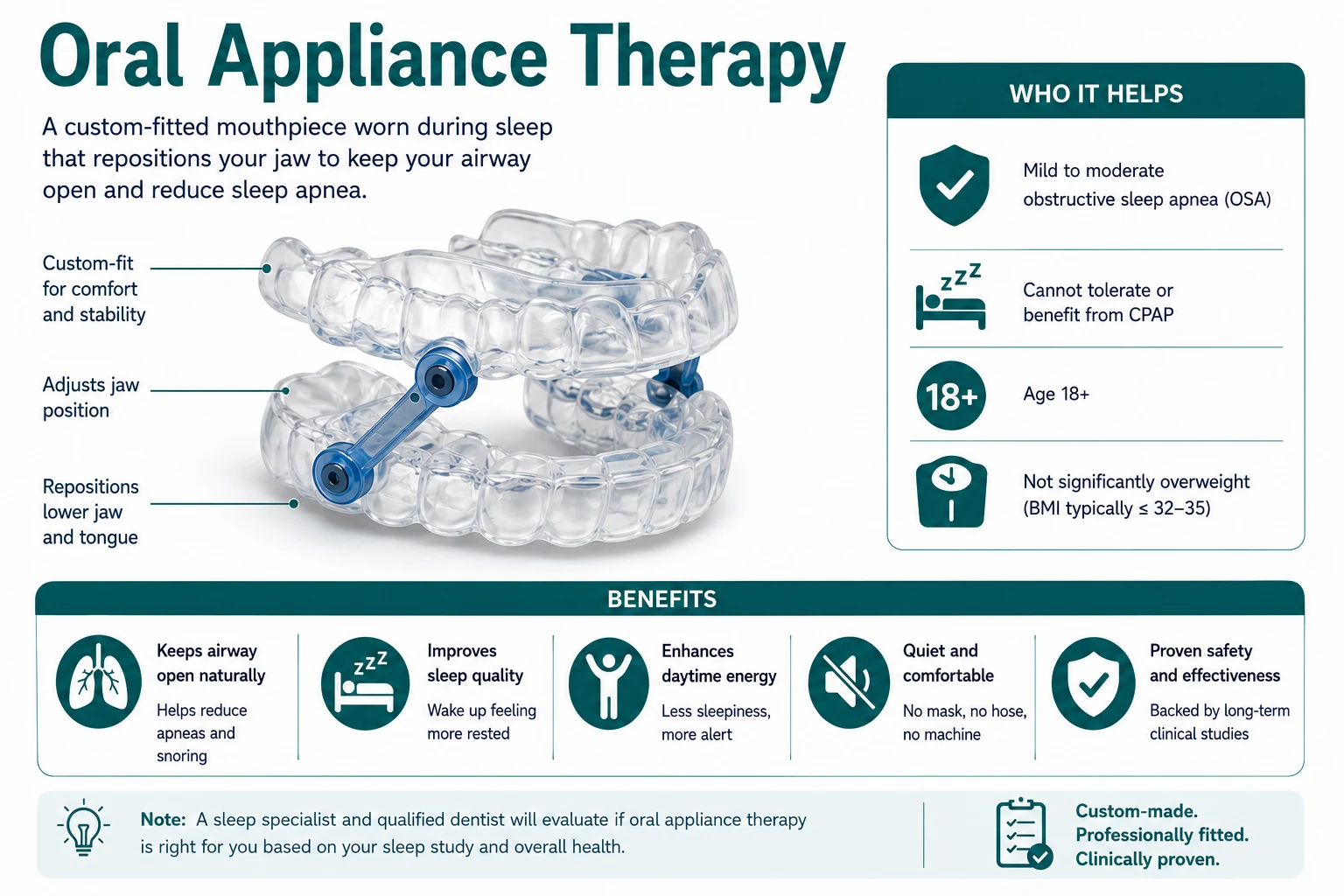
Oral appliance therapy uses a custom-fitted device, most commonly a mandibular advancement device (MAD), worn in the mouth during sleep to gently reposition the lower jaw forward and help keep the airway open in obstructive sleep apnea. It's a legitimate first-line option for many patients with mild-to-moderate OSA, and a well-supported alternative for patients with more significant OSA who cannot tolerate or prefer not to use CPAP. Fitting and follow-up involve a dentist with training in dental sleep medicine, and a follow-up sleep study after titration confirms the appliance is actually controlling breathing events.
At a Glance
Used For
Obstructive sleep apnea, most often mild-to-moderate cases, and more significant OSA in patients who cannot tolerate or prefer not to use CPAP.
How It Works
A custom device worn during sleep repositions the lower jaw (and often the tongue base) forward, helping keep the airway more open.
Who's Involved
A physician confirms candidacy and severity, and a dentist trained in dental sleep medicine handles fitting, titration, and ongoing follow-up.
Confirming It Works
A follow-up sleep study after fitting and titration checks that the appliance is actually reducing breathing events, rather than relying on symptoms alone.
Important Considerations
Generally somewhat less effective than CPAP for more severe OSA, with jaw discomfort, bite changes, and TMJ symptoms as monitored, usually manageable side effects.
Key Takeaways
- Oral appliance therapy, most often a custom mandibular advancement device (MAD), gently repositions the lower jaw forward during sleep to help keep the airway open in obstructive sleep apnea.
- It's a legitimate first-line option for many patients with mild-to-moderate OSA and a well-supported alternative for patients with more significant OSA who cannot tolerate or prefer not to use CPAP.
- A dentist with training in dental sleep medicine plays a central role, fitting a custom, titratable appliance and following it over time: non-custom or over-the-counter devices are not considered adequate treatment for diagnosed OSA.
- Oral appliance therapy is generally effective for appropriate candidates but is typically somewhat less effective than CPAP at fully normalizing breathing events in more severe OSA.
- A follow-up sleep study after fitting and titration is standard practice to confirm the appliance is working, and periodic dental follow-up helps monitor for bite changes or jaw joint symptoms.
Side-by-Side Comparison
| Dimension | Oral Appliance Therapy | CPAP |
|---|---|---|
| How It Works | Repositions the lower jaw (and often the tongue) forward to help keep the airway open | Delivers a steady stream of pressurized air through a mask to keep the airway open |
| Typically Best Suited For | Mild-to-moderate OSA, or more severe OSA when CPAP isn't tolerated or preferred | First-line therapy across mild, moderate, and severe OSA |
| Effectiveness | Generally effective, though often somewhat less complete than CPAP in more severe OSA | Generally the most effective option at fully controlling breathing events |
| Day-to-Day Experience | Small, portable device; no machine, mask, or power source needed | Requires a machine, mask, and power source each night |
| Follow-Up Involved | Dental fitting and titration, plus a follow-up sleep study to confirm control | Physician follow-up and download of usage/efficacy data from the device |
What Is Oral Appliance Therapy?
Oral appliance therapy uses a custom-fitted device worn in the mouth during sleep to help keep the airway open in obstructive sleep apnea. Two device categories exist, though one is far more common than the other in current practice.
Mandibular Advancement Devices
The most widely used type gently repositions the lower jaw, and with it the tongue base, in a forward position. That forward positioning helps create more space behind the tongue and soft palate, the area most often responsible for the airway narrowing and collapse that causes OSA.
Tongue-Retaining Devices
A related but far less common category holds the tongue forward directly rather than moving the jaw.
Mandibular advancement devices are what most clinicians and patients mean by “oral appliance therapy” today, and they’re the focus of the guidance below.
Who Is a Good Candidate?
Oral appliance therapy is not simply a fallback for people who “can’t handle” CPAP. Current sleep medicine practice weighs several factors together in determining candidacy:
OSA Severity
An appropriate first-line option for adults with mild-to-moderate OSA who prefer it to positive airway pressure, and a well-supported option for adults with more significant OSA who have tried CPAP and cannot tolerate it or consistently decline to use it.
Dental Structure
Enough natural teeth, or suitable implants, to anchor and stabilize the device.
Jaw Joint Health
Jaw joints and supporting structures able to comfortably hold a forward position through the night.
Confirmed Diagnosis
A physician evaluation, usually built on the results of a sleep study, establishes the diagnosis and severity of OSA before an appliance is fitted, since the right therapy depends heavily on how significant the sleep apnea actually is.
CPAP Intolerance or Preference Is a Legitimate Reason
Many patients who pursue oral appliance therapy do so after finding CPAP therapy genuinely difficult to live with, whether that means mask discomfort, a feeling of claustrophobia, trouble with the airflow, or simply never settling into consistent nightly use. That’s a common and clinically respected reason to explore an alternative, not a personal shortcoming.
Other patients choose oral appliance therapy from the outset, particularly when travel, portability, or avoiding a machine and mask matters to them. Either way, the choice belongs to the patient, made together with their physician and dentist based on their own OSA severity, anatomy, and preferences.
The Dental Evaluation and Fitting Process
A dentist with specific training in dental sleep medicine plays a central role in oral appliance therapy in a way CPAP simply doesn’t require. Getting from that first dental visit to a working, comfortable appliance follows a consistent sequence:
- 01Dental EvaluationChecks the health of the teeth, gums, and temporomandibular joints (TMJs), and confirms there is enough sound dental structure to support a device.
- 02Impressions or ScansDigital scans or dental impressions are taken and used to fabricate a custom appliance.
- 03DeliveryThe finished, custom appliance is fitted and delivered to the patient.
- 04TitrationThe dentist guides a gradual titration process, incrementally advancing the jaw position over subsequent visits to find the setting that manages breathing effectively while staying comfortable.
This ongoing collaboration between prescribing physician and treating dentist is a defining, and genuinely important, feature of oral appliance therapy.
Custom, Titratable Devices Are the Standard of Care
Not every mouthguard-like device marketed for snoring or sleep apnea is equivalent.
Custom, Titratable Appliances
Custom-fitted appliances, made from an individual dental impression or scan and adjustable in small increments over time, are considered the standard of care for treating diagnosed OSA, because that titration process is what allows the amount of jaw advancement to be tailored to what a specific patient actually needs.
Non-Custom or Over-the-Counter Devices
Non-custom, “boil-and-bite,” or over-the-counter devices sold for snoring are generally less effective, more poorly fitted, and not an appropriate substitute for a properly diagnosed and monitored oral appliance therapy plan.
How Effective Is Oral Appliance Therapy?
For appropriate candidates, oral appliance therapy meaningfully reduces the frequency of breathing pauses and improves related symptoms, and many patients see a significant drop in measured OSA severity once fitted and titrated. Compared with CPAP, though, it’s generally somewhat less effective at fully normalizing breathing events, particularly in more severe OSA.
That’s a genuine trade-off worth understanding up front, not a point to oversell in either direction, and it’s part of why expected results are discussed honestly before starting therapy. For some patients with more severe OSA, CPAP or another PAP therapy remains the more effective option even when oral appliance therapy would be more comfortable.
Follow-Up Testing to Confirm It’s Working
Because symptom improvement alone doesn’t reliably show whether an appliance is fully controlling OSA, a follow-up sleep study after fitting and titration, often a home sleep apnea test or an in-lab study, is standard practice rather than an optional extra. This confirms the device is providing adequate control at its current setting and can prompt further adjustment if it isn’t.
Ongoing periodic follow-up, with both the treating dentist and the prescribing physician, is also part of appropriate long-term care, since jaw position, effectiveness, and dental structures can all shift gradually over months and years of nightly use.
Possible Side Effects and TMJ Considerations
Most side effects of oral appliance therapy are mild and manageable with monitoring:
Salivation or Dry Mouth
Excess salivation, or less often dry mouth, is common early on and frequently eases as a patient adjusts.
Jaw or Tooth Discomfort
Particularly on first waking, this is also common, especially during titration.
Bite or Tooth Position Changes
With longer-term use, more gradual changes in bite alignment or tooth position can occur, which is exactly why periodic dental follow-up matters rather than a one-time fitting.
TMJ Symptoms
Jaw soreness, clicking, or stiffness are a real and specifically monitored consideration; a treating dentist typically checks for early signs at follow-up visits and can adjust the device's advancement or design to manage them before they become significant.
Oral Appliance Therapy vs. CPAP
At a high level, CPAP is generally more effective at fully controlling more severe OSA, while oral appliance therapy is often preferred for its comfort, portability, and ease of tolerance, especially in mild-to-moderate cases. Neither is universally “better”; the right choice depends on OSA severity, anatomy, and what a patient can realistically use consistently every night, since a therapy that isn’t used consistently doesn’t help regardless of its theoretical effectiveness.
For patients also weighing how CPAP itself compares with bilevel pressure therapy, our CPAP vs. bilevel comparison covers that distinction in more depth.
Getting Started
If you’ve been diagnosed with OSA, or suspect you may have it, a physician evaluation is the appropriate starting point for deciding whether oral appliance therapy, CPAP, or another approach fits your situation best. At VitalAir Sleep & Lung Center in Frisco, Texas, our team reviews sleep study results and OSA severity with patients across the North Dallas–Fort Worth area, and coordinates with qualified dental sleep medicine partners for fitting, titration, and follow-up care when an oral appliance is the right fit.
Patient Questions
What is oral appliance therapy for sleep apnea?
Oral appliance therapy uses a custom-fitted device worn in the mouth during sleep to help keep the airway open in obstructive sleep apnea. The most common type, a mandibular advancement device, gently holds the lower jaw in a forward position, which helps reduce airway narrowing behind the tongue and soft palate.
How does a mandibular advancement device actually work?
By holding the lower jaw slightly forward, a mandibular advancement device also brings the tongue base forward with it, since the tongue attaches to the jaw. That forward positioning helps create more space behind the tongue and soft palate, the area most commonly responsible for airway narrowing and collapse in obstructive sleep apnea.
Am I a candidate for oral appliance therapy instead of CPAP?
Candidacy depends on your OSA severity, dental health, and preferences, and it's confirmed by a physician evaluation and typically a sleep study. Many patients with mild-to-moderate OSA are good candidates from the start, and patients with more significant OSA who cannot tolerate or consistently use CPAP are often reasonable candidates as well, provided they have enough dental structure to support and stabilize a custom appliance.
Why would someone choose an oral appliance over CPAP?
Difficulty tolerating CPAP, whether due to mask discomfort, a feeling of claustrophobia, or never settling into consistent nightly use, is a common and entirely legitimate reason patients pursue oral appliance therapy. Others prefer it from the start for its portability and the fact that it doesn't require a machine, mask, or power source.
Do I need to see a dentist for oral appliance therapy?
Yes. A dentist with specific training in dental sleep medicine typically evaluates dental and jaw joint health, takes the impressions or scans used to fabricate a custom appliance, and guides a gradual titration process afterward to find the right amount of jaw advancement. This dental involvement is a defining part of oral appliance therapy that most other OSA treatments don't require.
Are over-the-counter or "boil-and-bite" mouthguards effective for sleep apnea?
Generally, no. Non-custom devices sold for snoring are typically less well-fitted and lack the titration process that lets a custom appliance be adjusted to an individual's specific needs. Custom-fitted, titratable appliances made from a dental impression or scan are considered the standard of care for treating diagnosed obstructive sleep apnea.
How effective is oral appliance therapy compared with CPAP?
For appropriate candidates, oral appliance therapy meaningfully reduces breathing pauses and related symptoms. However, it's generally somewhat less effective than CPAP at fully normalizing breathing events, particularly in more severe OSA, which is one reason candidacy and expected results are discussed honestly before starting therapy.
Will I need another sleep study after getting an oral appliance?
Yes, this is standard practice. A follow-up sleep study, often a home sleep apnea test or an in-lab study, is typically done after the appliance has been fitted and titrated to confirm it's actually controlling breathing events adequately, rather than assuming it's working based on symptoms alone.
What side effects should I expect?
Most side effects are mild and manageable. Excess salivation or dry mouth are common early on and often ease with time, and jaw or tooth discomfort, especially on waking, is common during the titration period. These are typically monitored and addressed at dental follow-up visits.
Can oral appliance therapy affect my bite or jaw joints long-term?
It can. Gradual changes in bite alignment or tooth position, and temporomandibular joint (TMJ) symptoms such as soreness, clicking, or stiffness, are real, monitored considerations with long-term use. Periodic dental follow-up helps catch these changes early so the device can be adjusted before they become significant.
Sources
Guidelines and Professional Societies
- American Academy of Sleep Medicine and American Academy of Dental Sleep Medicine. Clinical Practice Guideline for the Treatment of Obstructive Sleep Apnea and Snoring With Oral Appliance Therapy.View source
- American Academy of Sleep Medicine. AASM and AADSM Issue New Joint Clinical Practice Guideline for Oral Appliance Therapy.View source
Government and Regulatory Sources
- National Heart, Lung, and Blood Institute. Sleep Apnea — Treatment.View source
Key Evidence
- Bignold JJ, et al. Mandibular Advancement Device Use in Obstructive Sleep Apnea, ORCADES Study Long-Term Follow-Up Data. Journal of Clinical Sleep Medicine.View source