Sleep Medicine
Medically reviewed by Varun Halani, MD · August 12, 2026
Excessive Daytime Sleepiness
Persistent, impairing sleepiness during the day despite adequate opportunity to sleep, a symptom with many possible causes rather than a single disease, ranging from insufficient sleep to obstructive sleep apnea, narcolepsy, or a circadian rhythm problem.
In short
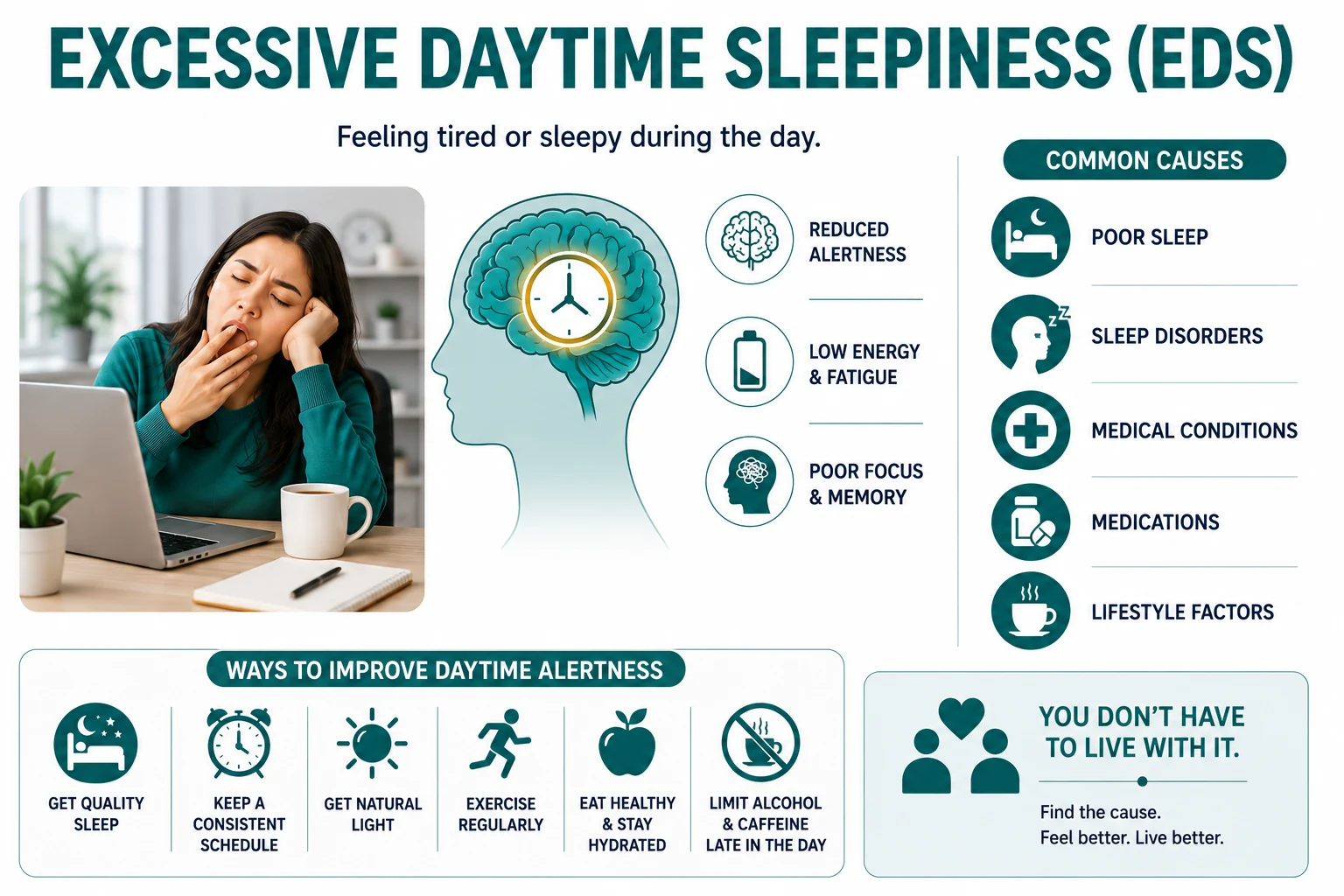
Excessive daytime sleepiness is persistent, impairing sleepiness during the day, difficulty staying alert or awake when you need to be, despite having had adequate opportunity to sleep. It is a symptom, not one disease, and can come from simply not sleeping enough, obstructive or central sleep apnea, insomnia, narcolepsy, idiopathic hypersomnia, a circadian rhythm problem, certain medications, or a medical or psychiatric condition. Identifying which of these applies, rather than treating "being tired" as a single problem, is the point of an evaluation.
Excessive Daytime Sleepiness at a Glance
What It Is
Persistent, impairing sleepiness during the day despite adequate sleep opportunity, distinct from fatigue, which is low energy without the involuntary urge to fall asleep.
How Common
One of the most common reasons patients bring up sleep concerns; the underlying cause varies widely from person to person.
How It Is Evaluated
Starts with a sleep history and often the Epworth Sleepiness Scale; further testing (sleep study, MSLT) is added only when specific causes are suspected, not routinely for everyone.
How It Is Treated
Treatment targets the underlying cause first; wake-promoting medication is considered after that cause is identified and addressed, not as a first step.
Key Takeaways
- Excessive daytime sleepiness (EDS) is a symptom with many possible causes, not a single diagnosis, and the right next step depends entirely on which cause fits.
- Sleepiness and fatigue are genuinely different experiences that call for different evaluations, even though people often use the words interchangeably.
- Not everyone with EDS needs a multiple sleep latency test (MSLT); it is a specific tool for specific diagnostic questions, most often when narcolepsy or idiopathic hypersomnia is suspected.
- Persistent, unexplained sleepiness, particularly with any impact on driving or work safety, is worth a physician evaluation rather than being written off as normal tiredness.
Symptoms
Core Symptom
- An involuntary urge to fall asleep during the day, even in situations that require alertness
- Needing frequent naps, or unintentionally falling asleep
- Difficulty staying awake while driving, in meetings, or during quiet activities
- Sleepiness that persists despite what seems like adequate time in bed
Commonly Confused With
- General low energy or tiredness without an actual urge to fall asleep (this is usually fatigue, discussed below)
- Brain fog or difficulty concentrating without true sleepiness
- Feeling unmotivated or low mood, which can overlap with, but is distinct from, sleepiness itself
Could My Sleepiness Be a Sleep Disorder?
Am I just tired, or is this excessive daytime sleepiness?
Fatigue is low energy or motivation without necessarily an urge to fall asleep. Excessive daytime sleepiness is a genuine, sometimes involuntary pull toward sleep, dozing off in a meeting, at a red light, or while reading. The distinction matters because the evaluation for each is different.
Do I need a sleep study for daytime sleepiness?
Not automatically. A sleep study is considered when your history suggests a specific cause, most often obstructive or central sleep apnea, that a sleep study can identify. Many cases of daytime sleepiness are explained by simply not getting enough sleep opportunity, which a sleep study won't show.
Could my daytime sleepiness be narcolepsy?
It's possible, but narcolepsy is far less common than causes like insufficient sleep, sleep apnea, or insomnia. Features like cataplexy (sudden muscle weakness with strong emotion), sleep paralysis, or vivid hallucinations while falling asleep raise that possibility and are worth discussing directly with a physician.
Is it safe for me to drive if I'm this sleepy?
Persistent excessive sleepiness is a genuine safety concern, particularly for driving and operating machinery. If you have ever felt at risk of falling asleep while driving, or have actually dozed off, that is a reason to talk to a physician promptly, not something to manage alone.
What Causes Excessive Daytime Sleepiness?
Insufficient Sleep
Simply not allowing enough total time for sleep is the most common cause of daytime sleepiness, and the first thing an evaluation considers.
Obstructive or Central Sleep Apnea
Repeated breathing interruptions fragment sleep throughout the night, even when the person doesn't fully wake up or remember it.
Insomnia & Fragmented Sleep
Difficulty falling or staying asleep reduces total and effective sleep time, which can produce daytime sleepiness alongside insomnia's other symptoms.
Circadian Misalignment
Shift work or a mismatch between a person's internal clock and their required schedule can produce sleepiness at the wrong times of day, even with adequate total sleep.
Narcolepsy or Idiopathic Hypersomnia
Less common central disorders of hypersomnolence in which excessive sleepiness persists despite adequate sleep, evaluated specifically when other causes don't fit.
Restless Legs Syndrome & Periodic Limb Movements
Leg discomfort or involuntary movements during sleep can repeatedly disrupt sleep continuity without the person being fully aware of it.
Medications & Substances
Sedating antihistamines, certain psychiatric or pain medications, and other prescription drugs are a common, reviewable contributor.
Medical & Psychiatric Conditions
Depression, hypothyroidism, and certain neurological conditions can each contribute to or present as excessive daytime sleepiness.
Risk Factors
- Not allowing enough time in bed for adequate sleepThe single most common, and most overlooked, contributor
- Untreated obstructive or central sleep apnea
- Chronic insomnia or otherwise fragmented, poor-quality sleep
- Shift work or an irregular schedule
- Certain medications, including some antihistamines, sedatives, and other prescription drugs
- Narcolepsy or idiopathic hypersomniaLess common than the causes above, but important to identify correctly when present
- A medical or psychiatric condition, including depression, hypothyroidism, or certain neurological conditions
- Restless legs syndrome or periodic limb movements disrupting sleep continuity
Why Excessive Daytime Sleepiness Matters
Driving & Workplace Safety
Excessive sleepiness meaningfully increases the risk of drowsy-driving crashes and workplace accidents, which is why it is taken seriously as a safety issue, not just a comfort or productivity concern.
Daytime Function
Concentration, memory, mood, and reaction time are all affected by persistent sleepiness, with real effects on work, relationships, and quality of life.
A Signal Worth Investigating
Because EDS can be the presenting symptom of several different, individually treatable conditions, persistent sleepiness is best treated as a signal to investigate rather than a fixed personal trait ("I'm just not a morning person").
Individualized Significance
How much a given case of EDS matters, and how urgently, depends on its underlying cause and its impact, particularly on driving and safety, which is why interpretation is always individualized.
When Should I Talk to a Sleep Specialist?
- Persistent daytime sleepiness despite what seems like adequate time in bed
- Ever feeling at risk of falling asleep while driving, or actually dozing off behind the wheel
- Daytime sleepiness alongside loud snoring, witnessed breathing pauses, or morning headaches
- Sudden muscle weakness with strong emotion, sleep paralysis, or vivid hallucinations while falling asleep or waking
- Daytime sleepiness that hasn't improved despite reasonable efforts to increase total sleep time
- Daytime sleepiness alongside a new or unexplained mood change, weight change, or other medical symptom
What Is Excessive Daytime Sleepiness?
A Symptom, Not One Disease
Excessive daytime sleepiness (EDS) is persistent, impairing sleepiness during the day, an urge to fall asleep, or actually falling asleep, in situations that call for alertness, despite having had adequate opportunity to sleep. It is one of the most common reasons people bring up a sleep concern.
Why That Matters
Unlike a condition such as obstructive sleep apnea, EDS itself is a symptom, not a single diagnosis. It can come from something as simple as not sleeping enough, or from a specific, treatable condition like sleep apnea, insomnia, a circadian rhythm problem, or, less commonly, narcolepsy or idiopathic hypersomnia. Naming EDS is the start of an evaluation, not the end of one.
Sleepiness vs. Fatigue
People often use these words interchangeably, but distinguishing them is one of the most useful things a patient can do before a visit, since it points toward a different evaluation.
| Dimension | Sleepiness | Fatigue |
|---|---|---|
| What It Feels Like | A genuine urge or pull toward falling asleep | Low energy, heaviness, or reduced motivation, without necessarily wanting to fall asleep |
| What Happens if You Sit Still | You may actually doze off | You feel tired, but typically do not fall asleep |
| Typical Cause Category | Insufficient sleep, sleep apnea, insomnia, narcolepsy, circadian misalignment | Deconditioning, chronic illness, depression, anemia, thyroid disease, medication effects, and other causes |
| Screening Tool | Epworth Sleepiness Scale, sleep history | Broader medical history and targeted lab or medical evaluation |
Some people genuinely have both, and untangling which is present, or confirming both, is part of what a careful history accomplishes.
How Excessive Daytime Sleepiness Is Evaluated
Starting With History
Evaluation starts with a detailed sleep history: typical sleep and wake times, sleep opportunity, snoring or witnessed breathing pauses, leg discomfort at night, medication use, and daytime patterns. The Epworth Sleepiness Scale, a short standardized questionnaire, is commonly used to characterize and track how sleepy someone actually is.
Adding Testing When It's Actually Needed
Further testing is added based on what the history suggests, not automatically for everyone. A home sleep test or in-lab sleep study is considered when sleep apnea is suspected. A multiple sleep latency test (MSLT), a series of scheduled daytime nap opportunities performed the day after an overnight study confirms adequate prior sleep, is reserved specifically for suspected narcolepsy or idiopathic hypersomnia, not used as a general sleepiness test.
The Evaluation Pathway
- 01Sleep HistorySleep timing, opportunity, snoring, leg symptoms, medications, and daytime pattern are reviewed in detail.
- 02Epworth Sleepiness ScaleA brief questionnaire helps characterize and quantify how sleepy you actually are.
- 03Considering Insufficient SleepA realistic look at whether adequate time is actually being set aside for sleep.
- 04Testing for Sleep Apnea, If SuspectedA home sleep test or in-lab study is added when the history points toward sleep apnea.
- 05MSLT, When IndicatedReserved specifically for suspected narcolepsy or idiopathic hypersomnia, performed after an overnight study.
- 06Personalized TreatmentTreatment targets the specific cause identified, rather than sleepiness as a generic complaint.
Why Not Everyone Needs an MSLT
It’s worth being direct about this, because the test is sometimes assumed to be a routine part of any sleepiness workup. It isn’t. Most excessive daytime sleepiness is explained by insufficient sleep, sleep apnea, or insomnia, none of which require an MSLT to diagnose or treat.
The MSLT is a specific tool for a specific diagnostic question: whether a patient’s sleepiness pattern is consistent with narcolepsy or idiopathic hypersomnia. It requires careful preparation, including adequate sleep in the nights beforehand and a review of any medications that could affect the result, to be interpreted reliably.
Driving, Work & Safety
Excessive daytime sleepiness is not only a comfort or productivity issue. It measurably increases the risk of drowsy-driving crashes and workplace accidents, which is part of why persistent sleepiness deserves a real evaluation rather than being treated as an inconvenience to push through.
If you have ever felt at genuine risk of falling asleep while driving, or have actually dozed off, that is worth discussing with a physician directly and promptly. Adjusting driving or safety-sensitive activities in the meantime is a reasonable precaution while the underlying cause is identified.
How Is Excessive Daytime Sleepiness Treated?
The starting principle is the same one that shapes the entire evaluation: treatment targets the underlying cause, not sleepiness as an isolated complaint.
Increasing Sleep Opportunity
For sleepiness from simply not sleeping enough, a more realistic and consistent schedule is often the most effective first step.
Treating Sleep Apnea
When sleep apnea is the cause, PAP therapy or another sleep apnea treatment is often the most effective way to improve daytime alertness.
Treating Insomnia
When fragmented sleep from insomnia is the cause, an insomnia-focused plan, typically starting with CBT-I, is the appropriate approach.
Addressing a Circadian Mismatch
When schedule misalignment is the cause, timed light exposure, schedule strategies, and, for shift workers, workplace-safety planning are considered.
Treating Narcolepsy or Idiopathic Hypersomnia
When one of these central disorders of hypersomnolence is confirmed, condition-specific medication options exist, individualized to the diagnosis.
Wake-Promoting Medication
Considered for residual sleepiness once the underlying cause is identified and treated, not as a substitute for that identification.
When Sleepiness Persists Despite Treatment
Some patients continue to feel sleepy even after their identified underlying cause has been appropriately treated. Well-controlled sleep apnea on consistent PAP therapy is a common example. This is a recognized situation, not a sign that something was missed or that the original diagnosis was wrong, though it is worth re-evaluating rather than assuming it’s simply permanent.
Reasonable next steps, roughly in this order, are to:
- Confirm the original treatment is actually working as intended, using device data for PAP therapy or a follow-up sleep diary.
- Re-screen for a second, separate contributor, such as insufficient sleep opportunity, a medication effect, or a mood disorder.
- Consider whether a wake-promoting medication is appropriate for the residual sleepiness itself, once those other factors are reasonably addressed.
The order matters: confirming and optimizing the original treatment comes first, not skipping straight to a medication aimed at the sleepiness alone.
Excessive Daytime Sleepiness at Work and School
Beyond driving, persistent sleepiness affects performance and safety in many day-to-day settings, including:
- Operating machinery or equipment
- Tasks that require sustained attention
- Academic performance for students
For shift workers in particular, whose sleepiness often has a genuine circadian component layered on top of any other cause, workplace scheduling conversations and, where relevant, formal workplace accommodations are a reasonable and often underused part of managing EDS, not a separate issue from the medical evaluation.
If your sleepiness is affecting your ability to safely or effectively do your job, that is worth raising directly with your physician, who can help document the issue and think through reasonable accommodations alongside the clinical treatment plan.
Excessive Daytime Sleepiness Care at VitalAir
Sleep testing and PAP therapy follow-up are core parts of how VitalAir works through daytime sleepiness when sleep apnea is a possibility; patients already on treatment who still feel sleepy may also find this guide to common PAP therapy issues useful before assuming residual sleepiness reflects a separate diagnosis.
VitalAir evaluates excessive daytime sleepiness for patients across Frisco, North Dallas, and the broader North Texas area. Because sleepiness has so many possible causes, that evaluation typically starts with a detailed sleep history and Epworth screening, then adds sleep testing or other evaluation specifically where the history points, rather than applying the same workup to everyone. Treatment is planned around whichever cause is actually identified. The clinical information on this page applies to patients everywhere; what differs locally is simply where that evaluation and follow-up care happens.
Patient Questions
What is the difference between sleepiness and fatigue?
Sleepiness is a genuine, sometimes involuntary pull toward falling asleep, nodding off while reading, at a red light, or in a quiet meeting. Fatigue is low energy, motivation, or physical tiredness without necessarily wanting to fall asleep. The two often overlap, but they point toward different evaluations, which is why a physician will usually ask specifically which one you're describing.
Do I need a multiple sleep latency test (MSLT)?
Not automatically. An MSLT is a specific daytime nap-based test used mainly when narcolepsy or idiopathic hypersomnia is suspected, generally performed the day after an overnight sleep study confirms adequate sleep beforehand. Most people with daytime sleepiness are evaluated and explained without ever needing one.
What is the Epworth Sleepiness Scale?
It's a short, standardized questionnaire that asks how likely you are to doze off in various everyday situations, used as a starting screening tool to help characterize and track sleepiness, not as a diagnosis on its own.
Can excessive daytime sleepiness be caused by something other than a sleep disorder?
Yes. Certain medications, depression, hypothyroidism, and other medical or psychiatric conditions can all cause or contribute to daytime sleepiness, alongside the sleep-specific causes like sleep apnea, insomnia, or narcolepsy.
Is it normal to feel sleepy every afternoon?
A mild dip in alertness in the mid-afternoon is a normal part of the body's circadian rhythm for many people. Sleepiness that is severe, occurs throughout the day, interferes with driving or work, or persists despite adequate sleep opportunity is not something to write off as normal and is worth discussing with a physician.
Can treating sleep apnea fix my daytime sleepiness?
For many patients whose sleepiness is caused by sleep apnea, effective treatment meaningfully improves daytime sleepiness, though the degree and timeline vary. Some residual sleepiness despite well-treated sleep apnea can occur and is its own reason for follow-up evaluation.
Why does my doctor want to rule out narcolepsy if I don't collapse or lose consciousness?
Narcolepsy does not require collapsing, and many people with narcolepsy never lose consciousness or experience cataplexy at all. It is considered based on the overall pattern, persistent, severe daytime sleepiness, sometimes with additional features like sleep paralysis or vivid hallucinations while falling asleep, not on a single dramatic symptom.
Can I just take a stimulant for my daytime sleepiness?
Wake-promoting medication can be an appropriate part of a treatment plan, but current guidance directs this toward managing sleepiness once its underlying cause is identified and addressed, not as a substitute for finding out what's actually causing it.
How much sleep is actually enough to avoid daytime sleepiness?
This varies by individual, though most adults need somewhere in the range of seven to nine hours. If you consistently sleep less than your body needs, daytime sleepiness is an expected, not mysterious, result, and increasing sleep opportunity is often the first thing to try.
What should I bring to a doctor's visit for daytime sleepiness?
A general sense of your typical sleep and wake times, how long the sleepiness has been going on, whether you snore or have witnessed breathing pauses, your current medications, and any specific situations where sleepiness has felt dangerous, such as while driving, all help focus the evaluation.
Sources
Guidelines and Professional Societies
- American Academy of Sleep Medicine. Clinical Significance of Sleepiness, An American Academy of Sleep Medicine Position Statement. Journal of Clinical Sleep Medicine, 2025.View source
- Maski K, et al. Treatment of Central Disorders of Hypersomnolence, An American Academy of Sleep Medicine Clinical Practice Guideline. Journal of Clinical Sleep Medicine, 2021.
- American Academy of Sleep Medicine. The Multiple Sleep Latency Test and Maintenance of Wakefulness Test, Clinical Practice Guidance.View source
Government and Regulatory Sources
- National Heart, Lung, and Blood Institute. Sleep Deprivation and Deficiency.View source