Testing & Diagnosis
Medically reviewed by Varun Halani, MD · August 12, 2026
In-Lab Sleep Study (Polysomnography)
A comprehensive, technician-supervised overnight study that records brain activity, eye movements, muscle tone, breathing, oxygen levels, and heart rhythm to diagnose sleep apnea, narcolepsy, parasomnias, and other sleep disorders.
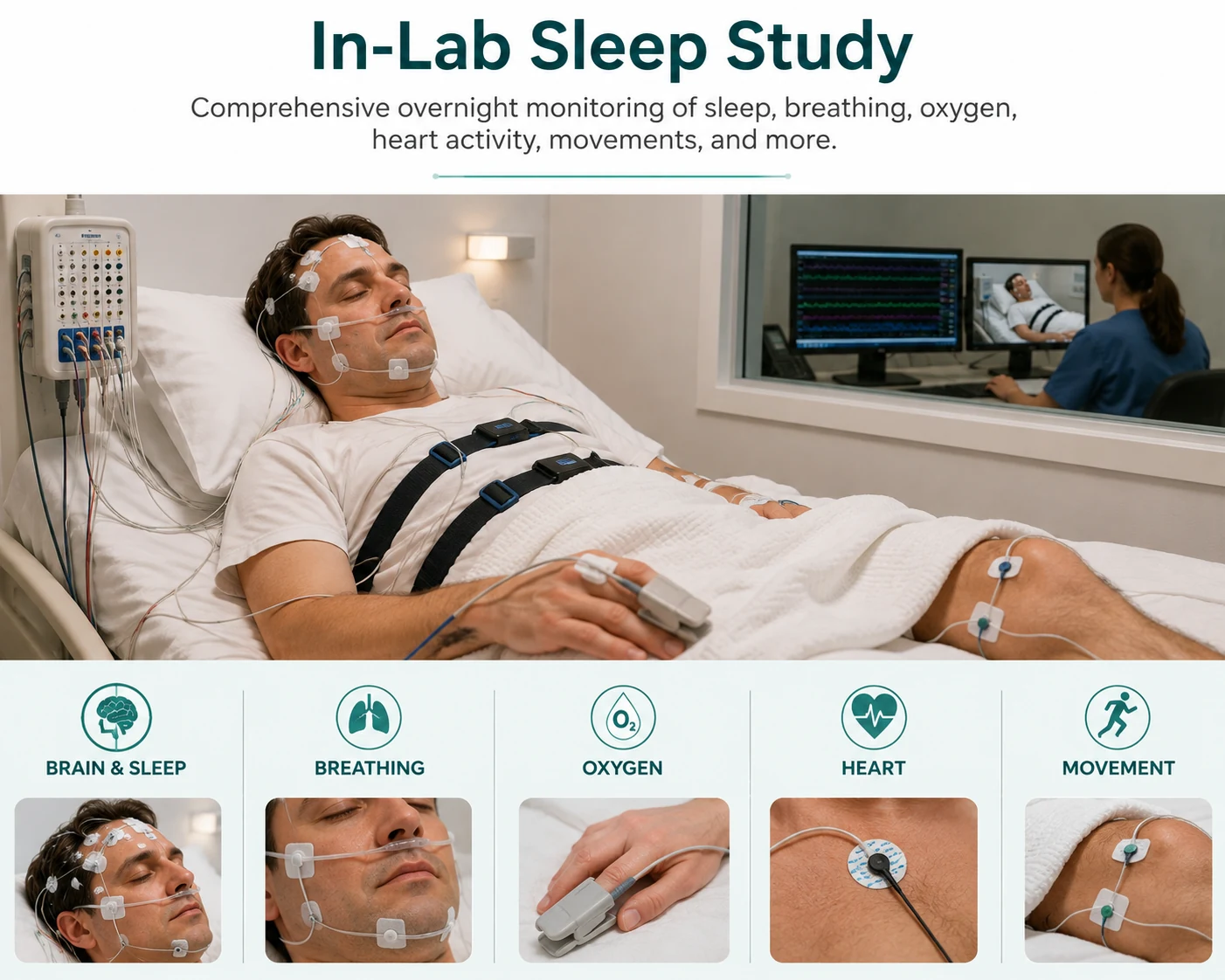
In short
An in-lab sleep study, or polysomnogram (PSG), is an overnight, technician-supervised test that records brain waves, eye movements, muscle activity, breathing, oxygen levels, and heart rhythm while you sleep in a private room at a sleep lab. It's the most comprehensive way to evaluate sleep and is used when a home sleep apnea test isn't sufficient, or when a condition such as central sleep apnea, narcolepsy, or a parasomnia is suspected. A physician reviews the recording and explains the results and next steps.
At a Glance
What It Measures
Brain waves (EEG), eye movements (EOG), chin and leg muscle activity (EMG), airflow, breathing effort, blood oxygen saturation, heart rhythm (ECG), body position, and video when clinically indicated.
Where It Happens
A private room in a sleep lab, with sensors placed by a technician who monitors the recording overnight from a nearby station.
When It's Ordered
When a home sleep apnea test is inconclusive, unsuitable, or negative despite ongoing suspicion, or when central sleep apnea, narcolepsy, or a parasomnia is suspected.
What Happens After
A physician reviews and scores the recorded data, then explains the findings, the diagnosis, and treatment options at a follow-up visit.
Key Takeaways
- Polysomnography records far more than breathing: it captures brain waves, eye movements, chin and leg muscle activity, airflow, respiratory effort, blood oxygen, heart rhythm, body position, and, when indicated, video.
- It's the reference-standard sleep test, ordered when a home sleep apnea test is inconclusive or inappropriate, and it's required before a next-day multiple sleep latency test when narcolepsy is suspected.
- You sleep in a private room with sensors attached and a technician monitoring the recording overnight from a nearby station: most patients get a reasonably representative night of sleep, even if not identical to home.
- A split-night study can combine diagnosis and the start of PAP titration in a single night when obstructive sleep apnea is confirmed early enough in the recording.
- A physician scores and interprets the full night's data against established criteria before explaining the results and any recommended treatment.
Side-by-Side Comparison
| Dimension | Home Sleep Apnea Test (HSAT) | In-Lab Sleep Study (PSG) |
|---|---|---|
| Where It's Done | At home, in your own bed | In a private room at a sleep lab |
| Supervision | Unattended; you apply the sensors yourself | Technician-attended overnight |
| What's Recorded | Airflow, breathing effort, oxygen levels, heart rate | All of the above, plus brain waves, eye movements, muscle tone, and video when indicated |
| Sleep Stages Measured | No: sleep stages are not recorded | Yes: EEG and EOG allow staging of sleep |
| Typical Use | Adults with a moderate-to-high likelihood of OSA and no complicating conditions | Suspected central sleep apnea, narcolepsy, parasomnias, or an inconclusive HSAT |
What Polysomnography Measures
An in-lab sleep study, formally called polysomnography (PSG), records several body systems at once through the night so a physician can see how they interact: something no single measurement can show on its own. A typical recording includes:
- EEG (electroencephalogram): small electrodes on the scalp record brain-wave activity, which is how the recording is divided into sleep stages, including light sleep, deep sleep, and REM sleep, and how arousals are identified.
- EOG (electrooculogram): sensors near the eyes track eye movements, which help distinguish REM sleep from other stages.
- Chin and leg EMG (electromyogram): electrodes measure muscle activity at the chin and, separately, the legs, capturing the muscle relaxation expected during REM sleep and detecting abnormal movements, such as periodic limb movements.
- Airflow: sensors at the nose and mouth detect airflow patterns and interruptions in breathing.
- Respiratory effort: belts around the chest and abdomen record the physical effort of breathing, which helps distinguish obstructive events from central ones.
- Blood oxygen saturation (SpO2): a finger sensor continuously measures oxygen levels, flagging drops that often accompany breathing pauses.
- ECG (electrocardiogram) / heart rate: chest electrodes track heart rhythm throughout the night.
- Body position: a sensor records whether you’re on your back, side, or stomach, since some breathing events are position-dependent.
- Video and audio recording: added when clinically appropriate, most often when a parasomnia or REM sleep behavior disorder is suspected, so unusual movements or behaviors can be reviewed alongside the physiologic data.
Together, these channels give a physician a far more complete picture of sleep architecture and physiology than breathing data alone can provide.
Before the Study
Scheduling typically starts with an evaluation to confirm an in-lab study is the right test for your situation, followed by a scheduled overnight appointment at the sleep lab. You’ll generally be asked to bring comfortable sleepwear, any items from your normal bedtime routine, and anything you’d need for the following morning.
Guidance around medications, caffeine, and daytime napping beforehand is individualized. Our team will review anything specific to your circumstances rather than apply a one-size-fits-all instruction sheet.
During the Study
The steps below outline how a typical overnight visit unfolds, from arrival through morning.
How the Overnight Visit Unfolds
- 01Settling InYou arrive in the evening and settle into a private room designed to feel more like a bedroom than a clinical space.
- 02Sensor PlacementA sleep technologist attaches the sensors described above, a process that typically takes some time before the recording begins.
- 03Signal VerificationThe technologist verifies each signal is recording properly before the study begins.
- 04Overnight RecordingLights go down and the technologist monitors the recording overnight from a nearby station, watching for equipment issues and documenting notable events without disturbing your sleep unnecessarily.
Sleeping with sensors attached is different from sleeping at home, and most patients notice that difference. Even so, the sensors and wiring are designed to allow normal repositioning, and most patients still get a reasonably representative night of sleep: rarely identical to a night at home, but generally sufficient for an accurate reading.
If a sensor loosens or a signal drops out, the technologist can address it without waking you fully.
The Technician’s Role
The overnight sleep technologist is a trained professional responsible for correct sensor placement, real-time signal quality, patient safety and comfort, and accurate documentation of the night’s events. What a technician does not do is interpret or diagnose the study: that assessment happens afterward, once a physician has reviewed the complete recording.
How Scoring and Interpretation Work
After the recording ends, the raw data is scored (broken into 30-second segments, staged by sleep phase, and marked for respiratory, cardiac, and movement events) using standardized criteria maintained by the American Academy of Sleep Medicine.
A physician then reviews the scored study as a whole, in the context of your reported symptoms and medical history, to determine whether a diagnosis is present, such as obstructive sleep apnea, central sleep apnea, narcolepsy, or a parasomnia, and how severe it is. Results and their implications are then discussed with you at a follow-up visit, along with recommended next steps outlined in our broader sleep apnea diagnosis guide.
Common Reasons an In-Lab Study Is Ordered
An in-lab sleep study is generally reserved for situations a simpler test can’t adequately address:
- Suspected obstructive sleep apnea when a home test isn’t sufficient: for example, when a home sleep apnea test was negative or technically inadequate despite ongoing clinical suspicion, or when significant heart, lung, or other medical conditions make in-lab monitoring safer and more reliable.
- Suspected central sleep apnea: because distinguishing central events, in which the brain briefly stops signaling the effort to breathe, from obstructive events, in which the airway itself is blocked, requires the respiratory effort channels only a full PSG provides.
- Suspected narcolepsy: an overnight PSG is the required study the night before a next-day multiple sleep latency test, ruling out other causes of daytime sleepiness and confirming adequate sleep time going into the nap test.
- Suspected parasomnias or REM sleep behavior disorder: video-synchronized PSG allows a physician to directly correlate observed movements or behaviors with brain-wave and muscle-tone data, which is often essential for confirming these diagnoses.
- Other complex or overlapping sleep disorders where breathing, sleep staging, and movement all need to be assessed together in one recording.
Polysomnography vs. Home Sleep Apnea Testing
| Dimension | Home Sleep Apnea Test (HSAT) | In-Lab Sleep Study (PSG) |
|---|---|---|
| Where It's Done | At home, in your own bed | In a private room at a sleep lab |
| Supervision | Unattended; you apply the sensors yourself | Technician-attended overnight |
| What's Recorded | Airflow, breathing effort, oxygen levels, heart rate | All of the above, plus brain waves, eye movements, muscle tone, and video when indicated |
| Sleep Stages Measured | No | Yes, via EEG and EOG |
| Typical Use | Adults with a moderate-to-high likelihood of OSA and no complicating conditions | Suspected central sleep apnea, narcolepsy, parasomnias, or an inconclusive HSAT |
Neither test is universally “better”: each is matched to a clinical situation. A physician evaluation helps determine which is the right starting point; see our home sleep test vs. sleep study comparison for a closer look at how that decision is made.
Split-Night Studies
A split-night study combines diagnosis and treatment initiation into a single overnight visit. If obstructive sleep apnea is clearly confirmed during the earlier part of the night, the technologist can transition the second portion of the recording to begin PAP titration rather than scheduling a separate night for it.
This approach isn’t suitable for everyone. It depends on how quickly and clearly the diagnosis emerges early in the study, and how much recording time remains to gather useful titration data. When a split-night protocol isn’t appropriate, diagnosis and titration are simply done as two separate overnight studies.
PAP Titration Studies
A PAP titration study is an in-lab night focused specifically on finding an effective pressure setting after obstructive sleep apnea has already been diagnosed, whether by a prior in-lab study, a split-night study, or in some cases an auto-adjusting device used at home.
During the study, the technologist gradually adjusts pressure through the night while the same physiologic channels are recorded, identifying the settings that control breathing events, minimize arousals, and support stable oxygen levels.
Your physician uses this data to finalize your prescription. The specific pressure required is individualized to each patient and is determined by this data rather than a standard number. This titration process directly informs CPAP therapy setup for patients who move forward with PAP treatment.
Local Care
For patients in Frisco, Texas and the surrounding North Dallas–Fort Worth area, the VitalAir Sleep & Lung Center offers physician-directed in-lab polysomnography alongside home sleep apnea testing, so the test ordered actually matches the clinical question being asked. If you’re unsure which study is right for you, a sleep evaluation is the place to start.
Patient Questions
What does an in-lab sleep study actually measure?
A polysomnogram records several data streams at once: brain waves (EEG) to identify sleep stages, eye movements (EOG), muscle activity in the chin and legs (EMG), airflow at the nose and mouth, chest and abdominal breathing effort, blood oxygen saturation, heart rhythm (ECG), and body position. When a parasomnia or REM sleep behavior disorder is suspected, synchronized video and audio recording are added so movements and behaviors can be reviewed alongside the physiologic data.
Why would my doctor order an in-lab study instead of a home sleep apnea test?
A home sleep apnea test is a simplified, breathing-focused test appropriate for many patients with a straightforward suspicion of obstructive sleep apnea. An in-lab study is used when that isn't a good fit: for example, when other significant heart, lung, or sleep conditions are present, when a home test was negative or technically inadequate despite ongoing suspicion, or when the concern is something a home device can't detect, such as central sleep apnea, narcolepsy, or a parasomnia.
Will I actually be able to sleep with all those sensors attached?
Most patients do sleep, though rarely as deeply or continuously as they would at home. The sensors are lightweight and designed to be as unobtrusive as possible, wires are bundled to allow normal repositioning, and the room is private and quiet. A technician monitors the recording overnight and can assist if a sensor needs adjustment. Even a night that feels lighter than usual generally still provides enough recorded sleep for an accurate interpretation.
What is a technician's role during the study?
A sleep technologist places each sensor before you go to bed, verifies the signals are recording correctly, and then monitors the study overnight from a separate room, watching for equipment issues, checking on your comfort, and documenting notable events. The technician doesn't interpret or diagnose the study. That's done afterward by a physician who reviews the complete recording.
How is a sleep study scored and interpreted?
After the recording is complete, the data is scored (broken into stages and events), against standardized criteria maintained by the American Academy of Sleep Medicine. A physician then reviews the scored recording as a whole, evaluates it in the context of your symptoms and history, and determines whether a diagnosis such as sleep apnea, narcolepsy, or a parasomnia is present, and how severe it is.
What is a split-night sleep study?
A split-night study is a single overnight recording divided into two parts. If obstructive sleep apnea is clearly confirmed during the first portion of the night, the second portion can be used to begin PAP titration (finding a pressure setting that controls the breathing events) rather than requiring a separate titration night. It isn't appropriate for every patient; whether it's used depends on how the first part of the night unfolds and how much sleep time remains.
What is a PAP titration study?
A PAP titration study is an in-lab night dedicated to finding an effective positive airway pressure setting after obstructive sleep apnea has already been diagnosed. A technician adjusts the pressure through the night, and the recording shows which settings control breathing events and support normal sleep. Your physician uses this information to set your prescription; specific pressure numbers are individualized to each patient rather than standardized.
Do I need an in-lab study before a multiple sleep latency test (MSLT)?
Yes. When narcolepsy or another disorder of excessive daytime sleepiness is being evaluated, an overnight polysomnogram is required the night before a multiple sleep latency test. The overnight study rules out other explanations for daytime sleepiness, such as significant sleep apnea, and confirms you got a technically adequate amount of sleep to make the next day's nap test interpretable.
Is an in-lab study used to evaluate parasomnias or REM sleep behavior disorder?
Yes. When a parasomnia such as sleepwalking or confusional arousals, or REM sleep behavior disorder, is suspected, an in-lab study with video and audio recording is typically needed. Video-EEG polysomnography allows a physician to correlate observed behavior directly with the brain-wave and muscle-tone recordings, which is essential for confirming these diagnoses and distinguishing them from other conditions, including seizures.
How should I prepare for an in-lab sleep study?
You'll typically be asked to arrive in the evening with comfortable sleepwear and your usual bedtime routine items. Guidance on medications, caffeine, and naps beforehand is individualized to your situation, so our team will walk you through anything specific to your appointment rather than a generic checklist.
How long does it take to get results after the study?
Scoring and physician interpretation typically take some time after the recording night, and results are not available the same morning. Your care team will let you know when to expect a follow-up visit to review the findings, discuss the diagnosis, and outline next steps.
Is an in-lab sleep study covered by insurance?
Coverage varies by plan and is often tied to documented symptoms and, in some cases, results of a prior home sleep apnea test. Our team can help verify your specific benefits before scheduling.
Sources
Guidelines and Professional Societies
- American Academy of Sleep Medicine — clinical guidance on the use of polysomnography and home sleep apnea testing for the diagnosis and management of obstructive sleep apnea in adults.View source
- American Academy of Sleep Medicine — standardized manual for the scoring of sleep and associated events, defining the criteria used to stage sleep and score respiratory, cardiac, and movement events on polysomnography.
- American Academy of Sleep Medicine — clinical practice guideline for the diagnostic testing of adult obstructive sleep apnea, including the role of in-laboratory polysomnography.
Government and Regulatory Sources
- National Heart, Lung, and Blood Institute (NIH) — patient-facing overview of polysomnography, including what the test measures and what to expect during an in-lab sleep study.