Pulmonary Medicine
Medically reviewed by Varun Halani, MD · August 13, 2026
COPD (Chronic Obstructive Pulmonary Disease)
A common, largely preventable and treatable lung condition marked by persistent airflow limitation that typically worsens gradually over time, distinct from asthma's more variable, reversible pattern.
In short
COPD is a common, largely preventable and treatable lung condition in which airflow out of the lungs becomes persistently limited, usually worsening gradually and causing chronic cough, sputum production, and exertional breathlessness. It's confirmed with spirometry, and current practice guides treatment using both symptom burden and exacerbation history rather than spirometry severity alone.
COPD (Chronic Obstructive Pulmonary Disease) at a Glance
What It Is
A common, largely preventable and treatable condition in which airflow out of the lungs becomes persistently limited, usually worsening gradually over years.
Two Overlapping Patterns
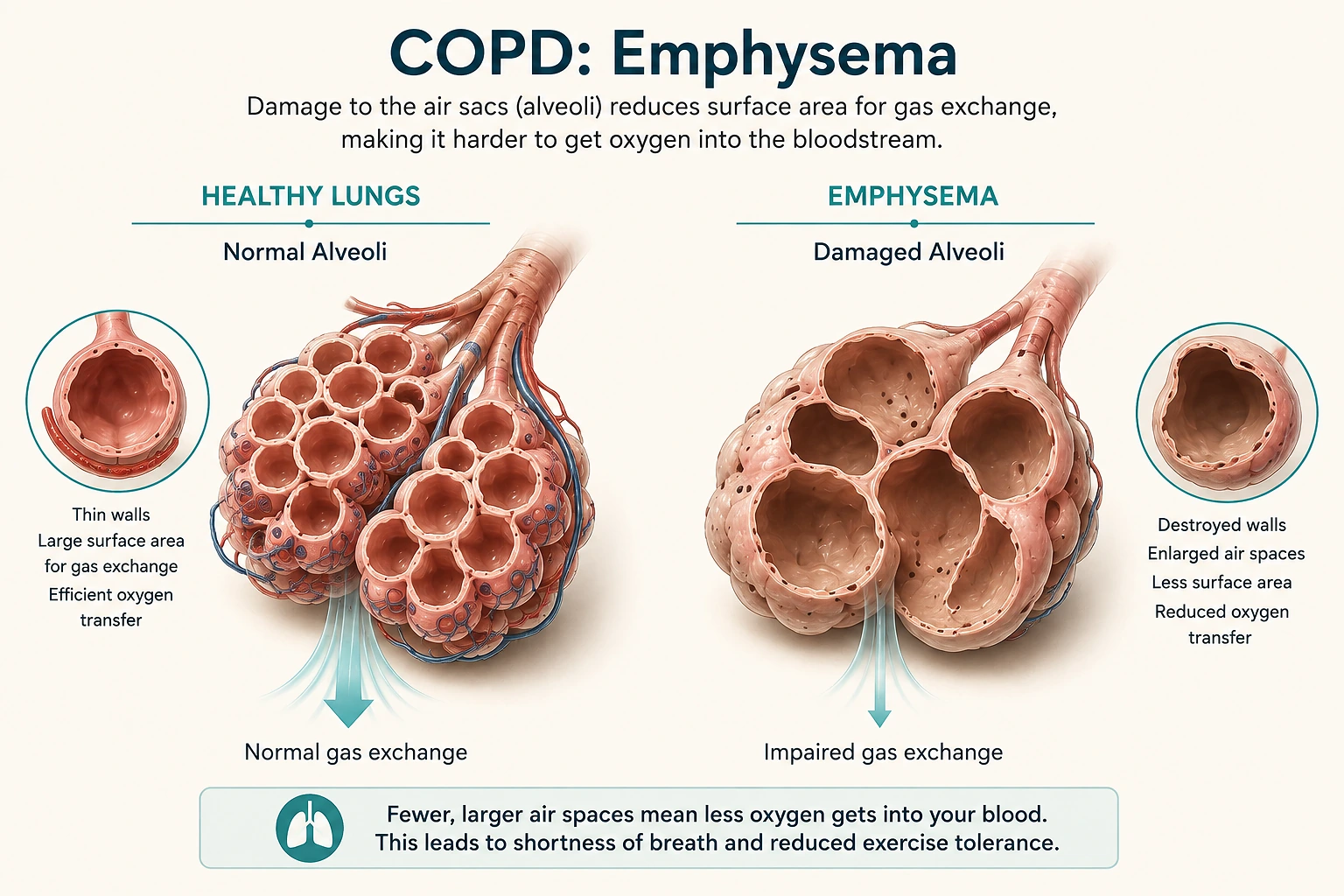
Emphysema (damage to the air sacs) and chronic bronchitis (persistent airway inflammation with mucus) are separate concepts, but most patients have elements of both.
Main Causes
Smoking is the leading cause in most places, alongside occupational and environmental exposures, biomass fuel smoke, and genetic factors like alpha-1 antitrypsin deficiency.
How It's Diagnosed
Spirometry, a breathing test that measures airflow, confirms the diagnosis by showing a fixed pattern of reduced airflow that doesn't fully reverse with a bronchodilator.
How It's Treated
Treatment decisions are guided by symptom burden and exacerbation history, not spirometry severity alone, and range from inhaled bronchodilators to pulmonary rehabilitation and, for select patients, supplemental oxygen.
Key Takeaways
- COPD describes persistent, usually progressive airflow limitation, distinct from asthma's more variable and often more reversible pattern.
- Emphysema and chronic bronchitis are overlapping concepts under the COPD umbrella; most patients have some mix of both rather than a pure form of either.
- Smoking is the dominant cause in most regions, but occupational and environmental exposures, biomass fuel smoke, and genetic factors such as alpha-1 antitrypsin deficiency also cause COPD.
- Spirometry confirms the diagnosis; current GOLD-aligned care then classifies patients by symptom burden and exacerbation history, not spirometry severity alone.
- Pulmonary rehabilitation has well-established benefit and deserves real emphasis, not a passing mention, for appropriate patients.
- Supplemental oxygen is prescribed based on objective testing of oxygen levels, never assumed from symptoms alone.
Symptoms
Common, Gradually Progressive Symptoms
- A persistent cough, often productive of mucus
- Regular sputum (phlegm) production
- Shortness of breath with exertion, initially only with significant activity
- Reduced exercise tolerance and stamina
- Wheezing, at times
- Chest tightness, at times
Easy to Overlook
- Gradually doing less to avoid becoming breathless
- Attributing breathlessness to "getting older" or being out of shape
- Frequent throat clearing mistaken for a chronic cold
- Fatigue from the added effort of breathing
- Winter chest infections that seem to linger longer than they used to
Common Questions When COPD Is Suspected
Is COPD the same as emphysema?
No, though the terms are related. Emphysema is one of two overlapping patterns that fall under the broader COPD umbrella, alongside chronic bronchitis. Most patients with COPD have some combination of both rather than a pure, textbook form of either.
Can you have COPD without ever smoking?
Yes. Occupational and environmental exposures, biomass fuel smoke, and genetic factors such as alpha-1 antitrypsin deficiency all cause COPD independent of smoking history, and COPD in a never-smoker is a genuine reason to consider these other causes specifically.
Is shortness of breath with exercise always a sign of COPD?
No, breathlessness has many possible causes. But gradually doing less to avoid becoming breathless, especially alongside a chronic cough or a relevant exposure history, is a pattern worth evaluating rather than attributing to age or fitness alone.
Why COPD Develops
Cigarette Smoking
The dominant cause of COPD in most regions of the world, related to cumulative exposure over years rather than any single episode.
Occupational Exposures
Long-term exposure to certain dusts, chemical fumes, and vapors in the workplace is a well-recognized, non-smoking cause of COPD.
Biomass Fuel Exposure
Indoor air pollution from burning wood, crop residue, or other biomass fuels for cooking or heating is a major cause of COPD globally, particularly for people who have never smoked.
Outdoor Air Pollution
Long-term exposure to significant outdoor air pollution is associated with reduced lung function and contributes to COPD risk.
Alpha-1 Antitrypsin Deficiency
A genetic condition that leaves the lungs less protected from everyday damage, causing or accelerating COPD, sometimes at a younger age and with little or no smoking history.
Early-Life and Developmental Factors
Impaired lung growth in childhood, from significant early respiratory infections or other developmental factors, can lower the lung function a person starts adulthood with, leaving less reserve later in life.
Asthma
Long-standing, poorly controlled asthma can, in some patients, lead to a degree of fixed airflow limitation that overlaps with COPD.
Risk Factors
- A history of cigarette smokingThe strongest and most common risk factor in most regions
- Significant occupational dust, fume, or chemical exposure
- Biomass fuel exposure for cooking or heatingParticularly important to consider in patients who have never smoked
- A family history of COPD or known alpha-1 antitrypsin deficiency
- AgeRisk rises with age, reflecting cumulative exposure and lung function decline over time
- A history of frequent childhood respiratory infections or asthma
- Significant outdoor air pollution exposure
Why COPD (Chronic Obstructive Pulmonary Disease) Matters
Exercise Tolerance
Progressive airflow limitation reduces the ability to exercise or exert without becoming breathless, often narrowing daily activity gradually enough to go unnoticed at first.
Exacerbation Risk
COPD carries a risk of acute flare-ups that can temporarily or, over time, more lastingly worsen lung function and symptoms.
Nutrition and Weight
Some patients with more advanced COPD experience unintended weight loss and muscle loss, related to the increased energy cost of breathing.
Cardiovascular Health
COPD is associated with a higher likelihood of cardiovascular disease, and the two conditions are often managed together.
Mental Health
Living with a chronic breathing condition is associated with higher rates of anxiety and depression, which are worth raising directly with a care team.
Sleep Quality
Nighttime symptoms and, in some patients, coexisting sleep-disordered breathing can meaningfully affect sleep quality.
When Should I Talk to a Pulmonary Specialist?
- Persistent cough or sputum production lasting weeks to months
- Shortness of breath that has gradually limited activities you used to do without difficulty
- A history of smoking, occupational exposure, or biomass fuel exposure alongside breathing symptoms
- COPD symptoms appearing at a younger age or without a significant smoking history
- A family history of COPD or known alpha-1 antitrypsin deficiency
- Frequent chest infections or symptom flares over the past year
- Breathlessness or fatigue that is increasingly limiting daily function despite treatment already in place
What Is COPD?
COPD involves persistent, usually progressive airflow limitation, meaning air moves out of the lungs more slowly and less completely than it should. Describing it as largely preventable and treatable is worth taking literally: while COPD generally cannot be cured, its course can often be favorably influenced with the right combination of avoiding causal exposures, appropriate treatment, and structured follow-up.
COPD is often confused with asthma, and the two do share some features, including airflow limitation and, at times, wheezing. The key distinction is pattern.
COPD
COPD’s airflow limitation is generally more fixed and persistent. It can improve somewhat with treatment, but it does not fully normalize the way asthma often can.
Asthma
Asthma classically involves airflow limitation that varies over time and is often substantially reversible with treatment, sometimes changing meaningfully from day to day or season to season.
Some patients have features of both, which their physician factors into the overall treatment approach.
Emphysema and Chronic Bronchitis: Two Overlapping Patterns
For decades, COPD was described as encompassing two separate clinical patterns, and while modern understanding treats COPD as a single umbrella condition, these two concepts remain useful shorthand for understanding what’s happening in the lungs.
Emphysema
Damage to the walls of the tiny air sacs (alveoli) deep in the lungs, where oxygen and carbon dioxide are actually exchanged with the blood. As these walls break down, the air sacs lose their normal elastic recoil and can merge into larger, less efficient spaces, reducing the surface area available for gas exchange and making it harder to fully empty the lungs with each breath.
Chronic Bronchitis
Persistent inflammation and mucus production in the airways themselves, clinically defined by a cough productive of sputum on most days for at least three months of the year, in at least two consecutive years. The inflamed, mucus-narrowed airways make it harder for air to move freely in and out of the lungs.
It’s important to understand that these are not mutually exclusive diagnoses. Most people living with COPD have some mixture of both airway inflammation and air sac damage, in varying proportions, rather than a pure, textbook case of one or the other.
Because the balance between the two can meaningfully affect symptoms and, at times, treatment considerations, a dedicated discussion of emphysema specifically, and of chronic bronchitis, is useful as a focused follow-up topic beyond this overview.
Symptoms and Why They’re Often Missed
The hallmark symptoms of COPD are a persistent cough, often with sputum production, exertional shortness of breath, and a gradual reduction in exercise tolerance. What makes COPD genuinely challenging to catch early is how these symptoms typically develop: not suddenly, but slowly, over years, as lung function declines gradually enough that day-to-day changes are barely noticeable.
This gradual onset is a real and well-recognized barrier to timely diagnosis. Many patients unconsciously adapt without quite realizing it:
- Taking stairs more slowly, or resting partway through routine tasks
- Skipping activities that used to feel unremarkable
- Attributing breathlessness to “getting older” or “being out of shape” rather than to a treatable lung condition
A chronic cough that has quietly become part of daily life, rather than something actively bothering the patient enough to mention, is a similarly common pattern. Recognizing this tendency toward under-reporting is part of why active case-finding among people with relevant exposure histories matters, rather than waiting for a patient to volunteer concerning symptoms unprompted.
Causes: Smoking and Beyond
Cigarette smoking is the dominant cause of COPD in most parts of the world, related to years of cumulative exposure rather than any single episode. That said, describing COPD as purely a smoker’s disease is inaccurate and can delay diagnosis in patients who don’t fit that assumption.
Meaningful, well-documented non-smoking causes include:
- Occupational exposure: long-term exposure to certain dusts, chemical fumes, and vapors in the workplace
- Biomass fuel exposure: indoor air pollution from burning wood, crop residue, or similar fuels for cooking or heating, a major global cause of COPD, particularly among people who have never smoked
- Genetic factors: most notably alpha-1 antitrypsin deficiency, discussed further below
- Impaired lung growth in childhood, which can also contribute to the airflow limitation seen in COPD
- Long-standing, poorly controlled asthma, which can similarly contribute over time
A patient who has never smoked but has one or more of these other exposures or risk factors can still develop COPD, and deserves the same diagnostic consideration as anyone else with compatible symptoms.
How COPD Is Diagnosed
A physician’s evaluation begins with a history of symptoms, smoking status, and other relevant exposures, along with a physical exam, but the diagnosis itself is confirmed with pulmonary function testing, specifically spirometry.
How a COPD Diagnosis Comes Together
- 01Symptom & Exposure HistoryA physician reviews symptoms, smoking status, and other relevant occupational or environmental exposures.
- 02Physical ExamAn exam looks for findings consistent with COPD and clues pointing toward a different or additional explanation.
- 03SpirometryMeasures how much air can be forcefully exhaled, and how quickly, comparing the total amount exhaled to the amount exhaled in the first second.
- 04Bronchodilator ResponseThe same comparison is repeated after a bronchodilator. A ratio that stays reduced and does not fully normalize reflects fixed airflow limitation.
- 05Clinical InterpretationA physician interprets the result alongside the full clinical picture, not as an isolated number.
The specific numeric cutoff used to define a reduced ratio has been described somewhat differently across versions of major clinical guidance over the years, so it’s worth understanding the general concept, a persistently reduced airflow ratio after bronchodilator, rather than treating any single number as a fixed, unchanging rule.
Symptom Burden and Exacerbation History: The Modern Assessment Approach
One of the most important, and most commonly misunderstood, aspects of current COPD care is how treatment decisions are actually made. Many patients assume that spirometry severity alone, meaning how abnormal the breathing test looks, determines what treatment is recommended. That is no longer how COPD is approached under current guidance from the Global Initiative for Chronic Obstructive Lung Disease (GOLD).
Instead, contemporary GOLD-aligned practice assesses each patient along two distinct dimensions.
Symptom Burden
How much day-to-day symptom burden a patient is experiencing, using validated questionnaires that capture breathlessness and overall impact on daily life.
Exacerbation History
How often a patient has had acute flare-ups and how severe those flare-ups were, particularly whether any required hospitalization.
A patient with relatively preserved spirometry can still have significant symptoms or a concerning exacerbation history, and a patient with more severely reduced spirometry can, at times, have comparatively few day-to-day symptoms. Combining both dimensions, rather than relying on spirometry severity in isolation, gives a fuller and more clinically useful picture of where a given patient stands and what level of treatment is appropriate.
This distinction matters practically. Exacerbation history in particular carries real weight in current guidance: even a single meaningful exacerbation is now understood to raise the likelihood of further exacerbations, which is part of why a physician may recommend adjusting treatment after just one significant flare-up rather than waiting for a pattern to repeat.
Patients are often surprised to learn that their treatment plan isn’t dictated purely by how “bad” their spirometry number looks. Understanding this combined-assessment approach can make the reasoning behind a physician’s specific recommendations considerably clearer.
Inhaled Treatment: The General Concept
For most patients with COPD, inhaled bronchodilator medication forms the foundation of treatment, relaxing the muscle surrounding the airways to ease airflow and reduce breathlessness. The right regimen, a single long-acting bronchodilator, a combination of two classes, or the addition of an inhaled corticosteroid in select cases, depends on a patient’s specific symptom burden and exacerbation history; the Treatment Options section further down this page outlines these choices in more detail.
This is deliberately described here in general, conceptual terms rather than as a specific regimen, because the right combination for any individual patient depends on their particular clinical picture and is determined through direct evaluation, not from a general overview like this one.
Pulmonary Rehabilitation
Pulmonary rehabilitation deserves real emphasis, not a passing mention, because it is one of the most consistently beneficial interventions available for appropriate patients with COPD, with a body of supporting evidence that rivals or exceeds that of many medications.
The program combines exercise training tailored to a patient’s ability, education about the condition and its day-to-day management, breathing technique instruction, and, often, nutritional and psychological support, typically delivered over several weeks of regular supervised sessions that progressively build exercise capacity and confidence.
The benefit is real and well documented: improved exercise tolerance, reduced breathlessness during daily activity, better overall quality of life, and a reduced likelihood of hospitalization for patients who complete a program after a significant flare-up. The Treatment Options section below has more on who it fits and what completing a program involves.
Oxygen Therapy: Evaluated, Not Assumed
Oxygen therapy is prescribed based on objective testing, either a blood test or pulse oximetry performed under standardized conditions, showing a significant, sustained drop in blood oxygen below a defined threshold. It is not assumed simply because a patient feels short of breath.
This distinction matters because breathlessness and low blood oxygen don’t always move together. Some patients feel quite breathless with normal oxygen levels, while others have significantly low oxygen with comparatively modest symptoms. For patients who do qualify based on testing, supplemental oxygen used as prescribed can meaningfully reduce strain on the heart and lungs over time.
Exacerbations: Acute Worsening Episodes
A COPD exacerbation is an acute worsening of respiratory symptoms, typically increased breathlessness, cough, and sputum production or a change in sputum color, beyond a patient’s usual day-to-day pattern. Exacerbations can range from relatively mild, managed with a temporary adjustment in inhaled medication, to more severe episodes requiring urgent medical attention or hospitalization.
Recognizing the warning signs of a developing exacerbation, and having a plan for how to respond, is a meaningful part of living with COPD. In general terms, escalation typically follows a step-wise pattern:
- Milder changes: closer symptom monitoring and adjustment of current inhaled therapy
- More significant episodes: oral medications and more urgent evaluation
- Rapidly worsening episodes: hospital-level care
The specific pattern of warning signs, self-management strategies, and when to seek urgent care deserve a fuller, dedicated discussion beyond this overview.
Prevention: What Genuinely Helps
For patients who currently smoke, stopping is the single most impactful modifiable step available, meaningfully slowing the rate of lung function decline compared with continuing to smoke, at any stage of the condition. Structured support, including counseling and, when appropriate, medication, meaningfully improves the odds of successfully quitting compared with attempting to stop without support.
Vaccination is another genuinely evidence-supported preventive measure, reducing the risk of respiratory infections that commonly trigger exacerbations. Current guidance supports influenza vaccination, pneumococcal vaccination, and other recommended vaccines for essentially all patients with COPD, as a standard part of routine care rather than an optional add-on.
Alpha-1 Antitrypsin Deficiency: A Genetic Cause Worth Testing For
Alpha-1 antitrypsin deficiency is a genetic condition in which the body doesn’t produce enough of a protein that normally protects the lungs from everyday damage. Over time, this lack of protection can cause or accelerate COPD, sometimes at a notably younger age than typical smoking-related COPD, and sometimes with little or no significant smoking history at all.
Because it’s a specific, identifiable, and testable cause, current guidance recommends testing for patients with certain characteristics:
- Diagnosed with COPD at a younger age
- No significant smoking history
- A family history of alpha-1 antitrypsin deficiency or early-onset lung disease
- A pattern of emphysema affecting the lower portions of the lungs more than the upper portions, a distribution that differs from typical smoking-related emphysema
Testing is a simple blood test. The full implications of a confirmed diagnosis, including family screening and condition-specific management considerations, are worth a dedicated, focused discussion beyond what’s covered here.
Advanced Disease and Ongoing Specialist Care
Despite appropriate, consistent management, some patients with COPD progress to more advanced, functionally limiting disease over time. This isn’t a reflection of anything done wrong by the patient or their care team; it reflects the underlying biology of a condition that, for some individuals, continues to progress despite best efforts.
For patients reaching this stage, ongoing involvement from a pulmonologist becomes particularly valuable:
- Closer monitoring and reassessment of the full treatment plan
- Evaluation for oxygen therapy, if not already in place
- Consideration of pulmonary rehabilitation, if not previously completed
- For carefully selected patients, discussion of more advanced interventions
The honest reality is that COPD’s course varies meaningfully between individuals, and staying engaged with a care team through changes in the condition, rather than assuming nothing more can be done, remains one of the most useful things a patient with more advanced disease can do for themselves.
Getting Evaluated
VitalAir Sleep & Lung Center, based in Frisco, Texas and serving patients across the North Dallas–Fort Worth area, evaluates patients for COPD through a full clinical history, spirometry, and, where relevant, further testing to clarify the specific pattern and severity of disease.
The clinical information above applies broadly to anyone with COPD or COPD-compatible symptoms. What a local evaluation adds is a personalized assessment of your own symptom burden, exacerbation history, and overall lung function, forming the basis for a treatment plan matched specifically to you.
If you have a persistent cough, ongoing shortness of breath with activity, or a relevant smoking, occupational, or family history, a conversation with a physician is a reasonable next step, whether or not you’ve previously considered COPD as a possibility.
COPD Care in Frisco, Texas
VitalAir Sleep & Lung Center evaluates and manages COPD for patients across Frisco, Texas, and the broader North Dallas-Fort Worth area, from spirometry-confirmed diagnosis through GOLD-aligned treatment and exacerbation prevention. The clinical information on this page applies to patients everywhere; what differs locally is simply where that evaluation and follow-up care happens.
Patient Questions
What is the difference between COPD and asthma?
Asthma's airflow limitation typically varies over time and often reverses substantially with treatment, sometimes changing from day to day. COPD's airflow limitation is generally more persistent and fixed, improving somewhat with treatment but not fully normalizing. Some patients have overlapping features of both.
Is COPD the same thing as emphysema?
Not exactly. Emphysema is one of two overlapping patterns, alongside chronic bronchitis, that together make up the broader condition called COPD. Most patients with COPD have some combination of both rather than a pure form of either.
What's the difference between emphysema and chronic bronchitis?
Emphysema involves damage to the air sacs deep in the lungs where oxygen exchange happens. Chronic bronchitis involves persistent inflammation and mucus production in the airways themselves, defined by a productive cough on most days for at least three months a year, over two consecutive years. Most patients with COPD have elements of both.
Can you get COPD without smoking?
Yes. Occupational dust or chemical exposure, biomass fuel smoke used for cooking or heating, and genetic factors like alpha-1 antitrypsin deficiency are all recognized causes of COPD independent of smoking history.
How is COPD diagnosed?
Diagnosis is confirmed with spirometry, a breathing test that measures how much air you can forcefully exhale and how quickly. COPD shows a pattern of reduced airflow that doesn't fully return to normal after inhaling a bronchodilator medication, reflecting fixed airflow limitation.
Does a low spirometry number always mean I need stronger treatment?
Not by itself. Current GOLD-aligned practice assesses patients by both symptom burden and exacerbation history, not spirometry severity alone. A patient with relatively preserved spirometry can still have significant symptoms or a concerning exacerbation history that warrants closer attention.
What counts as a COPD exacerbation?
An exacerbation is an acute worsening of respiratory symptoms, typically increased breathlessness, cough, and sputum production or a change in sputum color, beyond your usual day-to-day pattern. Exacerbations range from mild, managed with adjusted inhaled medication, to severe episodes requiring hospitalization.
Why does even one flare-up matter for future treatment?
Current understanding recognizes that even a single meaningful exacerbation raises the likelihood of further exacerbations, which is part of why a physician may adjust treatment after one significant flare-up rather than waiting for a repeated pattern.
Does pulmonary rehabilitation actually help?
Yes, genuinely. Pulmonary rehabilitation is a structured, supervised program of exercise training, education, and breathing technique instruction with well-established benefit for exercise tolerance, breathlessness, and quality of life, and it's particularly emphasized after a hospitalization for a flare-up.
Will I need oxygen if I have COPD?
Not necessarily. Supplemental oxygen is prescribed only when objective testing shows a significant, sustained drop in blood oxygen levels, not assumed simply because someone feels short of breath.
Who should be tested for alpha-1 antitrypsin deficiency?
Testing, a simple blood test, is recommended for patients diagnosed with COPD at a younger age, those without a significant smoking history, those with a family history of alpha-1 antitrypsin deficiency or early-onset lung disease, and those with emphysema affecting the lower lungs more than the upper lungs.
Can COPD get worse even with good treatment?
For some patients, yes. Despite consistent, appropriate management, some people progress to more advanced disease over time, reflecting the underlying course of the condition rather than a failure of treatment. Ongoing specialist involvement matters particularly at that stage.
Sources
Guidelines and Professional Societies
- Global Initiative for Chronic Obstructive Lung Disease. Global Strategy for the Diagnosis, Management, and Prevention of Chronic Obstructive Pulmonary Disease, 2026 Report.View source
- American Thoracic Society. Patient Education Information Series, What Is COPD?View source
- CHEST Physician. GOLD 2026 Updates in Global Strategy for Diagnosis, Management, and Prevention of COPD.View source
Government and Regulatory Sources
- National Heart, Lung, and Blood Institute. COPD.View source