Sleep Medicine
Medically reviewed by Varun Halani, MD · August 10, 2026
Obstructive Sleep Apnea
A common condition in which the airway repeatedly narrows or closes during sleep, causing breathing pauses, fragmented sleep, and daytime symptoms that are often mistaken for ordinary tiredness.
In short
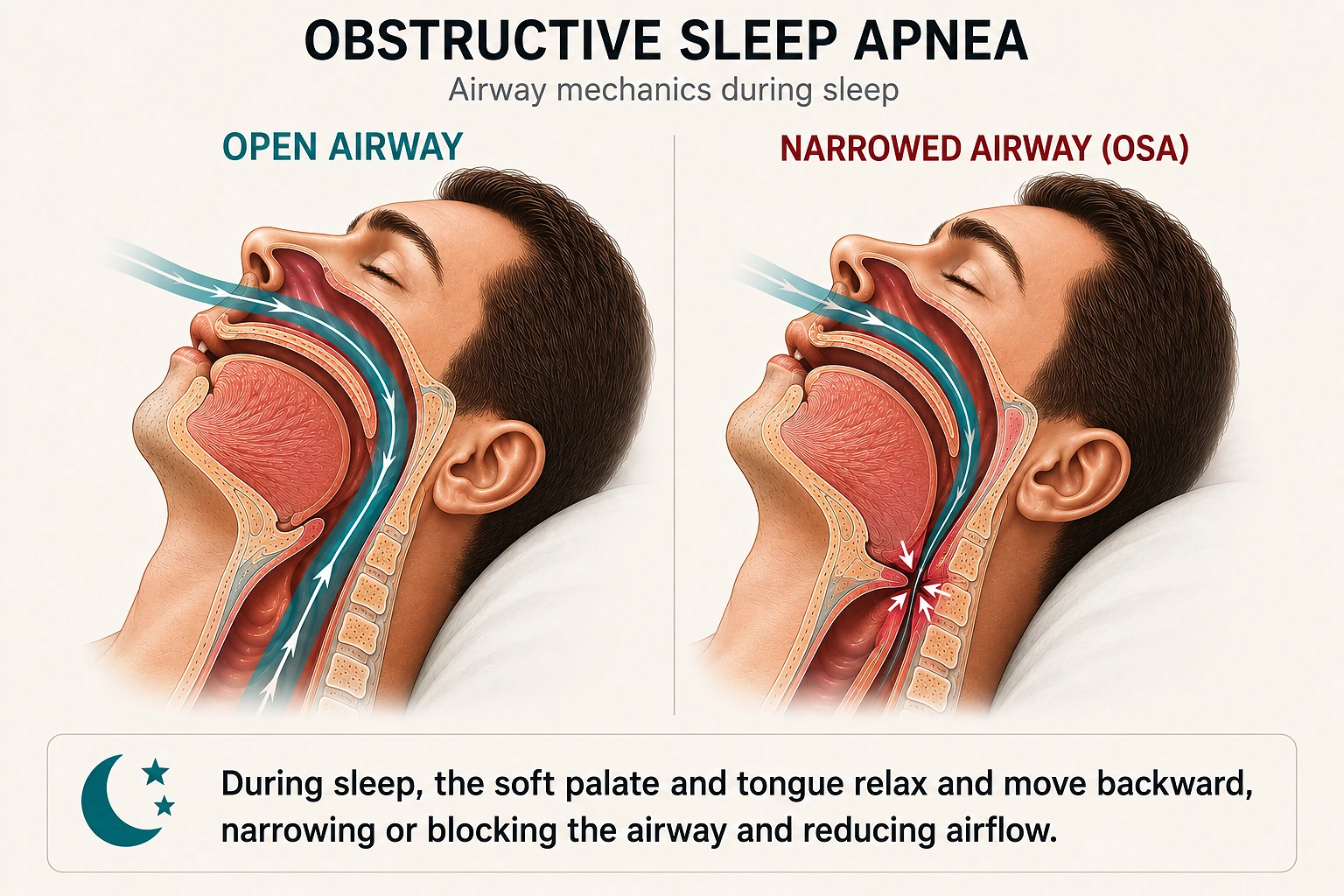
Obstructive sleep apnea is a condition in which the airway repeatedly narrows or closes during sleep, briefly interrupting breathing and fragmenting sleep, often without full awakening. It is diagnosed with a sleep study and treated with options that range from PAP therapy and oral appliances to weight management, positional therapy, surgery, and hypoglossal nerve stimulation, chosen based on severity, airway anatomy, and patient preference.
Obstructive Sleep Apnea at a Glance
What Happens
During sleep, the muscles supporting the throat relax more than they should, letting the airway narrow or fully close and briefly interrupting breathing, sometimes dozens or hundreds of times a night.
Common Clues
Loud, frequent snoring, breathing pauses a partner notices, gasping or choking, and daytime fatigue are the most recognized signs, though several less obvious symptoms also point to OSA.
How It Is Diagnosed
A sleep study, often a home sleep apnea test and sometimes an in-lab polysomnogram, objectively measures breathing during sleep and confirms both the diagnosis and its severity.
How It Is Treated
Treatment is matched to severity, airway anatomy, and preference, ranging from positional changes and weight management to PAP therapy, oral appliances, surgery, and hypoglossal nerve stimulation.
Key Takeaways
- OSA happens when the muscles supporting the throat relax during sleep, letting the airway narrow or close repeatedly.
- Loud snoring, witnessed breathing pauses, and daytime fatigue are the most recognized signs, but morning headaches, mood changes, and frequent nighttime urination can also point to OSA.
- A sleep study, often done at home, is the standard way to confirm a diagnosis and measure severity using the apnea hypopnea index, or AHI.
- Effective treatment exists at every severity level, and hypoglossal nerve stimulation now includes two FDA approved systems, Inspire and Genio, alongside PAP therapy, oral appliances, and weight management.
Symptoms
During Sleep
- Loud, frequent snoring
- Witnessed pauses in breathing
- Gasping or choking that briefly wakes you
- Restless sleep, with frequent tossing and turning
- Frequent awakenings that may not be fully remembered
- Dry mouth or sore throat upon waking
- Frequent nighttime bathroom trips
During the Day
- Excessive daytime sleepiness, even after a full night in bed
- Persistent fatigue that does not improve with rest
- Morning headaches
- Difficulty concentrating
- Memory problems
- Noticeable mood changes, including irritability or low mood
- Reduced performance at work, school, or while driving
Could I Have Sleep Apnea?
Why am I tired after sleeping eight hours?
Total time in bed is not the same as the quality of sleep you actually got. If breathing repeatedly pauses during the night, sleep is fragmented by brief arousals, often without full awakening, so eight hours can look complete from the outside while feeling nowhere near restorative.
Can I have sleep apnea if I do not snore?
Yes. Snoring is a common clue, not a requirement. Some people with OSA snore quietly, inconsistently, or not at all, particularly when the airway narrows without vibrating the surrounding tissue in an audible way.
Can thin people have sleep apnea?
Yes. Excess weight is a common contributor, but airway anatomy, such as a naturally narrow airway, a recessed jaw, or enlarged tonsils, can cause OSA in people at a normal weight. Body size is a risk factor, not a requirement for diagnosis.
Why does my partner say I stop breathing?
What a bed partner is describing is very likely an apnea, a pause in breathing caused by the airway briefly closing. These pauses often end with a snort, gasp, or brief arousal that restarts breathing, frequently without the person waking up enough to remember it.
Why do I wake up choking?
A choking or gasping sensation typically happens at the moment breathing restarts after an apnea, when the airway reopens suddenly. It is one of the more noticeable signs of OSA and is worth mentioning specifically when discussing symptoms with a physician.
Can sleep apnea cause morning headaches?
Yes. Overnight drops in oxygen and rises in carbon dioxide caused by repeated breathing pauses can produce a headache that is typically present on waking and eases within an hour or two.
Why do I urinate several times at night?
Repeated breathing pauses change pressure inside the chest in a way that can trigger a hormonal response that increases urine production overnight. Frequent nighttime bathroom trips are not unique to OSA, but they are a recognized and often overlooked symptom.
Can women have different sleep apnea symptoms?
Women with OSA are more likely to report fatigue, insomnia, morning headaches, and mood changes than the classic loud snoring and witnessed pauses more commonly reported by men, which can make OSA easier to overlook in women during a routine conversation about sleep.
What Causes Obstructive Sleep Apnea?
Airway Anatomy
A naturally narrower upper airway leaves less room for tissue to relax before the space closes.
Tongue and Soft Tissue
A larger tongue or excess soft palate tissue reduces the space available in the airway during sleep.
Jaw and Craniofacial Structure
A recessed or smaller jaw can position the tongue and surrounding tissue further back into the airway.
Tonsillar Tissue
Enlarged tonsils or adenoids narrow the airway and are a particularly common contributor in children, though they can matter in adults too.
Nasal Obstruction
A deviated septum or chronic nasal congestion can force mouth breathing and change airway pressure dynamics in ways that make collapse more likely.
Excess Body Weight
Fat deposits around the neck and pharynx narrow the airway and are one of the most common contributing factors, though not the only one.
Sleep Position
Lying on the back lets gravity pull the tongue and soft tissue backward, narrowing the airway more than side sleeping does for many people.
Sleep Stage
Muscle tone naturally drops further during REM sleep, which is why breathing events are often more frequent or severe during that stage.
Alcohol
Alcohol relaxes the muscles that support the airway and blunts the arousal response that normally helps reopen it.
Sedating Medications
Certain sedatives and muscle relaxants can relax airway muscles in a similar way to alcohol.
Age-Related Changes
Airway muscle tone and tissue elasticity tend to decline with age, which is part of why OSA becomes more common later in life.
Risk Factors
- Excess body weight, particularly weight carried around the neckOne of the strongest and most consistently documented risk factors
- Increasing ageRisk rises through middle age and tends to plateau in older adulthood
- Male sexMen are diagnosed more often, though the gap narrows after menopause
- MenopauseHormonal changes are associated with a meaningful rise in risk for women
- A family history of OSASuggests a genetic contribution to airway anatomy and collapsibility
- Craniofacial and upper airway anatomyA recessed jaw, enlarged tonsils, or a narrow airway independent of body weight
- Nasal obstruction
- Regular alcohol or sedative use before bed
- Certain medical conditionsIncluding hypothyroidism and some hormonal or neuromuscular conditions
Why OSA Matters
Blood Pressure
OSA is strongly associated with high blood pressure, and it is a common contributor when blood pressure is difficult to control despite medication.
Cardiovascular Health
Repeated drops in oxygen and sleep disruption are thought to place ongoing strain on the cardiovascular system over time.
Atrial Fibrillation
OSA is seen more often in people with atrial fibrillation, and untreated OSA is associated with a higher rate of recurrence after treatment for the arrhythmia itself.
Stroke
Large studies associate OSA with a higher likelihood of stroke, though this is an association rather than proof that OSA alone causes any individual case.
Metabolic Health
OSA is associated with insulin resistance and a higher likelihood of type 2 diabetes, independent of body weight alone.
Daytime Alertness
Fragmented sleep reduces daytime alertness even when total time in bed looks adequate.
Cognition
Memory and concentration can be measurably affected by ongoing sleep fragmentation.
Mood
Irritability, anxiety, and low mood are common and often improve after starting effective treatment.
Driving and Workplace Safety
Untreated OSA is linked to a higher risk of drowsy driving and workplace accidents.
Quality of Life
Many patients describe the day to day improvement in energy and clarity after treatment as the most immediately noticeable benefit.
When Should I Talk to a Sleep Specialist?
- Loud, habitual snoring, especially with pauses a partner has noticed
- Witnessed pauses in breathing during sleep
- Gasping or choking sensations that wake you
- Persistent daytime sleepiness despite spending enough time in bed
- Unexplained fatigue that does not improve with rest
- Morning headaches that ease within an hour or two of waking
- A bed partner's concern about your breathing or sleep quality
- Several of the symptoms and risk factors above appearing together, even without one dominant complaint
Overview
What Happens During Sleep
Obstructive sleep apnea (OSA) follows a repeating physiologic sequence. During sleep, the muscles that support the soft tissues of the throat relax, as they normally do. In OSA, that relaxation lets the airway narrow or close, and airflow drops or stops entirely for several seconds to more than a minute. As airflow stops, oxygen levels fall and carbon dioxide builds up.
Why Sleep Becomes Fragmented
The brain responds with a brief arousal, just enough to tighten the airway muscles and reopen the passage, often without the person waking up fully or remembering it in the morning. Breathing resumes, sleep continues, and the cycle can repeat dozens or hundreds of times in a single night.
The result is sleep that looks continuous from the outside but is repeatedly interrupted from the inside. This is what separates OSA from ordinary poor sleep: total time in bed can be normal while the quality of that sleep is not.
Normal Breathing vs. Obstructive Sleep Apnea
| Dimension | Normal Breathing | Obstructive Sleep Apnea |
|---|---|---|
| Airway | Stays open throughout sleep | Narrows or collapses repeatedly during sleep |
| Airflow | Continuous and uninterrupted | Drops or stops entirely for several seconds to more than a minute |
| Oxygen Levels | Stable | Falls as carbon dioxide builds up during each event |
| Arousal Response | Not needed to maintain breathing | A brief arousal reopens the airway, often without the person fully waking |
| Sleep Continuity | Genuinely continuous | Looks continuous from the outside but is repeatedly interrupted, dozens to hundreds of times a night |
Some of OSA’s most telling symptoms are easy to miss because they do not obviously point back to sleep.
Morning Headaches
Caused by overnight drops in oxygen and rises in carbon dioxide; common, and typically ease within an hour or two of waking.
Mood Changes
Irritability, anxiety, or low mood can result from fragmented sleep, even when the person is unaware their sleep was interrupted.
Frequent Nighttime Urination
Another commonly missed sign of OSA.
Dry Mouth or Sore Throat
Often from breathing through the mouth to compensate for a partially blocked airway; another frequently overlooked clue.
Diagnosis
Diagnosis starts with a conversation about symptoms, sleep habits, and risk factors, and it is confirmed with a sleep study that objectively measures breathing during sleep. The steps below outline how that process typically unfolds, from an initial concern through a personalized treatment discussion.
The Diagnostic Pathway
- 01Symptoms or ConcernYou, or a bed partner, notice signs such as snoring, breathing pauses, or unexplained daytime fatigue.
- 02Clinical EvaluationA physician reviews your symptoms, sleep habits, and risk factors.
- 03Sleep Testing DecisionYour physician determines whether a home test or an in-lab study better fits your clinical picture.
- 04HSAT or PSGThe chosen sleep study objectively measures breathing during sleep.
- 05Physician InterpretationA physician interprets the results and determines severity.
- 06Personalized TreatmentYou and your physician choose a treatment approach together.
Home Sleep Apnea Testing
What It Measures
A home sleep apnea test is a portable device worn overnight in your own bed. It typically measures airflow, breathing effort, and blood oxygen levels, and it is the appropriate starting point for many adults with signs of moderate to severe OSA who do not have significant additional health complications.
Advantages, Limitations & Next Steps
Home testing is convenient and is often sufficient to confirm a diagnosis without an overnight stay at a sleep center. It does have real limitations, though: home devices are designed for straightforward cases, and because they do not directly measure sleep itself the way an in-lab study does, they can understate severity in people with certain breathing or sleep patterns.
Current sleep medicine guidance is direct about what to do when a result does not match the clinical picture: if a home test is negative, inconclusive, or technically inadequate and suspicion for OSA remains, that result is not treated as the final word. The appropriate next step is an in-lab polysomnogram rather than assuming OSA has been ruled out.
Polysomnography
What It Measures
An in-lab polysomnogram is performed overnight at a sleep center and is a more detailed study than a home test. In addition to airflow, breathing effort, and oxygen levels, it records brain wave activity (EEG), eye movements, muscle activity, and heart rhythm. Measuring brain activity directly is what allows a polysomnogram to determine actual sleep stages rather than estimating sleep time indirectly, which matters most for patients with complex presentations.
When It's Preferred
An in-lab polysomnogram is generally the preferred starting point, rather than home testing, for patients with significant heart or lung disease, suspected low oxygen or high carbon dioxide levels while awake, regular opioid use, a prior stroke, or severe insomnia, since these situations benefit from the more detailed monitoring an in-lab study provides.
HSAT vs. In-Lab Polysomnography
| Dimension | Home Sleep Apnea Test | In-Lab Polysomnography |
|---|---|---|
| Location | At home, in your own bed | Overnight at a sleep center |
| Signals Measured | Airflow, breathing effort, oxygen levels | Airflow, effort, oxygen, brain waves, eye movement, muscle activity, heart rhythm |
| Actual Sleep Measurement | Estimated indirectly; does not record sleep stages | Measured directly through EEG and sleep staging |
| Typical Use | Straightforward cases with signs of moderate to severe OSA | Complex cases, or when a home test does not match symptoms |
| Complex Medical or Sleep Conditions | Not the preferred starting point | Preferred when heart or lung disease, opioid use, prior stroke, or severe insomnia are present |
| Advantages | Convenient, familiar environment, often sufficient | Most detailed data available, including true sleep staging |
| Limitations | Can understate severity in some patients | Requires an overnight stay at a sleep center |
| What Happens After a Negative Study | If suspicion remains, an in-lab study is the appropriate next step | A negative result is typically conclusive; further testing is uncommon |
Understanding AHI
What AHI Measures
Sleep study results are summarized using the apnea hypopnea index, or AHI, the average number of breathing pauses or significant reductions in airflow per hour of sleep. The categories below reflect common clinical convention for adults.
Why AHI Is Not the Whole Picture
AHI is a useful, standardized starting point, but it is not the whole picture. Oxygen desaturation, how far and how often blood oxygen drops during these events, adds important context, since two patients with a similar AHI can have meaningfully different oxygen patterns. Symptom severity, how long individual events last, whether events cluster during a particular sleep stage or sleep position, and other health conditions all factor into how a physician recommends treatment, which is why two patients with a similar AHI can reasonably end up with different treatment plans.
Mild OSA
AHI 5 to 14
Symptoms may be intermittent; treatment is still often recommended based on the full clinical picture.
Moderate OSA
AHI 15 to 29
Symptoms and health associations become more consistently significant.
Severe OSA
AHI 30 or higher
Treatment is typically recommended without delay given the frequency of breathing events.
These categories describe AHI alone. Oxygen desaturation, symptom burden, and other health conditions are considered alongside AHI, not replaced by it, when a physician recommends treatment.
Treatment Overview
Treatment is matched to OSA severity, airway anatomy, other health conditions, and patient preference, and it commonly involves more than one approach at once. The comparison below is a starting point, not a substitute for an individualized recommendation; each option is explained in more depth below.
Comparing Treatment Approaches
| Dimension | CPAP | Oral Appliance | Weight Management | Hypoglossal Nerve Stimulation |
|---|---|---|---|---|
| How It Works | Pressurized air keeps the airway open | Repositions the jaw or tongue to open the airway | Reduces a contributing cause of airway narrowing | Stimulates a nerve to keep the airway open |
| Typical Role | First line for moderate to severe OSA | Alternative for mild to moderate OSA or PAP intolerance | Complements other treatment when weight contributes to OSA | Option when PAP has not worked or is not tolerated |
| Who May Be Considered | Most patients with moderate to severe OSA | Patients with mild to moderate OSA or difficulty with PAP | Patients where weight is a meaningful contributing factor | Patients with confirmed PAP intolerance and suitable airway anatomy |
| Major Practical Consideration | Requires nightly mask use | Requires a custom fitted device | Benefit takes time and does not guarantee full resolution | Requires a minor surgical procedure to implant |
PAP Therapy
Positive airway pressure therapy, commonly CPAP (continuous positive airway pressure), APAP (automatically adjusting positive airway pressure), or less often BPAP (bilevel positive airway pressure), delivers pressurized air through a mask worn during sleep to keep the airway open.
What It Does
Pressurized air acts as a pneumatic splint, holding the airway open so it cannot narrow or collapse.
Typical Role
The most extensively studied OSA treatment; typically the first recommendation for moderate to severe OSA.
Considerations
Requires nightly mask use. Early difficulties with fit, leak, pressure, or dryness are usually addressable.
What If PAP Is Not Working For Me?
Difficulty with PAP therapy is common, and most causes are identifiable and addressable rather than a sign that PAP has permanently failed. The issues below fall into two groups: everyday comfort and fit problems, which are usually the first and easiest thing to address, and situations that call for a step back to reassess therapy itself.
Comfort & Fit Issues
Mask Fit
An improperly sized or positioned mask is one of the most common, and most fixable, sources of discomfort.
Air Leak
Leaks around the mask seal can reduce effective pressure and disturb sleep; a refit often resolves this.
Pressure Comfort
A pressure setting that feels too high, especially on exhale, can often be adjusted by your care team.
Nasal Congestion
Chronic congestion can make mask use uncomfortable; treating the underlying nasal issue often helps PAP tolerance.
Dryness
A heated humidifier, standard on most modern devices, addresses dryness of the nose, mouth, and throat.
Claustrophobia
A different mask style, or a structured desensitization approach, can help patients who feel confined by a mask.
When to Reassess Your Therapy
Incorrect Pressure or Settings
A follow-up download of device data can reveal whether current settings are actually controlling your AHI.
Persistent Symptoms Despite Use
If symptoms continue despite consistent, well-fitted PAP use, it is reasonable to revisit the diagnosis, settings, or consider another treatment.
It is worth being clear about one point directly: difficulty with PAP does not automatically mean a patient is a candidate for hypoglossal nerve stimulation. HNS candidacy depends on documented PAP intolerance or failure after reasonable troubleshooting, plus specific airway anatomy and severity criteria confirmed on individual evaluation.
Oral Appliance Therapy
Oral appliance therapy uses a custom fitted device, most commonly a mandibular advancement device, to help keep the airway open during sleep.
How It Works
The device repositions the lower jaw and tongue slightly forward during sleep, creating more space in the airway so it is less likely to narrow or collapse.
Who May Benefit
Generally considered for mild to moderate OSA, or for patients with higher severity OSA who cannot tolerate PAP.
Important considerations: fitting and follow-up require a qualified dentist experienced in dental sleep medicine, working alongside your sleep physician rather than independently. After an appliance is fitted, a follow-up sleep study is the standard way to confirm it is adequately controlling OSA, since comfort and symptom improvement alone do not reliably indicate how much the AHI has actually changed.
Weight Management
Why Weight Matters
Excess weight is one of the most common contributors to OSA, but the relationship between body weight and OSA is not simple: OSA occurs in people of every body size, and airway anatomy, sleep position, and other factors described above matter independent of weight.
How Weight Loss Can Affect OSA
For patients where weight is a meaningful contributing factor, physician supervised weight management can meaningfully reduce OSA severity, and some patients see substantial improvement. Weight loss does not guarantee full resolution, particularly when airway anatomy also plays a role.
Clinical note: weight management can improve OSA severity, but it does not automatically replace sleep-specific therapy. A follow-up sleep study remains the reliable way to confirm how much severity has actually changed, and treatment decisions remain individualized. Patients pursuing physician-supervised medical weight management alongside OSA treatment often see improvement in both areas together.
Positional Therapy
For some patients, OSA is meaningfully worse when sleeping on the back than on the side, a pattern called positional OSA.
When Position Matters
Lying on the back lets gravity pull the tongue and soft tissue backward, narrowing the airway more than side sleeping does for many people.
How It Helps
Devices or techniques that encourage side sleeping can meaningfully reduce breathing events for patients whose OSA is clearly position dependent.
Limitation
Most patients have some degree of obstruction that is not fully position dependent, so this is usually most effective as an add-on rather than a standalone treatment.
Surgery
Surgical treatment covers a range of procedures that remove or reposition airway tissue, or less commonly reposition the jaw itself, to address a specific anatomical cause of obstruction.
When Surgery Enters the Discussion
Typically considered after other options have been discussed, or when a clear, correctable anatomical cause is identified on evaluation.
Anatomy Matters
The specific pattern of airway collapse identified on evaluation, such as enlarged tonsils or another anatomical cause, determines whether surgery is a reasonable option at all.
Procedures Are Not Interchangeable
Not all surgical approaches are equivalent; anatomy and patient selection matter considerably, and surgery is not automatically a first line treatment for most adults with OSA.
Hypoglossal nerve stimulation, discussed next, offers a distinct, non-anatomy-removing surgical option for appropriate candidates.
Hypoglossal Nerve Stimulation
Hypoglossal nerve stimulation, often abbreviated HNS, is a treatment category, not a single product. It works by stimulating the hypoglossal nerve, the nerve that controls tongue movement, in coordination with the breathing cycle, so the tongue moves forward at the right moment to keep the airway open during sleep instead of relying on a mask.
As of 2026, two systems have FDA approval for hypoglossal nerve stimulation in the United States: Inspire and Genio. Each is described in its own section below, with attention to what is verified and current for each system specifically.
Broadly, candidacy for hypoglossal nerve stimulation depends on a few factors:
- Documented PAP intolerance or failure
- Favorable airway anatomy on evaluation, which may include drug induced sleep endoscopy (DISE) to assess the pattern of airway collapse
- Specific AHI and body mass index criteria that differ between FDA indication, CMS coverage policy, and individual private insurance requirements
A sleep physician confirms candidacy through individual evaluation rather than from general criteria alone.
What It Does
Stimulates the hypoglossal nerve in coordination with breathing so the tongue moves forward to keep the airway open.
Typical Role
Considered after documented PAP intolerance or failure, with favorable airway anatomy confirmed on evaluation.
Considerations
Candidacy is confirmed through individual evaluation with a sleep physician, not from general criteria alone.
Inspire
Inspire is an implanted hypoglossal nerve stimulation system, originally FDA approved in 2014 and the more established of the two HNS systems currently available. In June 2023, the FDA expanded Inspire’s approved indication to a wider AHI range (up to 100) and higher body mass index (up to 40).
System
Implanted pulse generator with sensing and stimulation leads, placed in the upper chest.
Stimulation
Unilateral hypoglossal nerve stimulation, moving the tongue forward to keep the airway open.
Timing
Synchronized with breathing: the generator sends a signal timed to each breath, not continuously.
Patient Control
Activated nightly before sleep with a small handheld remote.
How Inspire Works
- 01Sensing lead detects breathingA lead placed near the chest wall senses the normal breathing cycle throughout the night.
- 02Patient activates the systemBefore sleep, the patient turns the device on with a small handheld remote.
- 03Stimulation is synchronizedThe implanted pulse generator sends a signal timed to each breath, not continuously.
- 04The hypoglossal nerve respondsThe stimulation lead activates the hypoglossal nerve, moving the tongue forward to keep the airway open.
Who May Be Considered
Candidate evaluation typically includes confirmed PAP intolerance or failure and an assessment of airway anatomy, which may include drug induced sleep endoscopy to rule out complete concentric collapse of the soft palate, a pattern of collapse Inspire is not indicated for.
Inspire’s FDA approved indication covers:
- AHI from 15 to 100
- Body mass index up to 40
- Documented inability to tolerate or benefit from PAP therapy
- Central or mixed apnea events making up no more than 25 percent of total AHI
Separate, narrower criteria apply to patients with Down syndrome ages 13 to 18, and to patients ages 18 to 21 who meet additional surgical candidacy requirements.
FDA approval, CMS coverage, and private insurance approval are three distinct standards, and meeting one does not guarantee meeting the others. CMS coverage policy for hypoglossal nerve stimulation currently applies a narrower AHI range of 15 to 65 and a body mass index below 35, and private insurers may apply their own additional requirements.
What Patients Should Know
Implantation is an outpatient surgical procedure, followed by a healing period and device activation. A titration process, similar in concept to a PAP pressure adjustment, then personalizes stimulation settings, with ongoing follow-up to confirm the device is working as intended. VitalAir is not affiliated with any device manufacturer; candidacy and any recommendation are determined through individual clinical evaluation.
Genio
Genio is a newer hypoglossal nerve stimulation system, FDA approved in August 2025, using a different architecture than Inspire.
System
Single leadless implant paired with an external wearable device.
Power / Control
Powered and controlled externally by a wearable worn during sleep; adjusted through a smartphone app.
Stimulation
Bilateral hypoglossal nerve stimulation, stimulating both sides of the tongue.
Implant Architecture
No chest implanted pulse generator or leads. A single incision places the battery free, leadless implant.
How Genio Works
- 01External wearable is wornA wearable device worn on the neck during sleep powers and controls the system externally.
- 02Signal reaches the implantThe wearable sends power and a stimulation signal to a single, battery free, leadless implant placed through one incision.
- 03Bilateral stimulation beginsThe implant stimulates the hypoglossal nerve on both sides of the tongue, rather than one side.
- 04Settings adjust through an appA connected smartphone app lets a patient adjust comfort settings and review sleep data.
Who May Be Considered
Genio’s FDA approved indication covers:
- Adults with moderate to severe OSA
- AHI from 15 to 65
- Patients who have failed, refused, or cannot tolerate PAP therapies such as CPAP
- Additional eligibility criteria confirmed through individual evaluation
This summary reflects what is currently verified from FDA and professional sleep medicine sources. The complete additional eligibility criteria, comparable in kind to Inspire’s soft palate collapse and central apnea limits, were not independently confirmed in detail as part of this review and are not stated here to avoid overstating certainty. As with Inspire, FDA indication, CMS coverage, and private insurance requirements remain separate standards.
What Patients Should Know
Published trial data reports the following results for Genio, with effectiveness noted regardless of sleep position:
Genio Trial Data
~63.5%
Responder Rate for AHI Reduction
82%
Responders Reaching AHI Below 15
~71%
Median AHI Reduction
1.5T and 3T
MRI Compatibility
No additional surgery needed
Wearable Upgradability
VitalAir has not confirmed that it currently offers Genio specific implantation or management services; covering Genio here as patient education does not imply that it does. Patients interested in Genio specifically should ask directly about current availability during a consultation.
Inspire vs. Genio
| Dimension | Inspire | Genio |
|---|---|---|
| Stimulation Approach | Unilateral hypoglossal nerve stimulation, synchronized to breathing via a sensing lead | Bilateral hypoglossal nerve stimulation, synchronized to breathing |
| Implant Architecture | Chest implanted pulse generator with sensing and stimulation leads | Single battery-free, leadless implant placed through one incision |
| Power Source | Internal battery within the implanted generator | Powered externally through a wearable device worn during sleep |
| External Components | Small handheld remote to activate the device nightly | Wearable neck device connected to a smartphone app |
| Patient Interaction | Remote control to turn the device on before sleep | App based control of comfort settings and sleep data |
| Upgradability | Implant itself is not externally upgradable | External wearable can be upgraded without additional surgery |
| FDA Approved AHI Range | 15 to 100 | 15 to 65 |
| FDA Approval Date | 2014 (indication expanded June 2023) | August 2025 |
Neither system is established in head-to-head clinical evidence as more effective than the other; they differ meaningfully in architecture, power source, and specific eligibility ranges rather than in a proven effectiveness advantage for one over the other. Which system, if either, fits a specific patient depends on airway anatomy, AHI, body mass index, imaging and evaluation findings, insurance coverage, and personal preference, determined through individual evaluation with a sleep physician rather than from this comparison alone.
Living With OSA
For most patients, living with OSA means an initial period of adjusting to treatment, followed by periodic follow-up to confirm the treatment is working and still the right fit.
Adjusting to Treatment
An initial adjustment period is common, whether the treatment is a PAP mask, an oral appliance, a hypoglossal nerve stimulation device, or a new sleep position.
Follow-Up Matters
Symptoms that persist despite consistent treatment, meaningful changes in weight, or new health conditions are all reasons to revisit the treatment plan rather than assume nothing more can be done.
Safety & Persistent Sleepiness
Excessive daytime sleepiness that has not resolved with treatment deserves particular attention given its association with drowsy driving and workplace safety, and is worth raising directly with your care team.
Alcohol and sedating medications can undo some of the benefit of treatment even when the treatment itself is working correctly, so it is worth discussing both honestly at follow-up visits. Repeat sleep testing is reasonable whenever there is meaningful uncertainty about whether current treatment is adequately controlling OSA, not only at the time of initial diagnosis.
OSA management is rarely a single decision made once; it is an ongoing relationship between symptoms, testing, and treatment that is adjusted as circumstances change. If you have not yet been evaluated and recognize several of the symptoms or risk factors described above, that combination is a reasonable and common reason to start the conversation with a physician.
Related Health Connections
Sleep + Weight
Sleep and weight & metabolic health often influence each other — care that considers both tends to work better than treating either in isolation.
Sleep + Lungs
Sleep and lungs & breathing often influence each other — care that considers both tends to work better than treating either in isolation.
Sleep Apnea Care in Frisco, Texas
VitalAir evaluates and manages obstructive sleep apnea for patients across Frisco, North Dallas, and the broader North Texas area, from an initial conversation about symptoms through sleep testing and ongoing treatment. The clinical information on this page applies to patients everywhere; what differs locally is simply where that evaluation and follow-up care happens.
Patient Questions
Is snoring always a sign of sleep apnea?
No. Snoring is extremely common and often has no medical significance on its own. What raises concern for OSA is snoring that is loud and frequent, especially when it includes witnessed pauses in breathing, gasping, or choking sounds.
Can sleep apnea go away on its own?
It depends on the cause. OSA linked to a temporary factor, such as pregnancy, significant weight gain, or heavy alcohol use before bed, can improve when that factor resolves. OSA related to fixed airway anatomy typically does not resolve without treatment, though its severity can often be reduced through weight management or other therapy.
Can untreated sleep apnea affect blood pressure or heart health?
Yes. OSA is strongly associated with high blood pressure, and it is also seen more often in people with atrial fibrillation, heart failure, and a history of stroke. This is an association rather than proof that OSA alone causes any single case of heart disease, but it is a meaningful reason to treat OSA seriously.
Can sleep apnea cause or worsen atrial fibrillation?
OSA is associated with a higher likelihood of atrial fibrillation and, in patients who already have it, a higher rate of recurrence after treatment for the arrhythmia. Treating OSA is often considered part of a broader plan for managing atrial fibrillation, alongside cardiology care.
Can sleep apnea affect mood, memory, or concentration?
Yes. Fragmented sleep from repeated breathing pauses can affect memory, concentration, and mood, including irritability and low mood, even when a person is not consciously aware their sleep was interrupted overnight.
Can sleep apnea cause weight gain, or make weight loss harder?
OSA and weight influence each other in both directions. Excess weight is a common contributor to OSA, and OSA itself can make weight management more difficult by disrupting hunger regulating hormones and reducing energy for physical activity.
What does AHI actually mean?
AHI stands for apnea hypopnea index, the average number of breathing pauses or significant reductions in airflow per hour of sleep. It is a useful, standardized starting point for describing severity, but oxygen desaturation, symptoms, and other clinical factors matter alongside it.
How accurate is a home sleep apnea test?
Home sleep apnea tests are accurate and well validated for adults with signs of moderate to severe OSA and no significant additional health complications. They can understate severity in some patients, which is why a negative result that does not match the clinical picture is followed up rather than treated as final.
What does it mean if a home sleep apnea test is negative but I still have symptoms?
A negative home sleep apnea test does not always rule out OSA. Current sleep medicine guidance is direct on this point, if a home test is negative, inconclusive, or technically inadequate but suspicion for OSA remains, an in-lab polysomnogram is the appropriate next step.
Is CPAP the only treatment for sleep apnea?
No. CPAP is the most studied and often first recommended treatment for moderate to severe OSA, but oral appliances, positional therapy, weight management, surgery, and hypoglossal nerve stimulation are all real options depending on severity, airway anatomy, and preference.
What if I cannot tolerate my CPAP mask?
PAP difficulty is common and usually addressable. Mask fit, air leak, pressure settings, nasal congestion, dryness, and claustrophobia can each be adjusted or treated. If PAP genuinely cannot be tolerated after those adjustments are tried, other treatments, including oral appliances or hypoglossal nerve stimulation, may be discussed.
How effective is an oral appliance compared with CPAP?
CPAP is generally more effective at lowering AHI, particularly for moderate to severe OSA, but oral appliances can meaningfully reduce symptoms and are often better tolerated by patients who cannot adjust to a mask. The right choice depends on severity and personal fit.
Am I a candidate for hypoglossal nerve stimulation?
Candidacy depends on documented PAP intolerance or failure, airway anatomy findings on evaluation, and specific AHI and body mass index criteria that differ between FDA indication, CMS coverage, and individual insurance plans. A sleep physician confirms candidacy individually rather than from general criteria alone.
What is the difference between Inspire and Genio?
Both are FDA approved hypoglossal nerve stimulation systems that treat OSA by stimulating the nerve that controls tongue movement, but they differ in implant architecture, how the device is powered and controlled, and specific eligibility criteria. Neither is proven more effective than the other in head-to-head evidence; a physician helps determine which, if either, fits a specific patient.
Can losing weight improve or resolve sleep apnea?
Weight loss can meaningfully reduce OSA severity when excess weight is a contributing factor, and some patients see significant improvement. It does not guarantee full resolution, particularly when airway anatomy also plays a role, so a follow-up sleep study is the reliable way to confirm how much severity has changed.
Does sleeping on my side help sleep apnea?
For patients whose OSA is clearly worse on their back, positional therapy that encourages side sleeping can meaningfully help. It is usually most effective as an add-on to other treatment rather than a standalone solution for most patients.
Will I need another sleep study after starting treatment?
Often, yes. A follow-up study or device data review confirms that treatment is adequately controlling OSA, and repeat testing is also reasonable if symptoms return, weight changes significantly, or a new treatment is started.
Sources
Guidelines and Professional Societies
- American Thoracic Society. Patient Education Information Series, What Is Obstructive Sleep Apnea in Adults?View source
- Kapur VK, et al. Clinical Practice Guideline for Diagnostic Testing for Adult Obstructive Sleep Apnea, An American Academy of Sleep Medicine Clinical Practice Guideline. Journal of Clinical Sleep Medicine, 2017.View source
- Patil SP, et al. Treatment of Adult Obstructive Sleep Apnea with Positive Airway Pressure, An American Academy of Sleep Medicine Clinical Practice Guideline. Journal of Clinical Sleep Medicine, 2019.View source
- American Academy of Sleep Medicine. FDA Approves Inspire Upper Airway Stimulation Therapy for Sleep Apnea, May 2014.View source
Government and Regulatory Sources
- National Heart, Lung, and Blood Institute. Sleep Apnea.View source
- US Preventive Services Task Force. Obstructive Sleep Apnea in Adults, Screening, Final Recommendation Statement, 2022.View source
- Centers for Medicare and Medicaid Services. Local Coverage Determination L33718, Positive Airway Pressure (PAP) Devices for the Treatment of Obstructive Sleep Apnea.View source
- Centers for Medicare and Medicaid Services. Local Coverage Determination L38276, Hypoglossal Nerve Stimulation for Obstructive Sleep Apnea.View source
- US Food and Drug Administration. Inspire Upper Airway Stimulation, PMA P130008/S090 Approval Summary (expanded AHI and BMI indication), 2023.View source
- US Food and Drug Administration. Genio System, Premarket Approval Summary, 2025.