Sleep Medicine
Medically reviewed by Varun Halani, MD · August 12, 2026
Parasomnias
Unwanted, often complex behaviors, movements, or experiences that occur during sleep, at the transitions into or out of sleep, or during arousal from sleep, ranging from sleepwalking and sleep terrors to REM sleep behavior disorder.
In short
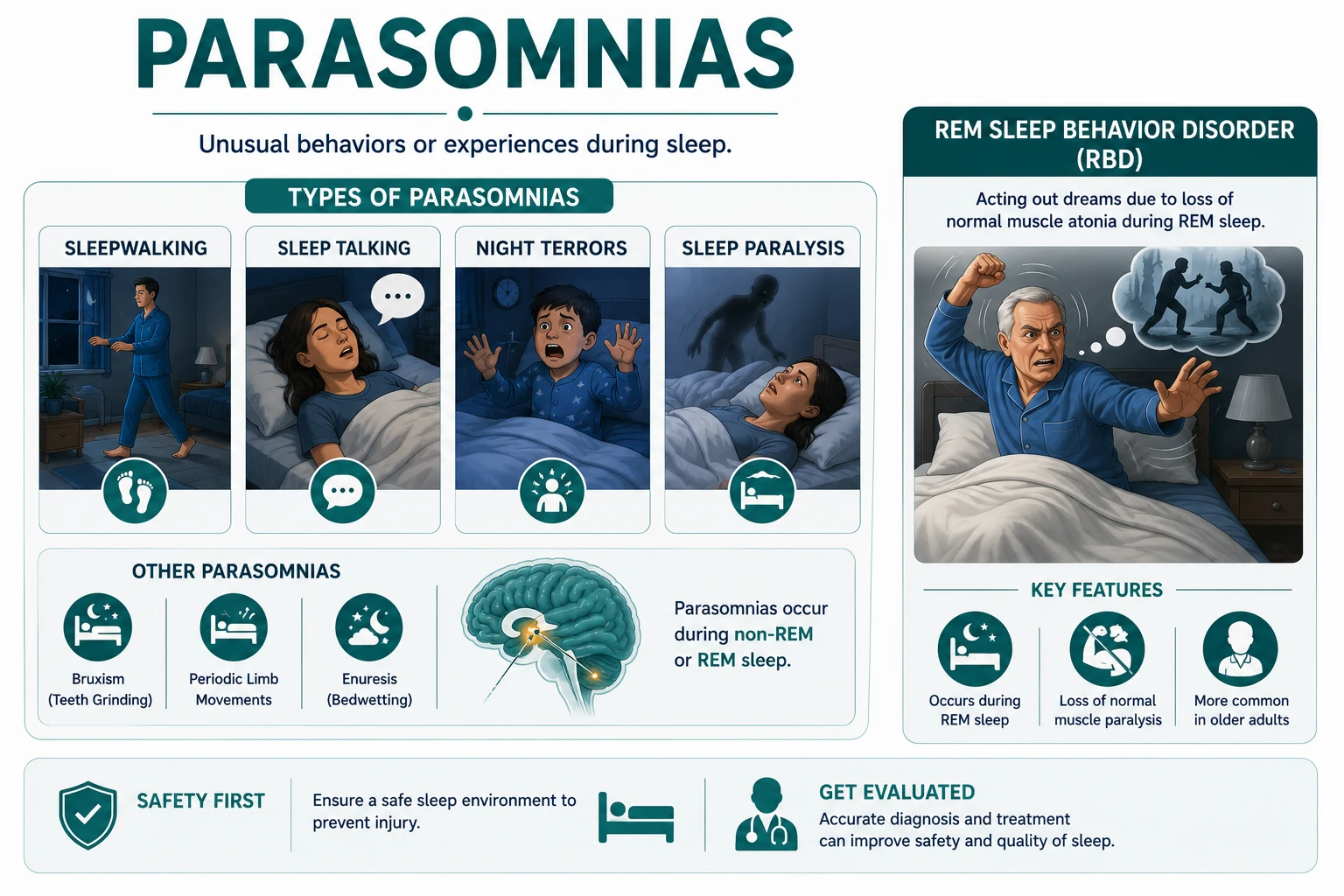
Parasomnias are unwanted behaviors, movements, or experiences that occur during sleep, at the transitions into or out of sleep, or during partial arousal. NREM disorders of arousal, sleepwalking, sleep terrors, and confusional arousals, arise from deep non-REM sleep, typically in the first part of the night, with little or no memory of the episode afterward. REM sleep behavior disorder (RBD) is a different category entirely, in which the normal paralysis of REM sleep is incomplete, allowing a person to physically act out vivid, often action-filled dreams, usually later in the night, with vivid recall. Distinguishing which category applies matters, because RBD in particular carries specific safety and evaluation considerations.
Parasomnias at a Glance
What Happens
Unwanted behaviors, movements, or experiences during sleep, ranging from NREM disorders of arousal (sleepwalking, sleep terrors) to REM sleep behavior disorder, a distinct condition involving dream enactment.
Two Different Categories
NREM disorders of arousal come from deep non-REM sleep, early in the night, with little memory; REM sleep behavior disorder comes from REM sleep, later in the night, with vivid dream recall.
How It Is Diagnosed
Clinical history for most NREM disorders of arousal; video polysomnography is often used to confirm suspected REM sleep behavior disorder specifically.
How It Is Treated
Injury prevention and trigger avoidance for NREM disorders in most cases; for RBD, injury prevention plus, when appropriate, medication such as melatonin or clonazepam.
Key Takeaways
- NREM disorders of arousal (sleepwalking, sleep terrors, confusional arousals) and REM sleep behavior disorder are fundamentally different conditions, not variations of the same thing, despite both being called "parasomnias."
- Timing, memory, and dream recall are three of the most useful clues for telling these categories apart: NREM events happen early in the night with little memory; RBD events happen later in the night with vivid dream recall.
- REM sleep behavior disorder is associated with certain neurological conditions, but this is a probabilistic association explained carefully, not a certainty, and a diagnosis of RBD does not mean a person definitely has or will develop Parkinson's disease or another neurodegenerative condition.
- Injury prevention in the bedroom is a genuinely important part of managing both categories, alongside medical evaluation and, when appropriate, medication.
Symptoms
NREM Disorders of Arousal
- Sleepwalking, walking or performing complex behaviors while still largely asleep
- Sleep terrors, sudden arousal with intense fear, screaming, or a racing heart, typically in the first part of the night
- Confusional arousals, waking up disoriented, slow to respond, sometimes with inappropriate behavior
- Typically little or no memory of the episode the next morning
- Most common in children, though they occur in adults too
REM Sleep Behavior Disorder
- Physically acting out dreams, talking, shouting, punching, kicking, or jumping out of bed
- Usually occurs later in the night, when REM sleep is more concentrated
- Often accompanied by vivid, action-filled, sometimes violent dream recall upon waking
- The person is often easily awoken and, once awake, coherent and oriented
- Most common in older adults, more often men, though it occurs in others as well
Could This Be a Parasomnia?
Is sleepwalking the same as REM sleep behavior disorder?
No, and the distinction matters. Sleepwalking is an NREM disorder of arousal, arising from deep non-REM sleep, typically early in the night, with little memory afterward. REM sleep behavior disorder involves acting out dreams during REM sleep, typically later in the night, usually with vivid recall of what was dreamed. They look superficially similar (both involve movement during sleep) but are different conditions with different evaluations.
My partner says I act out my dreams. Should I be worried?
This is worth a physician evaluation, since acting out dreams, especially with vivid recall and movements that could be forceful, is the hallmark symptom of REM sleep behavior disorder, a condition that has specific safety and evaluation considerations, discussed in detail below. It's a genuinely useful thing to bring up rather than dismiss.
Does acting out my dreams mean I have Parkinson's disease?
No, not by itself, and this is important to understand clearly. REM sleep behavior disorder is associated with certain neurological conditions, but this is a probabilistic association discussed over time with your physician, not a diagnosis or a certainty. Many people with RBD do not go on to develop a neurodegenerative condition, and RBD itself is a legitimate, treatable sleep disorder on its own.
Is night terrors the same thing as a nightmare?
No. A nightmare is a disturbing dream that you wake from and typically remember, usually during REM sleep, later in the night. A sleep terror is a sudden arousal from deep non-REM sleep, typically early in the night, with intense fear and often no memory of it afterward, even though it can look alarming to someone watching.
What Causes Parasomnias?
Incomplete Transitions Between Sleep and Wakefulness
NREM disorders of arousal happen when the brain doesn't fully transition out of deep non-REM sleep during an arousal, leaving someone partially asleep and partially awake, capable of complex behavior with little conscious awareness.
Genetics, for NREM Disorders of Arousal
A family history is common, and specific genetic factors are an active area of research.
Common Triggers
Sleep deprivation, fever, alcohol, certain medications, an irregular schedule, and untreated sleep disorders like obstructive sleep apnea can each trigger or worsen NREM disorders of arousal in susceptible individuals.
Incomplete REM Sleep Paralysis, for REM Sleep Behavior Disorder
REM sleep behavior disorder occurs when the muscle paralysis (atonia) that normally accompanies REM sleep is incomplete, allowing the body to physically act out dream content that would otherwise stay internal.
Neurologic & Medication Associations, for REM Sleep Behavior Disorder
RBD is associated with certain neurological conditions and with some antidepressant medications, discussed carefully in its own section below.
Risk Factors
- Family history, for NREM disorders of arousal specificallyA significant genetic component is well recognized
- Sleep deprivation, irregular sleep schedules, or feverCommon triggers for NREM disorders of arousal, particularly in those already prone to them
- Alcohol or certain medicationsCan trigger or worsen NREM disorders of arousal in susceptible individuals
- Untreated obstructive sleep apneaCan fragment sleep in ways that trigger NREM arousal parasomnias in some patients
- Older age and male sex, for REM sleep behavior disorder specifically
- Certain neurological conditions or their early stages, for REM sleep behavior disorderAn important association discussed carefully in its own section below
- Certain antidepressant medications, associated with REM sleep behavior disorder in some patients
When Parasomnias Matter
Injury Risk
Both categories carry real injury risk, to the person or a bed partner, which is why bedroom safety modifications are a genuinely important part of management for both, not just a suggestion for severe cases.
Sleep Disruption
Frequent episodes can fragment sleep for both the person and a bed partner, contributing to daytime fatigue.
Distress & Relationship Impact
Both categories can be distressing to witness or experience, and vivid, sometimes violent RBD dream content in particular can affect a couple's sleeping arrangements and peace of mind.
A Genuine Diagnostic Signal, for RBD Specifically
Because REM sleep behavior disorder carries a real, evidence-based association with certain neurological conditions, an accurate RBD diagnosis matters for longer-term monitoring and care planning, handled carefully and individually with your physician.
When Should I Talk to a Sleep Specialist?
- Sleepwalking, sleep terrors, or confusional arousals that are frequent, dangerous, or continuing well past childhood
- Any report of physically acting out dreams, punching, kicking, shouting, or falling out of bed during sleep
- An injury to yourself or a bed partner during a sleep episode
- Vivid, action-filled, or violent dream recall paired with corresponding movement during sleep
- New parasomnia-like behavior starting in adulthood, particularly older adulthood
- A bed partner's concern about your safety or their own during your sleep
What Are Parasomnias?
A Broad Category
Parasomnias are unwanted behaviors, movements, or experiences that occur during sleep, at the transitions into or out of sleep, or during partial arousal. The term covers a wide range, from common childhood sleepwalking to a distinct adult condition, REM sleep behavior disorder.
Two Very Different Groups
The single most important thing to understand about parasomnias is that they are not one condition. NREM disorders of arousal (sleepwalking, sleep terrors, confusional arousals) and REM sleep behavior disorder come from entirely different sleep stages, follow different patterns, and require different evaluations. Treating them as interchangeable is where confusion, and sometimes real safety risk, comes from.
NREM Disorders of Arousal vs. REM Sleep Behavior Disorder
| Dimension | NREM Disorders of Arousal | REM Sleep Behavior Disorder |
|---|---|---|
| Sleep Stage | Deep non-REM sleep | REM sleep |
| Typical Timing | First part of the night | Later in the night, when REM sleep is more concentrated |
| Awareness During the Episode | Largely unaware; difficult to fully wake | Often easily awoken; can be surprisingly responsive |
| Memory Afterward | Usually little or none | Often vivid, detailed dream recall |
| Typical Behavior | Walking, sitting up, screaming, confusion, complex but usually non-goal-directed behavior | Punching, kicking, shouting, jumping out of bed, often matching specific dream content |
| Typical Age Pattern | Most common in children, often outgrown | Most common in older adults, more often men |
| Injury Potential | Real, especially with sleepwalking near stairs or exits | Real, and often the reason for evaluation, since movements can be forceful |
| How It Is Confirmed | Usually clinical history alone | Video polysomnography, when the diagnosis needs confirmation |
NREM Disorders of Arousal
Sleepwalking
Walking or performing other complex behaviors while still largely asleep, with little to no memory of it afterward.
Sleep Terrors
A sudden arousal with intense fear, often screaming and a racing heart, typically in the first part of the night, with little memory the next morning even though it can look alarming to witness.
Confusional Arousals
Waking up disoriented and slow to respond, sometimes with inappropriate behavior, most common in children but also seen in adults.
These are common, especially in children, and frequently improve or resolve with age. Common triggers, sleep deprivation, fever, an irregular schedule, alcohol, certain medications, and untreated sleep disorders like obstructive sleep apnea, are worth identifying, since addressing them often reduces episode frequency without needing medication.
REM Sleep Behavior Disorder
REM sleep behavior disorder (RBD) deserves particular care in how it’s explained, both because of its safety implications and because of an association that is easy to overstate.
What Happens
Normally, REM sleep comes with near-complete muscle paralysis (atonia), which is what keeps most people physically still while dreaming. In RBD, this paralysis is incomplete, so a person can physically act out dream content, punching, kicking, shouting, or getting out of bed, usually corresponding to vivid, sometimes action-filled or violent dreams they remember clearly upon waking.
Why Evaluation Matters
Because RBD movements can be forceful and occur without the person’s conscious control, injury to the person or a bed partner is a real, practical concern, which is why bedroom safety and, often, an in-lab video sleep study to confirm the diagnosis are both emphasized in current guidance.
The Neurologic Association, Explained Carefully
RBD is associated with certain neurological conditions, including Parkinson’s disease, dementia with Lewy bodies, and multiple system atrophy, and this is a real, evidence-based association worth knowing about. It is important, though, to be precise about what that means and what it doesn’t. This is an association observed over time in populations of people with RBD, not a certainty for any individual, and not every person with RBD goes on to develop one of these conditions. A diagnosis of REM sleep behavior disorder is not the same as a diagnosis of, or a guarantee of developing, Parkinson’s disease or any other neurodegenerative condition. What it does mean, in current practice, is that RBD is treated as a condition worth diagnosing accurately and monitoring over time with your physician, alongside treating the RBD symptoms themselves, rather than as an alarming standalone prognosis to carry alone. If this association is on your mind, it’s worth raising directly and specifically with your physician, who can talk through what it does and doesn’t mean for your own situation.
How Parasomnias Are Diagnosed
The Evaluation Pathway
- 01Detailed HistoryTiming, behavior, memory afterward, and dream recall are reviewed carefully, often with input from a bed partner or, for a child, a parent.
- 02Category DeterminationThe pattern is sorted into an NREM disorder of arousal, REM sleep behavior disorder, or another parasomnia, since the two categories are managed differently.
- 03Trigger & Contributor ReviewSleep deprivation, alcohol, medications, and untreated sleep disorders like sleep apnea are considered as contributing factors.
- 04Video Polysomnography, When NeededAn in-lab, video-recorded sleep study is often used to confirm suspected REM sleep behavior disorder, directly observing REM sleep without atonia and any corresponding behavior.
- 05Personalized Safety & Treatment PlanBedroom safety measures, trigger management, and, when appropriate, medication are planned around the specific category and severity.
Parasomnias in Children vs. Adults
NREM disorders of arousal are, by a wide margin, most common in childhood, and for most children, sleepwalking, sleep terrors, and confusional arousals are a normal, usually self-limited part of development that many outgrow by adolescence, without needing more than reassurance, basic safety measures, and trigger management. The evaluation threshold is generally lower for adults with new NREM-type parasomnia symptoms, since new-onset sleepwalking or sleep terrors in adulthood is less common and more often worth a closer look for an underlying trigger, such as untreated sleep apnea, a new medication, or significant sleep deprivation, rather than assumed to be a benign childhood-pattern condition simply appearing late. REM sleep behavior disorder follows close to the opposite age pattern: it is uncommon in children and most typical in older adults, which is itself a useful clue when sorting out which category of parasomnia is actually present.
When to Seek Care Urgently
Most parasomnia episodes, while sometimes alarming to witness, are not medical emergencies in the moment; the general guidance for a sleepwalking or sleep terror episode is to gently guide the person back to bed without abruptly waking them, rather than trying to forcibly stop the behavior. An actual injury during a sleep episode, to the person experiencing it or to a bed partner, is a reason to seek prompt medical evaluation, as is any new confusion, weakness, or other neurological symptom that persists after full awakening, which would be atypical for a straightforward parasomnia and worth ruling out other causes for. Ongoing, frequent, or worsening episodes of either category are a reasonable and appropriately proactive reason to schedule a sleep medicine evaluation, rather than waiting for a more severe event to prompt it.
Parasomnias Care at VitalAir
Sleep testing, including video-recorded in-lab studies when REM sleep behavior disorder is suspected, is part of how VitalAir evaluates parasomnias; patients whose parasomnia is connected to poor overall sleep quality may also find this guide on unexplained daytime tiredness useful additional context.
VitalAir evaluates and manages parasomnias for patients across Frisco, North Dallas, and the broader North Texas area. That evaluation starts with a careful history to distinguish an NREM disorder of arousal from REM sleep behavior disorder or another parasomnia, followed by bedroom safety guidance, trigger management, and, when appropriate, medication, planned individually and, for suspected RBD, alongside thoughtful, unhurried conversation about what the diagnosis does and doesn’t mean. The clinical information on this page applies to patients everywhere; what differs locally is simply where that evaluation and follow-up care happens.
Patient Questions
What's the difference between sleepwalking and REM sleep behavior disorder?
Sleepwalking is an NREM disorder of arousal, arising from deep non-REM sleep, typically in the first part of the night, usually with little or no memory afterward, and the person is often difficult to fully wake. REM sleep behavior disorder involves physically acting out dreams during REM sleep, typically later in the night, usually with vivid dream recall, and the person is often easily awoken and coherent once awake.
Are night terrors dangerous?
A sleep terror itself, the sudden fear, screaming, and racing heart, is not typically dangerous on its own, though the accompanying movement can occasionally lead to injury, and it can be alarming for a bed partner or parent to witness. Reasonable bedroom safety and identifying triggers are usually the main practical steps.
Does acting out dreams always mean something is neurologically wrong?
No. REM sleep behavior disorder is a real, definable sleep condition on its own, and while it does carry an association with certain neurological conditions worth monitoring over time with your physician, having RBD does not mean a person definitely has, or will go on to develop, a neurodegenerative condition. This is a nuanced, probabilistic association, not a diagnosis, and it's discussed individually and carefully, not as an alarming certainty.
How is REM sleep behavior disorder diagnosed?
Typically with a video polysomnogram, an in-lab sleep study that records video alongside the usual sleep-stage and muscle-activity data, allowing a physician to directly observe REM sleep without the normal muscle paralysis (atonia), alongside any corresponding dream-enactment behavior.
Can children have REM sleep behavior disorder?
It's uncommon in children; RBD is far more typical in older adults, more often men. Parasomnias in children are much more commonly NREM disorders of arousal, like sleepwalking, sleep terrors, or confusional arousals, which are a normal, usually self-limited part of childhood sleep for many kids.
What should I do if my partner acts out dreams and could hurt me or themselves?
Bedroom safety modifications, removing bedside hazards, padding furniture edges, and, if needed, separate sleeping arrangements until things are better controlled, are reasonable immediate steps, alongside seeking a physician evaluation. This is a real, manageable condition, and taking safety seriously now doesn't have to be permanent.
Do sleepwalking and sleep terrors need to be treated with medication?
Often not. For many children and adults with infrequent, non-dangerous episodes, reassurance, addressing common triggers like sleep deprivation or alcohol, and basic safety measures are enough. Medication is considered for more frequent, dangerous, or distressing cases, individualized to the situation.
Is REM sleep behavior disorder treatable?
Yes. Current AASM guidance identifies immediate-release melatonin and clonazepam as reasonable options for clinicians to consider, alongside bedroom safety modifications, which remain important regardless of medication choice.
What causes REM sleep behavior disorder?
It occurs when the muscle paralysis that normally accompanies REM sleep is incomplete, allowing the body to physically act out dream content. It is associated with certain neurological conditions and, in some patients, with certain antidepressant medications, though the exact mechanism and full range of causes remain an active area of research.
When should I see a doctor about a parasomnia?
Reasonable prompts include frequent or dangerous NREM episodes, sleepwalking or sleep terrors continuing well past childhood, any report of physically acting out dreams, an injury during a sleep episode, or a bed partner's genuine safety concern. A physician evaluation can clarify which category applies and build an appropriate, individualized plan.
Sources
Guidelines and Professional Societies
- American Academy of Sleep Medicine. Management of REM Sleep Behavior Disorder, An American Academy of Sleep Medicine Clinical Practice Guideline. Journal of Clinical Sleep Medicine, 2023.View source
- Mayo Clinic. Sleepwalking, Symptoms and Causes.View source
- Mayo Clinic. REM Sleep Behavior Disorder, Symptoms and Causes.View source
Government and Regulatory Sources
- National Heart, Lung, and Blood Institute. Sleep-Related Movement and Behavior Disorders.View source