Testing & Diagnosis
Medically reviewed by Varun Halani, MD · August 12, 2026
Spirometry
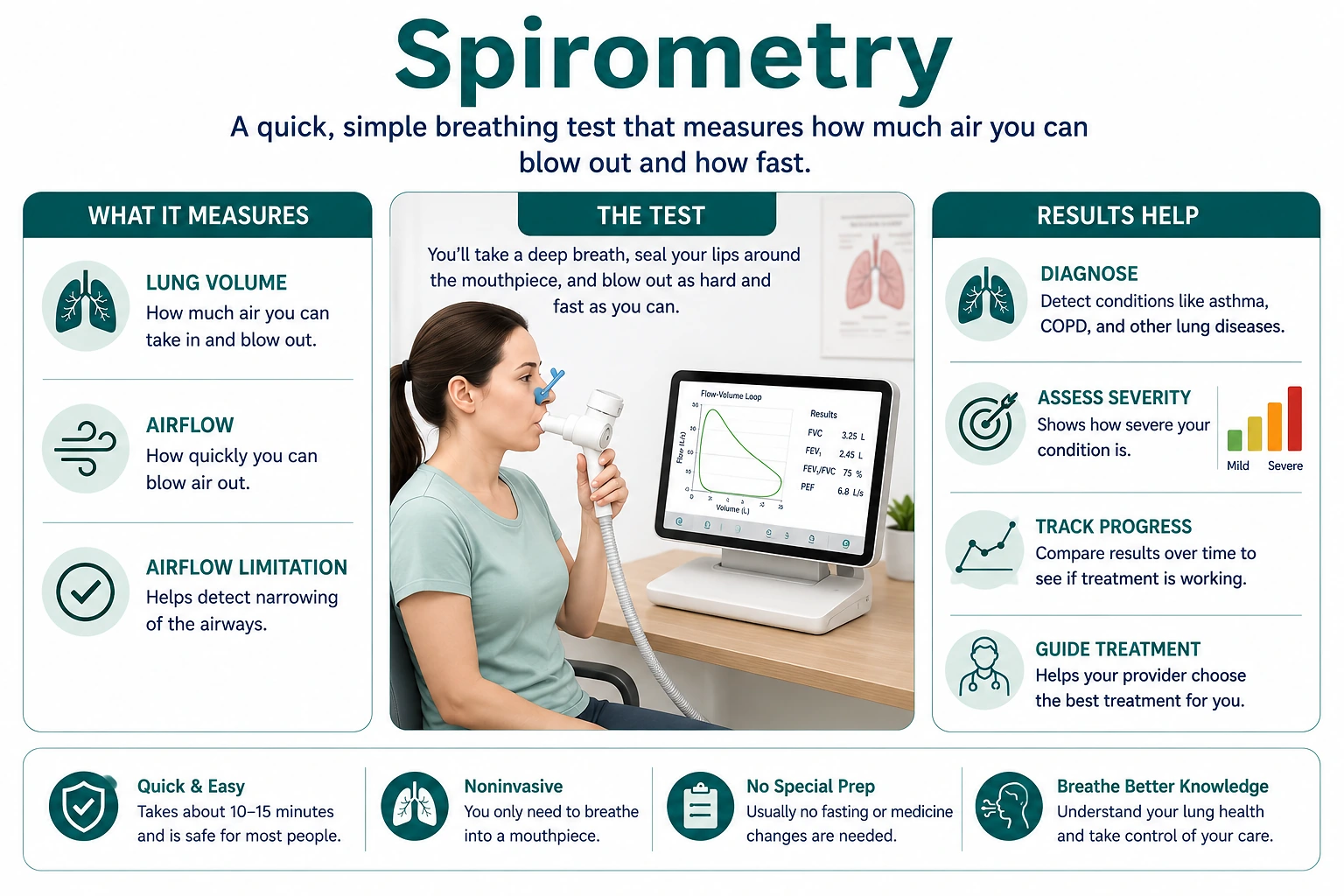
Spirometry is a common breathing test that measures how much air you can forcefully exhale and how quickly you can exhale it, helping evaluate lung health.
In short
Spirometry is a breathing test that measures how much air you can forcefully exhale (FVC) and how quickly you can exhale it (FEV1). Together with the FEV1/FVC ratio, these measurements help evaluate airflow and support diagnosis and monitoring of conditions like asthma and COPD, always alongside a fuller clinical picture.
At a Glance
What It Measures
The total amount of air you can forcefully exhale and how fast you exhale it, expressed as FVC, FEV1, and the FEV1/FVC ratio.
Why It Is Ordered
To help evaluate breathing symptoms and to support diagnosis or monitoring of conditions such as asthma and COPD.
What to Expect
Breathing forcefully into a mouthpiece several times, sometimes repeated after an inhaled bronchodilator.
What Results May Mean
Results are interpreted by a physician alongside symptoms and medical history, not as a stand-alone diagnosis.
Key Takeaways
- Spirometry measures FVC (total air exhaled), FEV1 (air exhaled in the first second), and the FEV1/FVC ratio.
- A reduced FEV1/FVC ratio can suggest airway obstruction, but a single number is never a diagnosis on its own.
- Results depend heavily on patient effort and technique, so the test is usually repeated to confirm reproducibility.
- Spirometry is often repeated after an inhaled bronchodilator to check for a reversible airflow response.
- Spirometry is one component of the broader pulmonary function testing family, which can also include lung volume and DLCO measurements.
What Spirometry Measures
Spirometry is one of the most common breathing tests used to evaluate how well the lungs are moving air. During the test, you breathe into a mouthpiece connected to a device called a spirometer, which records how much air you exhale and how quickly you exhale it. The results are usually reported as a few key numbers you may see on your printout.
FVC (Forced Vital Capacity)
The total amount of air you can forcefully exhale after taking as full a breath in as possible. It reflects the overall volume of air your lungs can move during a forceful breath out.
FEV1 (Forced Expiratory Volume in One Second)
The portion of that air you're able to exhale during just the first second of the effort. Because airway narrowing tends to slow airflow early in an exhale, FEV1 is especially useful for assessing how freely air is moving out of the lungs.
FEV1/FVC Ratio
The fraction of your total exhaled air that came out in that first second, comparing FEV1 to FVC. This ratio is one of the values clinicians look at when considering whether airflow is obstructed.
Each of these values is also expressed as a percentage of what would be expected for someone of your age, height, sex, and sometimes ethnicity, since normal lung capacity varies from person to person.
The Flow-Volume Curve
What the Curve Shows
In addition to these numbers, spirometry generates a flow-volume curve, a graph that plots airflow against exhaled volume throughout the breathing maneuver. Clinicians use this curve as a visual tool to assess the overall pattern of airflow during the test.
How It's Interpreted
Different patterns on this curve can point toward different types of breathing issues, but reading the curve is part of a broader clinical assessment, not something patients are expected to interpret on their own from a printout.
What a Reduced FEV1/FVC Ratio Can Suggest
What It Can Suggest
What It Doesn't Tell You Alone
A single ratio number is not a diagnosis. Interpreting spirometry results requires looking at the overall pattern across FVC, FEV1, and the flow-volume curve, comparing those numbers to expected values for your body, and weighing all of that against your symptoms and medical history. The same ratio can mean different things in different people, which is why this interpretation is done by a clinician rather than by reading a single value in isolation.
What Happens During the Test
- 01Full Breath InYou take as full a breath in as possible before the maneuver begins.
- 02Forceful, Complete ExhaleYou exhale into the mouthpiece as forcefully, completely, and steadily as you can, which takes real effort and coordination.
- 03Repeated AttemptsTechnicians typically ask you to repeat the maneuver multiple times to confirm your results are reproducible. The most consistent, technically acceptable efforts are used for the final report; if your results vary widely between attempts, you may be asked for additional tries.
- 04Bronchodilator (If Ordered)You may be given an inhaled bronchodilator medication and asked to wait about fifteen minutes.
- 05Repeat After BronchodilatorThe breathing maneuver is repeated so your care team can see whether your airflow improves meaningfully after the medication.
A significant improvement in airflow after the bronchodilator supports the possibility of a reversible, asthma-type component to your breathing pattern. This response is one piece of information among several: it does not, by itself, confirm an asthma diagnosis, and its absence does not rule one out. Your physician weighs the bronchodilator response alongside your other results and clinical history.
Preparing for the Test
Because certain factors can affect how your lungs perform on the day of testing, your care team may give you specific preparation instructions. These commonly include:
- Avoiding a heavy meal before the test
- Avoiding vigorous exercise before the test
- Avoiding smoking for a period of time before the test
- Possibly holding certain inhaled medications beforehand so they don’t mask your baseline results
These are general categories of guidance, not a substitute for your own physician’s instructions. Always follow the specific preparation directions given by the office that ordered your test, since they may differ based on why the test was ordered and what medications you take.
If you’re unsure whether to take your usual inhaler or other breathing medication on the morning of your appointment, it’s reasonable to call the ordering office ahead of time rather than guess. Skipping a dose you actually need, or unexpectedly taking one you were asked to hold, can both affect how your results should be interpreted.
What Spirometry Results Can and Cannot Tell You
Spirometry provides objective, measurable information about airflow that supports the diagnosis and ongoing monitoring of conditions such as asthma and COPD. It is a core part of how COPD is diagnosed and staged, and it plays an important supporting role in asthma evaluation, particularly when combined with bronchodilator response testing.
At the same time, spirometry results are one part of a broader clinical evaluation. They are always interpreted together with your symptoms, physical exam, medical history, and sometimes additional testing. Spirometry alone does not deliver a stand-alone diagnostic verdict, and no single value from the test, including the FEV1/FVC ratio, should be used to self-diagnose a breathing condition.
Where Spirometry Fits Within Pulmonary Function Testing
One Component of a Broader Family
Spirometry is one component within the broader family of pulmonary function testing. While spirometry focuses on forced exhaled airflow, a fuller pulmonary function testing session can also include measurements like total lung volumes and diffusion capacity (DLCO), which capture additional aspects of lung function that spirometry alone doesn’t assess.
When a Fuller Session Is Ordered
If your evaluation calls for a more complete picture of your lung health, your physician may order these additional measurements alongside spirometry.
Spirometry may also be paired with other pulmonary tests, such as feno testing, depending on what your care team is trying to evaluate. Reviewing your spirometry results together with any related testing gives your physician a more complete view than any single test could provide on its own.
Patient Questions
What do FEV1 and FVC mean on my spirometry results?
FVC (forced vital capacity) is the total amount of air you can forcefully exhale after a full breath in. FEV1 (forced expiratory volume in one second) is the portion of that air exhaled during just the first second. Both are typically shown on result printouts along with a percentage of the expected value for someone of your age, height, sex, and sometimes ethnicity.
What does a low FEV1/FVC ratio mean?
A lower than expected FEV1/FVC ratio can suggest that air is moving out of the lungs more slowly than usual, a pattern often associated with airway obstruction, such as in asthma or COPD. However, this single number is not a diagnosis by itself. It must be interpreted by a clinician together with the overall test pattern, your symptoms, and your medical history.
How should I prepare for a spirometry test?
Preparation instructions vary, but general guidance often includes avoiding a heavy meal, vigorous exercise, and smoking shortly before the test, since these can affect results. Your care team may also ask you to hold certain inhaled medications beforehand. Always follow the specific instructions given by the office that ordered your test.
Does spirometry hurt?
Spirometry is not painful, though it does require real effort. You will be asked to take a full breath in and then exhale as forcefully and completely as you can into a mouthpiece, which can feel tiring for a few seconds.
Why do I have to repeat the breathing maneuver several times?
Spirometry results depend on how well you follow the technique and how much effort you give. Technicians typically ask for multiple attempts to confirm that your results are consistent and reproducible before selecting the best efforts for interpretation.
What is the bronchodilator portion of the test for?
After an initial set of measurements, you may be given an inhaled bronchodilator and asked to repeat the test about fifteen minutes later. A significant improvement in airflow afterward supports the possibility of a reversible, asthma-type component, though it does not by itself confirm a diagnosis.
How is spirometry different from full pulmonary function testing?
Spirometry measures forced exhaled airflow, including FVC, FEV1, and the FEV1/FVC ratio. Broader pulmonary function testing can include spirometry plus additional measurements, such as total lung volumes and diffusion capacity (DLCO), which capture aspects of lung function that spirometry alone does not assess. Learn more on the pulmonary function testing overview.
How is spirometry used in diagnosing asthma or COPD?
Spirometry is a core tool for diagnosing and staging COPD, and it can support an asthma evaluation, particularly when combined with bronchodilator response testing. It is used alongside symptoms, history, and sometimes other tests rather than as a stand-alone determination.
Can spirometry results alone confirm a diagnosis?
No. Spirometry provides objective airflow measurements that support diagnosis and monitoring, but results are always interpreted together with your symptoms, history, and other clinical findings. A single test result, including the FEV1/FVC ratio, should not be used to self-diagnose a condition.
What does the flow-volume curve show?
In addition to the numeric FVC and FEV1 values, spirometry produces a flow-volume curve, a graph that clinicians use to visually assess the pattern of airflow throughout the breath. Certain shapes can suggest particular breathing patterns, but interpreting this curve is part of the broader clinical assessment performed by your physician.
Sources
Guidelines and Professional Societies
- American Thoracic Society and European Respiratory Society — technical standards for the performance of spirometry.
- American Thoracic Society — guidance on interpretive strategies for lung function tests.
- Global Initiative for Chronic Obstructive Lung Disease — role of spirometry in diagnosing and staging COPD.
- Global Initiative for Asthma — role of spirometry and bronchodilator reversibility testing in asthma evaluation.