Treatment
Medically reviewed by Varun Halani, MD · August 12, 2026
BiPAP and Bilevel PAP: How It Differs From CPAP
What bilevel PAP (BiPAP) therapy is, how its two alternating pressures work, why it's selected for certain patients, and what starting it typically involves.
In short
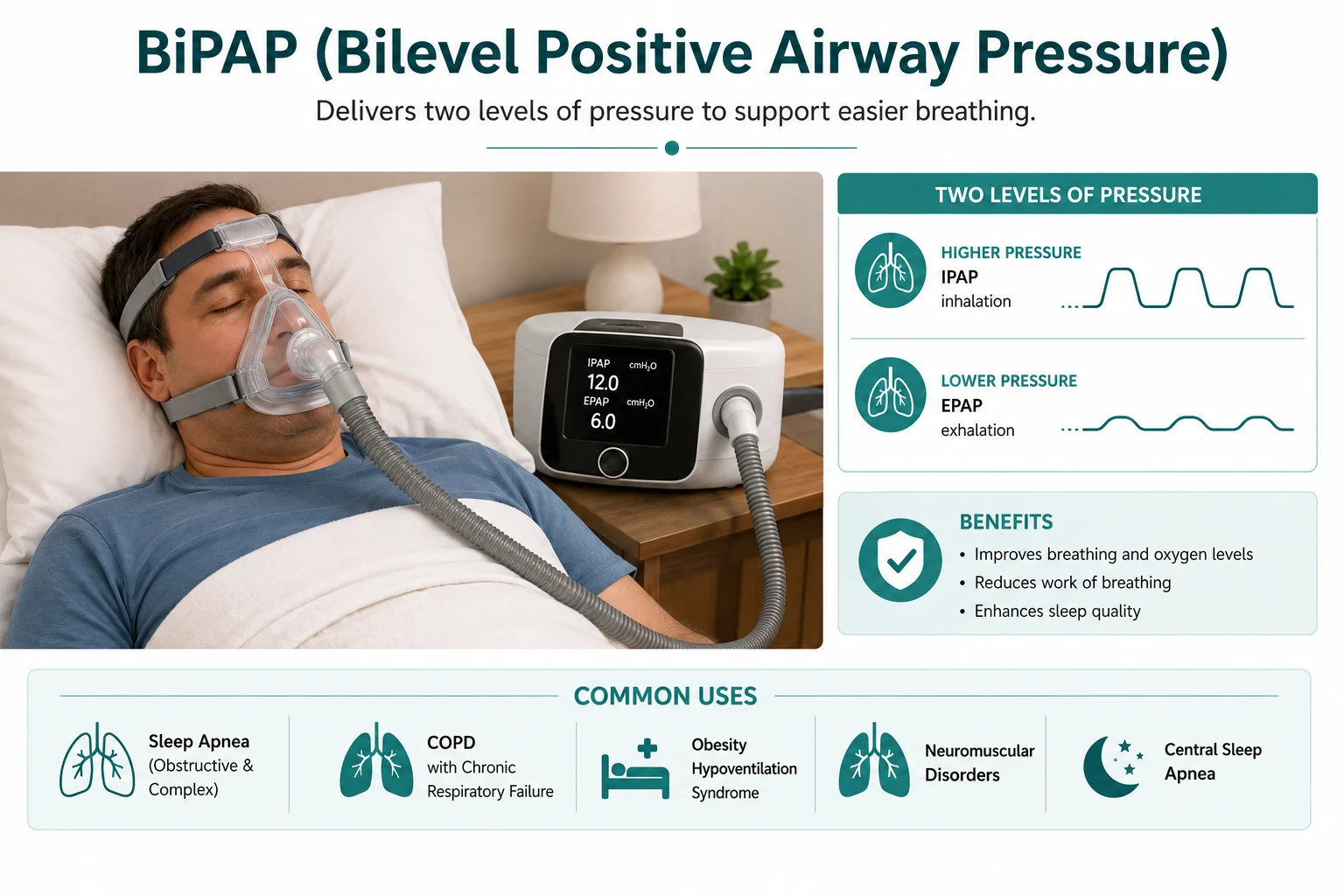
Bilevel PAP therapy, often called BiPAP, is a form of positive airway pressure therapy that delivers two different pressures rather than one constant pressure. It supplies a higher pressure during inhalation (IPAP) and a lower pressure during exhalation (EPAP), which can make exhaling more comfortable for some patients and, in certain devices and clinical situations, provide added ventilatory support. It's generally selected for specific situations, such as difficulty tolerating a single constant pressure or certain hypoventilation and breathing-control disorders, rather than used as a routine first choice for typical obstructive sleep apnea, where CPAP remains standard first-line therapy.
Key Takeaways
- Bilevel PAP delivers two alternating pressures, a higher one during inhalation (IPAP) and a lower one during exhalation (EPAP), instead of CPAP's single constant pressure.
- "BiPAP" is a widely used, brand-derived term for bilevel PAP therapy generally; the clinically generic term is bilevel positive airway pressure, or simply "bilevel."
- Bilevel is not a stronger or more advanced version of CPAP. It's a different way of delivering pressure, suited to different clinical situations, not a more aggressive escalation of the same therapy.
- CPAP remains standard first-line therapy for straightforward obstructive sleep apnea. Bilevel is generally considered for specific situations, not because it works "better" for OSA in general.
- Most CPAP discomfort is resolved through mask, pressure, or humidification troubleshooting rather than by moving to bilevel therapy.
- Adaptive servo-ventilation (ASV) is a distinct, more advanced device category, not a form of standard bilevel PAP.
What Is Bilevel PAP Therapy?
Bilevel positive airway pressure therapy is a form of positive airway pressure treatment that delivers two different pressures, rather than the single constant pressure used by CPAP.
Like CPAP, it’s delivered through a bedside machine, tubing, and a mask worn during sleep, and its underlying goal is similar: supporting breathing through the night. Where it differs is mechanical, in exactly how that pressure is delivered.
Many patients and even some clinicians refer to this therapy as “BiPAP.” It’s worth being precise about where that term comes from: BiPAP is technically a brand name, originally trademarked by a specific device manufacturer for its line of bilevel machines.
Over time, much like how certain brand names become the everyday word for an entire product category, “BiPAP” has become the common, colloquial way people refer to bilevel PAP therapy in general, regardless of which company made the actual device.
The clinically accurate, generic term is bilevel positive airway pressure, or simply “bilevel,” which is the term used through most of this page. It’s genuinely how patients search and talk about the therapy, though, so “BiPAP” is used here occasionally too.
Two Pressures Instead of One: IPAP and EPAP
The defining feature of bilevel therapy is right in its name: two pressure levels instead of one, switching automatically as the machine senses your breathing cycle, breath by breath, through the night.
IPAP
Inspiratory positive airway pressure: the higher of the two levels, delivered while breathing in.
EPAP
Expiratory positive airway pressure: the lower of the two levels, delivered while breathing out.
That drop in pressure during exhalation is the central design difference from CPAP. With CPAP’s single, unchanging pressure, breathing out means pushing against the same pressure the whole time. With bilevel, the pressure eases specifically during exhalation, which some patients find noticeably more comfortable.
This page focuses on understanding the therapy itself; if you want a direct, side-by-side look at how CPAP and bilevel compare on pressure delivery, typical use, and decision factors, see our CPAP vs. bilevel comparison.
Bilevel Is Not “a Stronger CPAP”
This is worth stating plainly, because it’s a common and understandable misconception: bilevel PAP is not a more powerful, more advanced, or more aggressive version of CPAP. It isn’t a “next level up” reserved for people whose sleep apnea is somehow worse. The two therapies are built around different physiological approaches, not a strength hierarchy.
What CPAP Is Built to Do
CPAP’s single steady pressure exists to do one job well: mechanically holding the airway open.
What Bilevel Is Built to Do
Bilevel’s two alternating pressures exist to solve different problems, primarily comfort during exhalation and, in some clinical circumstances, active support for how much air moves in and out of the lungs.
A patient using bilevel therapy isn’t necessarily someone with more severe disease than a patient using CPAP; more often, they’re someone whose specific clinical situation fits a different physiological picture altogether.
It’s equally important to be clear about the reverse: bilevel is not automatically “better” than CPAP for typical obstructive sleep apnea.
For most adults diagnosed with straightforward obstructive sleep apnea, CPAP remains the standard first-line treatment, supported by the longest track record and the most extensive evidence base. Bilevel is generally reserved for more specific situations, discussed below, rather than used as a general first choice.
Why Bilevel May Be Selected for Certain Patients
Bilevel therapy tends to come up in a handful of more specific clinical contexts:
- Pressure intolerance that persists after troubleshooting. Some patients genuinely struggle with exhaling against a single, higher continuous pressure, particularly at higher pressure requirements. Most CPAP discomfort, though, is resolved through practical adjustments, mask refitting, pressure comfort features, humidification changes, not by escalating to a different device. Bilevel is considered for the smaller group of patients whose intolerance is genuine and persists despite those adjustments.
- Hypoventilation and chronic hypercapnic respiratory disorders. In some conditions where breathing doesn’t move enough air in and out of the lungs, allowing carbon dioxide to build up, bilevel devices can be configured to provide additional ventilatory support beyond simply holding the airway open. This is a meaningfully different clinical purpose from treating airway obstruction. If this describes your situation, our page on chronic respiratory failure covers that broader picture in more depth.
- Selected central breathing disorders. Certain patterns of centrally driven breathing irregularity, distinct from the airway narrowing seen in typical OSA, may prompt a physician to consider bilevel support as part of a broader treatment strategy. Our central sleep apnea page covers those causes and treatment options in full; this page only touches on bilevel’s role there briefly, since a dedicated discussion already exists.
In every case, whether bilevel therapy fits is a clinical decision made after a sleep evaluation and testing, not something a patient decides to try on their own.
Spontaneous and More Advanced Bilevel Modes, Conceptually
Bilevel devices can operate in different modes. Here’s the general concept at a high level, without getting into technical ventilator-mode terminology.
Spontaneous Mode
The device switches between the higher and lower pressure in response to your own natural breathing effort, following your breaths rather than driving them.
Backup Rate
A feature some bilevel devices also offer, ensuring a minimum number of breaths are delivered even if your own breathing effort briefly lapses, which can matter in certain central breathing situations.
Which mode, if any, is appropriate is a setting your physician selects and adjusts, not a choice you make yourself. The specific technical distinctions between modes go well beyond what’s useful to cover here.
Bilevel Is Also Distinct From ASV
It’s worth a brief, direct clarification: standard bilevel PAP is not the same therapy as adaptive servo-ventilation (ASV).
Standard Bilevel PAP
Alternates between two comparatively fixed pressure levels, set and adjusted by a clinician based on testing.
Adaptive Servo-Ventilation (ASV)
Continuously and automatically adjusts its level of support, breath by breath, based on a patient’s own recent breathing pattern. Generally reserved for specific central breathing disorder presentations.
ASV has its own dedicated page covering how it works and who it may fit.
What Starting Bilevel Therapy Generally Involves
- 01EquipmentA bedside machine, often with a heated humidifier, flexible tubing, and a mask interface (nasal, nasal pillow, or full-face), conceptually similar to CPAP. Mask selection is just as individualized here, based on how you breathe, your facial anatomy, and comfort.
- 02TitrationBecause bilevel involves two separate pressure settings, determining the right numbers typically involves a titration process, most often as part of an in-lab sleep study, where a technologist adjusts your inhale and exhale pressures while monitoring your breathing directly.
- 03Ongoing MonitoringAs with CPAP, modern bilevel devices record data your care team reviews at follow-up visits, including residual breathing events, mask leak, and hours of nightly use, to confirm the therapy is actually working as intended.
Side Effects
Bilevel side effects fall into broadly the same categories as CPAP:
Dryness
Of the mouth or nose, common to both bilevel and CPAP.
Mask Fit & Skin Irritation
From the mask interface, addressed the same way as with CPAP.
Adjustment Period
Getting used to the sensation of the airflow and the equipment.
Many patients specifically find exhaling more comfortable on bilevel because of its lower exhale pressure, which is often the exact issue that led to trying it. As with CPAP, most of these issues are manageable with practical adjustments; our CPAP overview and its linked troubleshooting guide cover many of the same comfort strategies that apply here as well.
Local Care in North Dallas/Fort Worth
If your physician has raised the possibility of bilevel therapy, or you’re working through ongoing discomfort with your current PAP therapy, the team at VitalAir Sleep & Lung Center in Frisco, Texas can evaluate whether bilevel fits your specific breathing pattern and comfort needs, and help you get properly titrated and set up.
Patient Questions
What is bilevel PAP (BiPAP)?
Bilevel PAP is a positive airway pressure therapy that delivers two different pressure levels rather than one constant pressure, a higher pressure while you breathe in and a lower pressure while you breathe out. "BiPAP" is the common, brand-derived term many patients and clinicians use for this general therapy class.
Is BiPAP a real medical term or a brand name?
"BiPAP" originated as a trademarked brand name for a specific manufacturer's bilevel devices. Over time it became a common, informal way to refer to bilevel PAP therapy generally, similar to how some brand names become everyday words for a broader product category. The clinically generic term is bilevel positive airway pressure, or simply "bilevel."
How is bilevel PAP different from CPAP?
CPAP delivers one steady pressure throughout the whole breathing cycle. Bilevel PAP delivers two pressures, a higher inhale pressure and a lower exhale pressure, which can ease the sensation of breathing out against pressure and, in some situations, provide added ventilatory support. For a full side-by-side look at when each is typically used, see our CPAP vs. bilevel comparison.
Is bilevel PAP stronger than CPAP?
No. It's a common misconception that bilevel is simply a more powerful or "upgraded" CPAP. In reality, the two deliver pressure differently to solve different problems. Bilevel isn't a more aggressive version of the same therapy; it's a different approach altogether, chosen for a different clinical picture.
Who is bilevel PAP typically considered for?
A physician may consider bilevel PAP for a patient who has genuine difficulty tolerating a single constant CPAP pressure after troubleshooting, or for certain hypoventilation syndromes, chronic hypercapnic respiratory disorders, or selected central breathing patterns identified during a sleep evaluation. It's a decision made after testing, not a preference a patient sets on their own.
If I'm struggling with CPAP, does that mean I need bilevel?
Not necessarily, and usually not. Most CPAP discomfort, including pressure sensations, mask fit, and dryness, is resolved through practical troubleshooting rather than by moving to a different therapy. Bilevel is considered for a smaller group of patients whose situation doesn't resolve with those adjustments, or who have a specific underlying reason for needing it.
What does bilevel PAP treat besides obstructive sleep apnea?
Beyond sleep apnea, bilevel devices are used in respiratory medicine to support patients whose breathing doesn't move enough air, such as certain chronic hypercapnic respiratory disorders, and in select central breathing patterns identified during evaluation. The specific clinical use and settings are always individualized by a treating physician.
What's the difference between bilevel PAP and ASV?
They're related but distinct categories. Standard bilevel PAP alternates between two fixed pressures. Adaptive servo-ventilation (ASV) is a more advanced device that continuously and automatically adjusts its support breath by breath, and it's generally reserved for specific central breathing disorder presentations. ASV is not simply "advanced bilevel."
What are IPAP and EPAP?
IPAP is the higher pressure delivered while you inhale, and EPAP is the lower pressure delivered while you exhale. This two-pressure design is the core feature that distinguishes bilevel therapy from CPAP's single constant pressure.
What does starting bilevel therapy typically involve?
It generally involves a mask and machine setup conceptually similar to CPAP, a titration process where a clinician determines your specific inhale and exhale pressures, and ongoing follow-up that reviews your device data and comfort. Settings are never something to configure or adjust on your own.
Are bilevel PAP side effects different from CPAP side effects?
They're broadly similar in category: dryness, mask fit and skin irritation, and an initial adjustment period are common to both. Many patients find exhaling more comfortable on bilevel specifically because of the lower exhale pressure. Our CPAP troubleshooting guide covers many of these day-to-day comfort issues in more depth.
Does everyone who can't tolerate CPAP eventually move to bilevel?
No. Most patients who struggle with CPAP are helped through mask, pressure comfort feature, or humidification adjustments, not by switching devices. Bilevel is considered for a specific subset of patients, based on findings from evaluation and testing, not as an automatic next step.
Sources
Guidelines and Professional Societies
- Patil SP, et al. Treatment of Adult Obstructive Sleep Apnea with Positive Airway Pressure, An American Academy of Sleep Medicine Clinical Practice Guideline. Journal of Clinical Sleep Medicine, 2019.View source
- American Academy of Sleep Medicine. Treatment of Central Sleep Apnea in Adults, An American Academy of Sleep Medicine Clinical Practice Guideline. Journal of Clinical Sleep Medicine, 2025.View source
Government and Regulatory Sources
- U.S. Food and Drug Administration, device classification framework for continuous and bilevel positive airway pressure devices.
- National Heart, Lung, and Blood Institute. CPAP Machines for Treating Sleep Apnea.View source