Sleep Medicine
Medically reviewed by Varun Halani, MD · August 12, 2026
Insomnia
Persistent difficulty falling asleep, staying asleep, or waking too early despite adequate opportunity to sleep, occurring often enough and causing enough daytime impact to be a sleep disorder in its own right.
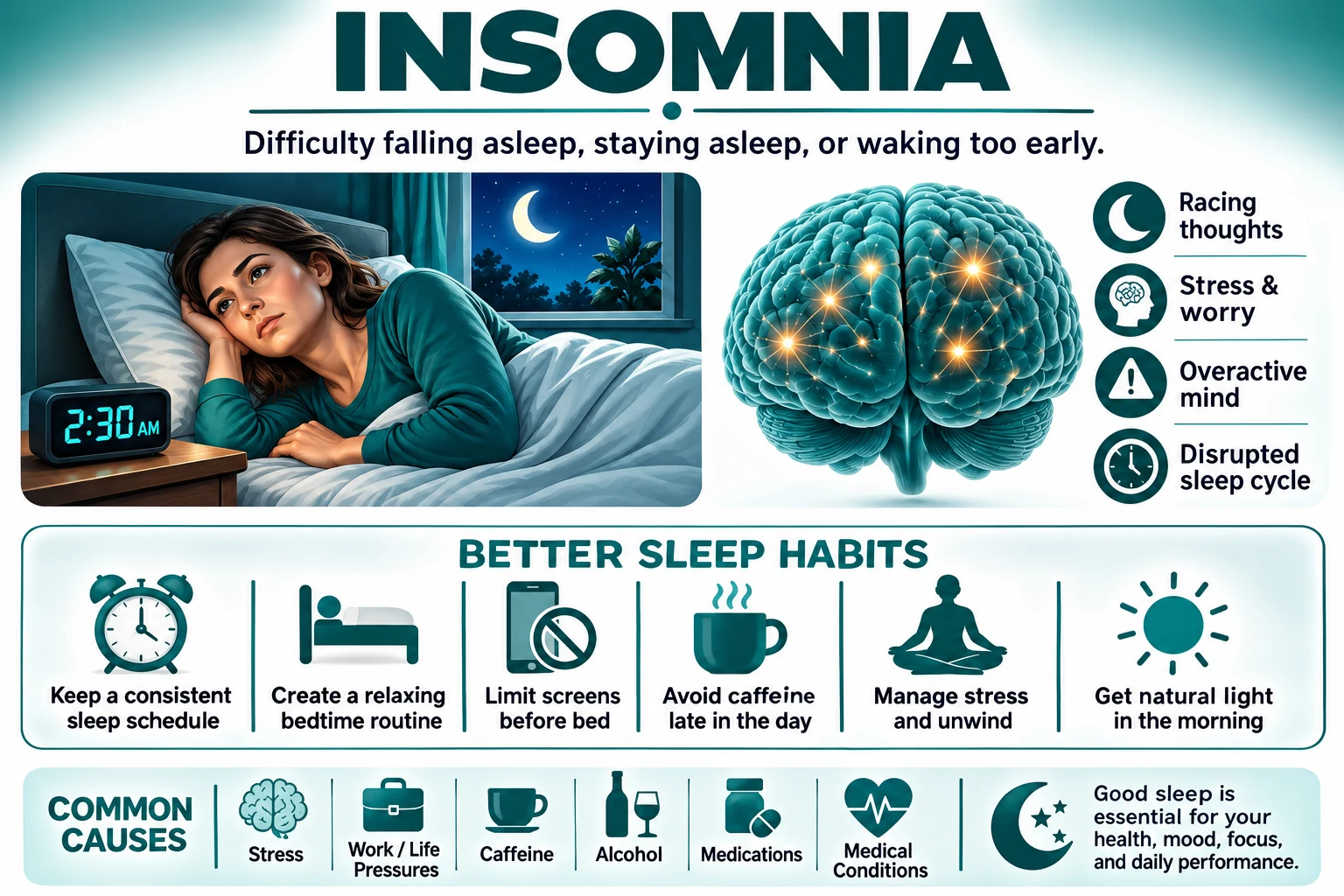
In short
Insomnia is persistent trouble falling asleep, staying asleep, or waking too early despite having adequate opportunity to sleep, along with daytime effects like fatigue, poor concentration, or mood changes. A few rough nights during a stressful week are common and usually resolve on their own; insomnia disorder specifically means the pattern has lasted at least three nights a week for three months or more. The current first-line treatment for chronic insomnia is cognitive behavioral therapy for insomnia (CBT-I), a structured behavioral approach, not simply "better sleep hygiene" or a sleeping pill.
Insomnia at a Glance
What Happens
Persistent difficulty falling asleep, staying asleep, or waking too early, despite having enough opportunity to sleep, with daytime effects like fatigue or poor concentration.
How Common
One of the most common sleep complaints in adults; a smaller share of people meet criteria for chronic insomnia disorder specifically.
How It Is Diagnosed
Primarily through clinical history, sleep patterns, and standardized questionnaires; a sleep study is not routinely needed unless another sleep disorder is also suspected.
How It Is Treated
Cognitive behavioral therapy for insomnia (CBT-I) is the current first-line approach; medication may be added or used short-term depending on the individual situation.
Key Takeaways
- Insomnia is a specific, definable pattern (trouble falling or staying asleep, at least three nights a week, for three months or more, with daytime impact), not just any bad night of sleep.
- Chronic insomnia disorder is different from simply not giving yourself enough time to sleep, and different from other conditions, like sleep apnea or a circadian rhythm problem, that can look similar.
- Cognitive behavioral therapy for insomnia (CBT-I) is the current first-line treatment, with a stronger long-term evidence base than medication alone.
- Medication has a real, individualized role in an insomnia treatment plan, but current guidance does not support it as the default long-term strategy on its own.
Symptoms
At Night
- Taking a long time to fall asleep
- Waking up frequently during the night
- Difficulty falling back asleep after waking
- Waking up earlier than intended and being unable to fall back asleep
- Lying awake worrying about not being able to sleep
During the Day
- Fatigue or low energy
- Difficulty concentrating or remembering things
- Irritability or low mood
- Reduced performance at work or school
- Anxiety specifically about sleep, or dread about bedtime
Could This Be Insomnia?
Is it insomnia if I only sleep poorly sometimes?
Not necessarily. Occasional bad nights, especially during a stressful period, are common and usually resolve without treatment. Chronic insomnia disorder specifically refers to trouble falling or staying asleep at least three nights a week for three months or more, along with daytime effects.
Could something else be causing my sleep trouble?
Possibly. Sleep apnea, restless legs syndrome, a circadian rhythm problem, certain medications, and untreated anxiety or depression can all look like insomnia or worsen it. Part of an insomnia evaluation is making sure one of these isn't the primary driver.
Do I have insomnia, or am I just not giving myself enough time to sleep?
These are different things, and the distinction matters. Insomnia is trouble sleeping despite adequate opportunity. Inadequate sleep opportunity, not setting aside enough time in bed for the sleep you need, can look identical during the day (fatigue, poor concentration) but the fix is different.
Is it just stress, or is it insomnia disorder?
Short-term insomnia triggered by an identifiable stressor is extremely common and often resolves as the stressor eases. It becomes chronic insomnia disorder when the pattern persists at least three nights a week for three months or longer, whether or not the original trigger is still present.
What Causes Insomnia?
Stress, Anxiety & Depression
Psychological factors are among the most common triggers and are frequently intertwined with insomnia in both directions, each capable of worsening the other.
Learned, Sleep-Interfering Habits
Irregular bed and wake times, extended time in bed while awake, and bedtime worry about sleep itself can develop after a triggering event and persist long after it resolves, sustaining insomnia on their own.
Medical Conditions & Medications
Chronic pain, certain respiratory or cardiac conditions, and some prescription and over-the-counter medications can directly interfere with sleep.
Substances
Caffeine, nicotine, and alcohol can each disrupt sleep continuity, even when consumed earlier in the day than a person might expect.
Circadian & Schedule Factors
Shift work, irregular schedules, and circadian rhythm problems can produce insomnia-like symptoms tied to a mismatch between sleep timing and the body's internal clock.
Hormonal Changes
Perimenopause and menopause are a recognized contributor for many women, related to hormonal shifts affecting sleep continuity.
Risk Factors
- Stress, anxiety, or depressionAmong the most common contributors, in both triggering and prolonging insomnia
- Irregular schedule or shift work
- Chronic pain or another medical condition that disrupts sleep
- Certain medications or substances, including caffeine, nicotine, alcohol, and some prescription drugs
- Female sex, particularly during perimenopause and menopauseHormonal changes are a recognized contributor during this period
- Older ageSleep architecture changes with age, though insomnia is not an inevitable or "normal" part of aging
- A personal or family history of insomnia
- Habits that work against sleep, such as irregular bed and wake times or extensive time in bed while awakeOften a consequence of insomnia as much as a cause, and a specific focus of CBT-I
Why Chronic Insomnia Matters
Daytime Function
Persistent poor sleep affects concentration, memory, mood, and reaction time, with real effects on work, relationships, and daily safety.
Mental Health
Insomnia and conditions like depression and anxiety frequently occur together and can each worsen the other, which is part of why addressing insomnia directly, not just treating it as a symptom of something else, matters.
A Self-Reinforcing Cycle
Worry about not sleeping, and habits adopted to try to force sleep, such as extra time in bed, can themselves prolong insomnia well past its original trigger. This is a central reason CBT-I specifically targets these patterns.
Long-Term Health Associations
Chronic insomnia is associated with, though not proven to directly cause, certain long-term health outcomes; the strength of this evidence varies by outcome, and individualized evaluation matters more than an isolated statistic.
When Should I Talk to a Sleep Specialist?
- Trouble falling asleep, staying asleep, or waking too early at least three nights a week for three months or more
- Daytime fatigue, poor concentration, or mood changes tied to poor sleep
- Sleep trouble alongside loud snoring, witnessed breathing pauses, or an urge to move the legs at night
- Insomnia that hasn't improved with basic sleep habit changes
- Relying on alcohol, over-the-counter sleep aids, or someone else's prescription medication to fall asleep
- Sleep problems occurring alongside new or worsening anxiety, depression, or chronic pain
What Is Insomnia?
A Common Complaint
Almost everyone has a rough night of sleep now and then, and a stretch of poor sleep during a stressful week is extremely common. Most of the time, this resolves on its own once the stressor eases, without ever becoming a lasting problem.
A Specific Disorder
Insomnia, as a diagnosis, refers to something more specific: persistent trouble falling asleep, staying asleep, or waking too early, despite having adequate opportunity to sleep, along with daytime effects like fatigue, difficulty concentrating, or low mood. When this pattern occurs at least three nights a week for three months or more, it is generally described as chronic insomnia disorder.
Insomnia vs. Insufficient Sleep
This distinction is genuinely useful, not a technicality, because the two are treated differently.
| Dimension | Insomnia | Insufficient Sleep Opportunity |
|---|---|---|
| The Core Problem | Difficulty sleeping despite adequate time set aside for it | Not enough time set aside for sleep in the first place |
| Time in Bed | Often normal or even extended, spent partly awake | Genuinely too short for the person’s sleep need |
| What Happens on a Day Off | Sleep difficulty can persist even with no schedule pressure | Sleep, and daytime function, often improve significantly with more opportunity |
| Typical Fix | CBT-I and, when appropriate, medication | A more realistic, consistent sleep schedule |
The two can also coexist, and distinguishing them, or recognizing both, is part of a proper evaluation rather than something to sort out alone.
What Kind of Sleep Problem Is This?
Not every persistent sleep complaint is chronic insomnia disorder, and getting this distinction right matters for choosing the right treatment.
Short-Term Insomnia
Trouble sleeping tied to an identifiable stressor, lasting less than three months. Often resolves as the stressor resolves, though it can become chronic if sleep-interfering habits take hold.
Chronic Insomnia Disorder
Trouble falling asleep, staying asleep, or waking too early, at least three nights a week, for three months or more, with daytime impact: whether or not the original trigger is still present.
Circadian Rhythm Problems
Sleep timing itself, not sleep ability, is misaligned with the desired schedule, such as in delayed sleep phase or shift work-related circadian disruption. Can look like insomnia but calls for a different approach.
Other Sleep Disorders
Obstructive sleep apnea, restless legs syndrome, and other conditions can produce insomnia-like symptoms or coexist with true insomnia, which a physician evaluation is meant to sort out.
How Is Insomnia Diagnosed?
Mostly a Clinical Diagnosis
Insomnia is usually diagnosed through a detailed clinical history: sleep patterns, timing, daytime effects, medical and psychiatric history, medication and substance use, and how long the pattern has lasted. Sleep diaries and standardized questionnaires often support this history. A sleep study is not routinely needed to diagnose insomnia itself.
When Additional Testing Is Considered
Testing, most often a home sleep test or in-lab sleep study, is considered when another sleep disorder, such as obstructive sleep apnea or restless legs syndrome, is also suspected as a contributing or coexisting condition, rather than as a routine part of every insomnia evaluation.
The Evaluation Pathway
- 01Sleep HistoryA physician reviews sleep timing, patterns, duration, and daytime effects, often supported by a sleep diary.
- 02Ruling Out MimicsMedical, psychiatric, medication, and substance-related causes, along with other sleep disorders, are considered.
- 03Pattern ConfirmationThe three-nights-a-week, three-month pattern (or a shorter-term equivalent) is confirmed against the history.
- 04Additional Testing, If NeededA sleep study is added only if another sleep disorder is also suspected, not as a routine step.
- 05Personalized TreatmentA treatment plan, generally starting with CBT-I, is built around the specific pattern and contributing factors.
Cognitive Behavioral Therapy for Insomnia (CBT-I)
CBT-I is a structured, evidence-based behavioral therapy, and current sleep medicine guidance identifies it as the first-line treatment for chronic insomnia disorder, ahead of medication alone.
Stimulus Control
Rebuilds the association between the bed and sleep, generally by getting up if unable to sleep after a period rather than lying awake trying.
Sleep Restriction Therapy
Temporarily consolidates time in bed to more closely match actual sleep time, then gradually expands it, to strengthen sleep drive.
Cognitive Techniques
Addresses anxious or unhelpful thoughts about sleep itself, which often become part of what sustains insomnia over time.
CBT-I is typically delivered over several sessions, in person, by phone, or through a structured digital program, by a clinician trained in the approach. It is a genuinely active therapy that asks something of the patient between sessions, not a single piece of advice or a handout.
Where Medication Fits
Medication is not a fringe or discouraged option, but current guidance is specific about how it fits alongside CBT-I rather than replacing it. A newer AASM guideline on combination treatment, CBT-I started together with medication, gives two conditional recommendations that add up to an evidence-supported order of preference:
- CBT-I alone is generally preferred over combination treatment, for most patients.
- Combination treatment (CBT-I started together with medication) is generally preferred over medication alone.
- Medication alone sits last in this preference order, though it still has a real, individualized role.
An important caveat applies here too: patients who place high value on faster or more pronounced early improvement in sleep duration may reasonably choose combination treatment instead. The right choice for a given patient is still an individualized discussion, not a fixed rule.
Sleep medication itself is not one thing: different classes work through different mechanisms and carry different considerations around dependency, tolerance, and next-day effects, covered further under Treatment Options below. This page intentionally does not present a simplified list of pills to choose from, since that framing does not reflect how insomnia medication is actually selected in practice.
Building Sustainable Sleep Habits
Several supporting habits are genuinely useful, and several overlap directly with CBT-I’s own techniques:
- A consistent wake time
- Limiting caffeine and alcohol, especially later in the day
- A comfortable, dark sleep environment
- Getting out of bed if unable to sleep, rather than lying awake trying
Current guidance is clear, though, that habit changes alone, absent the fuller structure of CBT-I, are generally not an adequate treatment for chronic insomnia disorder once it is established. Think of good sleep habits as a foundation CBT-I builds on, not a substitute for it.
When Insomnia Occurs Alongside Another Condition
Insomnia frequently occurs alongside anxiety, depression, chronic pain, or another medical condition. For a long time, the working assumption in medicine was that this kind of insomnia was simply a symptom of the other condition, expected to resolve once that condition was treated.
Current understanding treats this differently: insomnia occurring alongside another condition, sometimes called comorbid insomnia, is generally treated as its own target for direct treatment, in parallel with managing the other condition, rather than something to simply wait out.
In practice, this means a patient with, for example, well-managed anxiety who still has chronic insomnia is still a reasonable candidate for CBT-I specifically for the insomnia, not just further anxiety treatment. This matters because insomnia and conditions like depression and anxiety can reinforce each other; treating both, rather than assuming one will resolve the other, tends to produce better outcomes for both.
What to Expect From a CBT-I Program
Patients considering CBT-I sometimes picture a single conversation about better habits. In practice, it is closer to a structured, several-week program:
- An initial detailed assessment of your specific sleep pattern
- Often a week or two of sleep-diary tracking to establish an accurate baseline
- Active work on stimulus control and sleep restriction, adjusted session to session based on your progress
- Cognitive techniques addressing sleep-related worry, as it comes up
Early weeks can temporarily involve less time in bed and, for some patients, slightly more daytime sleepiness as sleep restriction takes effect. This is a normal, time-limited part of the process a trained clinician will walk you through, not a sign that it isn’t working.
Insomnia Care at VitalAir
Sleep testing is part of how VitalAir works through an insomnia evaluation when another sleep disorder, such as obstructive sleep apnea, is also a possibility. Patients whose sleep trouble persists despite reasonable habit changes, or who wonder whether daytime fatigue reflects something other than insomnia, may also find this guide on unexplained daytime tiredness useful context before their visit.
VitalAir evaluates and manages insomnia for patients across Frisco, North Dallas, and the broader North Texas area, following the same evaluation pathway and treatment approach, including CBT-I, described above. The clinical information on this page applies to patients everywhere; what differs locally is simply where that evaluation and follow-up care happens.
Insomnia Care in Frisco, Texas
VitalAir Sleep & Lung Center evaluates and manages insomnia for patients across Frisco, Texas, and the broader North Dallas area, typically beginning with a detailed sleep history and building a treatment plan around CBT-I as first-line care. The clinical information on this page applies to patients everywhere; what differs locally is simply where that evaluation and follow-up care happens.
Patient Questions
What is the difference between insomnia and just not sleeping enough?
Insomnia is difficulty falling or staying asleep despite having adequate opportunity to sleep. If someone consistently only allows themselves five or six hours in bed, poor daytime function from that inadequate opportunity can look similar to insomnia, but the underlying problem, and the fix, are different. A physician can help sort out which pattern actually fits.
How long does insomnia have to last to be a real disorder?
Chronic insomnia disorder is generally defined as trouble falling asleep, staying asleep, or waking too early, occurring at least three nights a week, for at least three months, along with daytime impact. Shorter-lasting sleep trouble, often tied to a specific stressor, is usually called short-term insomnia and frequently resolves on its own.
Is CBT-I better than sleeping pills?
Current sleep medicine guidance identifies CBT-I as the first-line treatment for chronic insomnia disorder, with a stronger long-term evidence base than medication alone. That does not mean medication has no role. For some patients, starting CBT-I together with medication is a reasonable, evidence-supported choice, particularly when faster early improvement matters to them; this is a conversation to have individually with a physician.
What actually happens in CBT-I?
CBT-I is a structured program, typically delivered over several sessions, that usually combines techniques like stimulus control (rebuilding the bed's association with sleep), sleep restriction therapy (temporarily consolidating time in bed to strengthen sleep drive), and cognitive techniques addressing anxious thoughts about sleep. It is an active, skills-based therapy, not a single piece of advice.
Can insomnia be caused by another sleep disorder?
Yes. Obstructive sleep apnea, restless legs syndrome, and circadian rhythm disorders can each produce insomnia-like symptoms or make insomnia harder to treat if left unaddressed. This is one reason a physician evaluation, rather than self-diagnosis, matters when insomnia is persistent.
Will improving my sleep hygiene cure my insomnia?
Good sleep habits, consistent schedule, limiting caffeine and alcohol, a comfortable sleep environment, are a reasonable foundation, but current guidance does not consider sleep hygiene alone an adequate treatment for chronic insomnia disorder. CBT-I addresses the behavioral and cognitive patterns that sustain insomnia more directly and comprehensively.
Are sleep medications safe to use long-term?
This depends heavily on the specific medication and the individual patient. Some carry dependency or tolerance risk with prolonged use; others have different considerations, including next-day effects. Current guidance generally does not support open-ended medication as the default long-term strategy for chronic insomnia, which is part of why CBT-I is emphasized as the first-line approach. Any medication plan should be reviewed periodically with your physician.
Can insomnia go away on its own?
Short-term insomnia tied to an identifiable stressor often does improve as that stressor resolves. Chronic insomnia disorder, once the pattern and its sustaining habits are established, is less likely to resolve completely without active treatment, which is why evaluation is worthwhile once the three-nights-a-week, three-month pattern is met.
Does alcohol help with insomnia?
Alcohol can make falling asleep feel easier but tends to fragment sleep and worsen sleep quality later in the night, often making insomnia worse overall rather than better. It is not a recommended insomnia treatment.
When should I see a doctor about insomnia?
Reasonable prompts include insomnia lasting three months or more, daytime effects that are affecting work, safety, or relationships, sleep trouble alongside snoring or leg discomfort at night, or relying on alcohol or someone else's medication to fall asleep. A physician can help distinguish chronic insomnia disorder from other sleep or medical conditions and build an appropriate treatment plan.
Sources
Guidelines and Professional Societies
- Edinger JD, et al. Behavioral and Psychological Treatments for Chronic Insomnia Disorder in Adults, An American Academy of Sleep Medicine Clinical Practice Guideline. Journal of Clinical Sleep Medicine, 2021.View source
- American Academy of Sleep Medicine. Combination Treatment for Chronic Insomnia Disorder in Adults, An American Academy of Sleep Medicine Clinical Practice Guideline. Journal of Clinical Sleep Medicine, 2026.
- Mayo Clinic. Insomnia, Symptoms and Causes.View source
Government and Regulatory Sources
- National Heart, Lung, and Blood Institute. What Is Insomnia?View source