Testing & Diagnosis
Medically reviewed by Varun Halani, MD · August 12, 2026
FeNO Testing
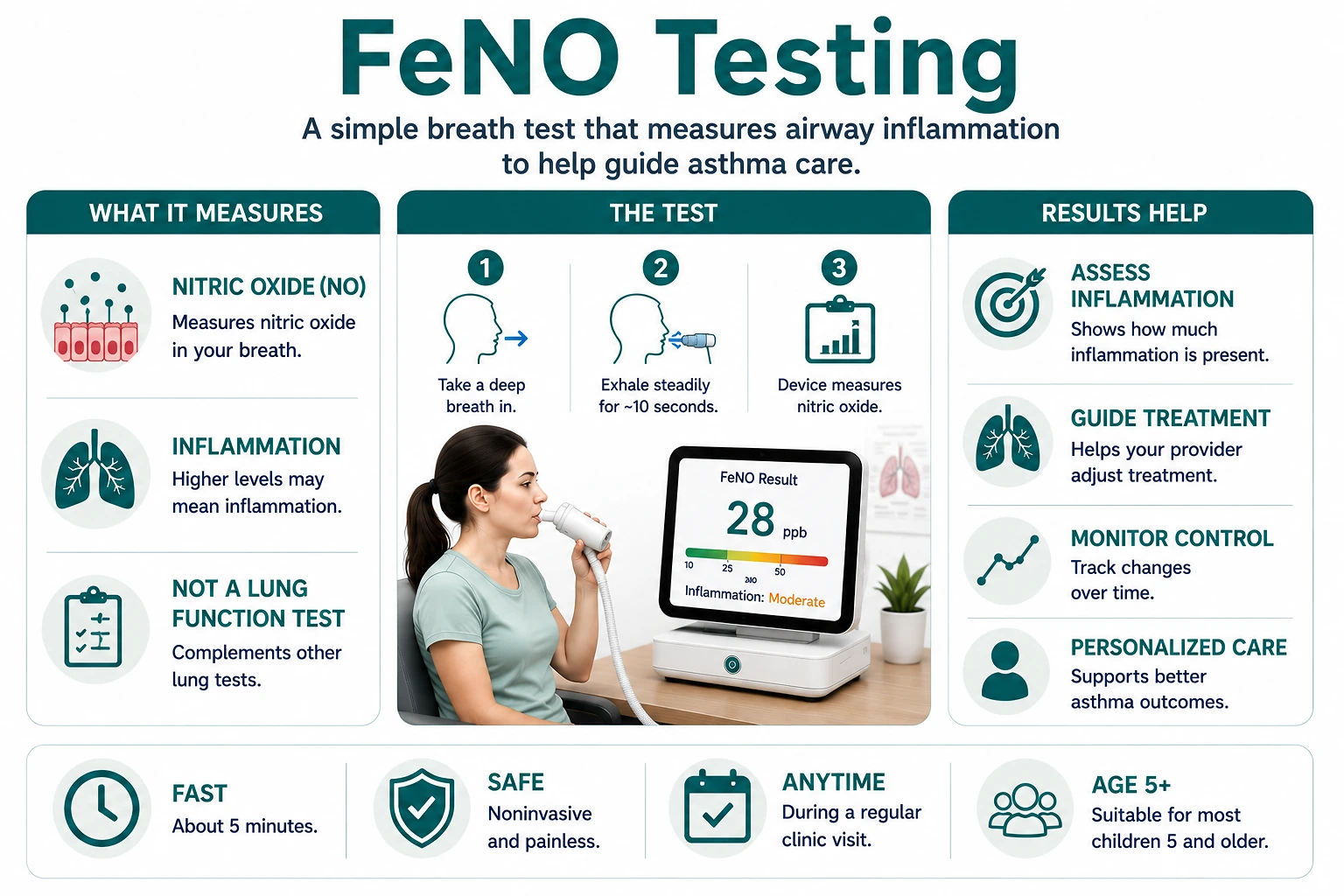
FeNO testing is a simple breath test that measures nitric oxide in exhaled air as a marker of airway inflammation, most often used alongside other information when evaluating possible asthma.
In short
FeNO testing is a simple breath test that measures the level of nitric oxide gas in your exhaled breath, which can reflect a type of airway inflammation common in many people with asthma. It is used as one supporting piece of evidence alongside symptoms, history, and other tests like spirometry, not as a standalone way to diagnose or rule out asthma.
At a Glance
What It Measures
The concentration of nitric oxide gas in exhaled breath, used as a marker of a specific type of airway inflammation.
Why It Is Ordered
To provide supporting information when evaluating possible asthma, and sometimes to help inform decisions about anti-inflammatory treatment.
What to Expect
A quick, non-invasive breath test: you exhale steadily into a device at a controlled rate for about 10 seconds.
What Results May Mean
Results are interpreted alongside symptoms, history, and other testing: a normal result does not rule out asthma, and a high result does not confirm it on its own.
Key Takeaways
- FeNO testing measures nitric oxide gas in exhaled breath as a marker of a type of airway inflammation often called "type 2" or eosinophilic inflammation.
- FeNO is a supporting tool, not a standalone diagnostic test: a normal FeNO does not rule out asthma, and an elevated FeNO does not by itself confirm it.
- Results are most useful when interpreted together with symptoms, medical history, and other tests such as spirometry.
- FeNO can sometimes help inform whether inhaled corticosteroid treatment is likely to help, and some clinicians use it to help monitor response to anti-inflammatory therapy over time.
- Several factors unrelated to asthma control can affect FeNO levels, including smoking, recent corticosteroid use, and allergic or atopic inflammation.
- The test itself is simple and non-invasive: it involves exhaling steadily into a device for about 10 seconds, with no needles or discomfort.
What FeNO Testing Measures
FeNO stands for fractional exhaled nitric oxide. It is a simple breath test that measures the level of nitric oxide gas present in the air you exhale. Nitric oxide is a naturally occurring gas in the body, and its concentration in exhaled breath tends to rise with a specific type of airway inflammation (often referred to as “type 2” or eosinophilic inflammation) that is common in many, though not all, people with asthma.
In plain terms, FeNO gives physicians a window into a particular kind of inflammatory activity in the airways, without the need for more invasive testing. It does not measure airflow, lung capacity, or lung damage directly; those are assessed by other tools, such as pulmonary function testing.
FeNO vs. Spirometry
FeNO and spirometry are often used together during an asthma evaluation, but they measure fundamentally different things. The table below summarizes how each one contributes to the picture.
| Dimension | FeNO | Spirometry |
|---|---|---|
| What It Measures | Nitric oxide gas, a marker of a type of airway inflammation | Airflow and lung function |
| What It Doesn't Show | Airflow, lung capacity, or lung damage | The type of inflammation driving symptoms |
| Role in an Asthma Evaluation | One piece of supporting evidence, alongside symptoms and history | A core objective measure, typically interpreted together with FeNO and clinical history |
The Type 2 Inflammation Connection, in Plain Terms
Asthma is not a single, uniform condition: different people can have airway inflammation driven by different underlying processes. One common pattern, often described as type 2 or eosinophilic inflammation, involves a set of immune signals that, among other effects, increase the amount of nitric oxide produced in the airway lining. This is why measuring exhaled nitric oxide can serve as an indirect marker for this type of inflammation.
This explanation is intentionally kept at a conceptual level; the detailed immunology of type 2 inflammation is a matter for your physician to discuss as it applies to your specific situation. The key practical point is that elevated FeNO can reflect a pattern of airway inflammation relevant to asthma care for many patients.
FeNO’s Role in Asthma Evaluation
When a physician is evaluating possible asthma, FeNO adds one piece of supporting evidence to a picture built from your symptoms (such as wheeze, cough, or shortness of breath), a physical exam, medical history, and spirometry. It is best understood as an adjunct tool that adds useful context to a thorough evaluation, not a shortcut that replaces one.
FeNO Is Not a Standalone Diagnostic Test
This is one of the most important things to understand about FeNO testing: it is not a standalone diagnostic test for asthma. A normal FeNO result does not rule out asthma. Some people with asthma have forms of airway inflammation that FeNO does not capture well. Likewise, an elevated FeNO result does not, by itself, confirm an asthma diagnosis, since other conditions and factors can also raise nitric oxide levels.
Because of this, FeNO results are always interpreted together with your symptoms, medical history, other testing, and clinical judgment. If you have questions about what your specific FeNO result means, that conversation belongs with the physician who ordered the test.
Using FeNO to Help Guide Treatment
Beyond diagnosis, FeNO measurements can sometimes help inform whether inhaled corticosteroid therapy is likely to be helpful for a given patient, since this type of medication targets the inflammation that FeNO reflects. Some clinicians also use FeNO over time as one way to help monitor how well a patient is responding to anti-inflammatory treatment.
This use is appropriately hedged rather than universal: not every clinician uses FeNO this way, and it is one tool among several that may inform treatment decisions, rather than a fixed protocol applied the same way to every patient.
Limitations and Factors That Affect Results
FeNO levels can be affected by a number of factors that are unrelated to how well-controlled a person’s asthma is, which is why results always need clinical context.
Smoking
Known to lower FeNO levels, sometimes making it harder to interpret results in people who currently smoke.
Recent Corticosteroid Use
Inhaled or oral corticosteroids also tend to lower FeNO, since these medications reduce the underlying inflammation being measured.
Allergic or Atopic Inflammation
Can raise FeNO even in people who do not have asthma, since the type of inflammation FeNO reflects is not exclusive to asthma.
Because of these influences, a FeNO result is never read in isolation: your physician will factor in your smoking status, current medications, and any allergic conditions when interpreting what a given number means for you.
What the Test Feels Like
FeNO testing is simple and non-invasive. You breathe out steadily into a small handheld device or mouthpiece at a controlled, even rate for about 10 seconds, similar in feel to a breathalyzer test. There are no needles, no discomfort, and no recovery time needed. The entire breathing portion typically takes less than a minute, and the full visit, including setup and instructions from your care team, usually takes just a few minutes.
How Results Are Interpreted
A FeNO result is one data point that your physician weighs together with your full clinical picture: your reported symptoms, physical exam findings, medical history, and results from other tests such as spirometry. It is not a number meant to be interpreted on its own, and it should not be used to self-diagnose or self-manage asthma. If FeNO testing is part of your evaluation, your physician will explain how your result fits into the broader assessment and what, if anything, it means for next steps in your care.
Patient Questions
What does FeNO testing measure?
FeNO testing measures the concentration of nitric oxide gas in your exhaled breath. Nitric oxide levels can rise with a specific type of airway inflammation, often called type 2 or eosinophilic inflammation, that is common in many people with asthma.
Does FeNO testing hurt?
No. FeNO testing is non-invasive and involves no needles. You simply breathe out steadily into a mouthpiece connected to a small device, similar to a breathalyzer.
How do I prepare for a FeNO test?
Your care team may ask you to avoid smoking, certain foods, or specific medications for a period before the test, since these can affect results. Follow the specific instructions you are given, since they may vary based on why the test is being ordered.
Can a high FeNO result confirm that I have asthma?
Not by itself. An elevated FeNO level is one piece of supporting evidence that can be consistent with a type of airway inflammation common in asthma, but it is interpreted together with your symptoms, history, and other tests rather than used alone to make a diagnosis.
If my FeNO result is normal, does that mean I don't have asthma?
Not necessarily. A normal FeNO result does not rule out asthma. Some people with asthma do not have the type of inflammation that FeNO reflects, so a normal result is just one data point among several your physician will consider.
Does smoking affect FeNO results?
Yes. Smoking is known to lower FeNO levels, which can make results harder to interpret in people who currently smoke. Your physician will take smoking history into account when reviewing your results.
How is FeNO testing used alongside spirometry?
FeNO and spirometry measure different things: FeNO reflects a type of airway inflammation, while spirometry measures airflow. Used together with your symptoms and history, they can give a more complete picture during an asthma evaluation than either test alone.
Is FeNO testing used to monitor asthma treatment?
It can be. Some clinicians use FeNO measurements over time to help inform whether inhaled corticosteroid therapy is likely to help, or to help monitor response to anti-inflammatory treatment, though this approach is not used the same way for every patient.
What else can affect FeNO levels besides asthma?
FeNO can be influenced by factors unrelated to asthma control, including smoking, recent use of inhaled or oral corticosteroids, and allergic or atopic inflammation in general, which can raise FeNO even in people without asthma. This is why results need to be interpreted in clinical context.
How long does a FeNO test take?
The breathing portion of the test itself typically takes less than a minute: you exhale steadily into the device for about 10 seconds at a controlled rate. The full visit, including setup and instructions, usually takes just a few minutes.
Sources
Guidelines and Professional Societies
- American Thoracic Society Clinical Practice Guideline — Interpretation of Exhaled Nitric Oxide Levels for Clinical Applications.
- European Respiratory Society — technical standards and clinical applications of exhaled nitric oxide measurement.
- Global Initiative for Asthma — role of FeNO and other supportive tools in asthma assessment.
Government and Regulatory Sources
- National Heart, Lung, and Blood Institute — patient guidance on asthma diagnosis and evaluation tools.