Testing & Diagnosis
Medically reviewed by Varun Halani, MD · August 13, 2026
DLCO (Diffusing Capacity) Testing
A breathing test that measures how well oxygen moves from the lungs' air sacs into the bloodstream.
In short
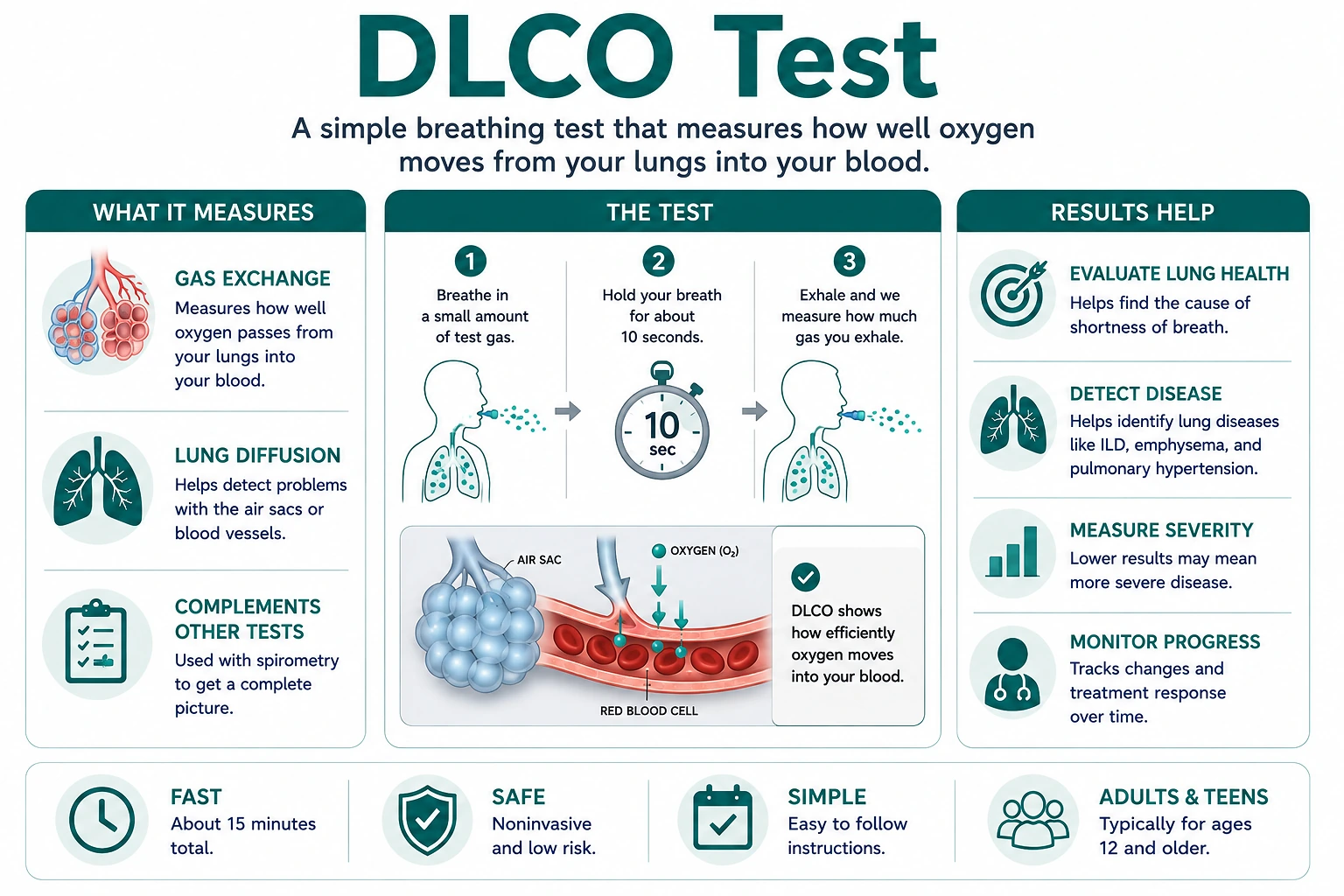
DLCO, or diffusing capacity, is a breathing test that measures how efficiently oxygen moves from the tiny air sacs in the lungs into the bloodstream. It uses a trace, medically safe amount of carbon monoxide as a tracer gas and is typically performed as part of a complete pulmonary function testing session, not as a stand-alone test.
At a Glance
What It Measures
How efficiently gas transfers from the lungs' air sacs into the bloodstream, a distinct question from how much or how fast air moves.
Why It Is Ordered
To help evaluate conditions affecting lung tissue or lung blood vessels, often alongside spirometry and lung volumes.
What to Expect
A single deep breath of a gas mixture containing a trace amount of carbon monoxide, briefly held, then exhaled.
What Results May Mean
Reported as a percentage of predicted normal and interpreted as part of a broader clinical picture, not as a stand-alone number.
Key Takeaways
- DLCO measures gas transfer (how efficiently oxygen moves from the lungs' air sacs into the bloodstream), a distinct question from how much or how fast air moves.
- The test uses an extremely small, medically safe trace amount of carbon monoxide as a tracer gas for technical reasons, not because that amount is clinically meaningful.
- Reduced DLCO can reflect loss of alveolar surface area, as in emphysema, or thickening and scarring of lung tissue, as in interstitial lung disease.
- DLCO can also be reduced in conditions affecting the lungs' blood vessels, such as pulmonary hypertension, since gas transfer depends on blood flow as well as tissue integrity.
- DLCO results can be affected by hemoglobin and anemia status and are often mathematically corrected for hemoglobin level.
- DLCO is typically ordered as part of a complete pulmonary function testing session alongside spirometry and lung volumes, not usually as a stand-alone test.
What DLCO Measures
What It Measures
DLCO, short for diffusing capacity of the lungs for carbon monoxide, evaluates a specific and conceptually distinct part of lung function: how efficiently oxygen moves from the tiny air sacs in the lungs, called alveoli, into the bloodstream. This is a different question from the one answered by spirometry and lung volume testing, which measure how much air the lungs can hold and how quickly air moves in and out.
Two Separate Physiological Questions
DLCO instead asks how well the lungs actually accomplish gas exchange once air has arrived in the alveoli. These are genuinely separate physiological processes: some people have normal airflow and normal total lung capacity yet still have reduced gas transfer, and conversely, some conditions that reduce gas transfer have relatively little effect on how much or how fast air moves.
DLCO fills in this part of the picture, giving a more complete profile when combined with the other components described on the pulmonary function testing page.
Two Jobs, Two Measurements
The lungs perform two related but separate jobs, and DLCO is built to isolate the second one.
Moving Air
The first job is mechanical: moving air in and out through the airways, which is what spirometry and lung volumes assess.
Transferring Gas
The second job is physiological: transferring oxygen across the thin tissue barrier between the air sacs and the tiny surrounding blood vessels, called capillaries, so oxygen can bind to hemoglobin and be carried to the rest of the body. DLCO measures how well this second job is working.
Several things can interfere with this second job even when the first job, moving air, is working fine:
- Reduced surface area: less alveolar tissue is available for oxygen to cross into the blood
- Thickened or scarred tissue: the barrier oxygen must cross becomes slower and less efficient
- Reduced blood flow: less blood passes through the capillaries to carry oxygen away
DLCO testing is designed to detect a reduction in this overall gas-transfer process, though it does not by itself distinguish which of these underlying mechanisms is responsible. That determination depends on the broader clinical picture.
How the Test Works: The Carbon Monoxide Principle
DLCO testing uses carbon monoxide as a tracer gas, which can understandably raise a question for patients: is that safe? The answer is yes. The amount used is extremely small and is mixed with other gases for a single test breath.
Carbon monoxide is chosen for technical reasons: it binds readily and predictably to hemoglobin in the blood, which makes its uptake from a single breath precisely measurable using specialized testing equipment. The trace amount used is not clinically meaningful and is not a health concern; it is a measurement tool, not a treatment or exposure of any real consequence.
What Happens During the Test
- 01Inhale the Gas MixtureYou take a single deep breath of a gas mixture containing a trace, safe amount of carbon monoxide.
- 02Hold Your BreathYou hold your breath briefly, typically around ten seconds.
- 03ExhaleYou exhale, and the equipment measures how much tracer gas was absorbed compared to how much was inhaled.
- 04Result CalculatedThe amount absorbed is compared against predicted normal values and, over time, against your own prior results.
The more efficiently your lungs transfer gas into the bloodstream, the more of the tracer gas is absorbed during the breath-hold. This single-breath technique is standardized so results can be compared meaningfully across visits.
How Results Are Interpreted
DLCO results are reported as a percentage of a predicted normal value, calculated using factors such as your age, sex, height, and sometimes race or ethnicity, the same general approach used for other pulmonary function measurements like spirometry and lung volumes. A result within the expected range suggests gas transfer is functioning normally, while a result below the expected range suggests some degree of impaired gas exchange.
As with every other component of pulmonary function testing, a DLCO result is meaningful as part of an overall pattern, not as a stand-alone number. The same percentage-of-predicted value can arise from very different underlying processes, and DLCO alone cannot tell you which one applies to you.
This is why DLCO is always interpreted by a physician together with your symptoms, your other pulmonary function testing results, your medical history, and sometimes imaging studies, never as an isolated figure to be read on its own.
What Can Lower DLCO
DLCO can be reduced by several distinct underlying processes, each explored in more detail below.
Common Causes of a Reduced DLCO
Emphysema
Destruction of the walls between alveoli reduces the total surface area available for oxygen to cross into the bloodstream.
Interstitial Lung Disease
Thickening, inflammation, or scarring of lung tissue slows and reduces gas transfer across the barrier oxygen must cross.
Pulmonary Vascular Disease
Reduced blood flow through the lungs' capillary network limits how much oxygen can be carried away, even when lung tissue is unaffected.
Anemia
Lower-than-normal hemoglobin reduces how much tracer gas is taken up, independent of the lungs' tissue or blood vessels.
Low DLCO From Changes in Lung Tissue
Emphysema
A reduced DLCO is a classic and well-recognized finding in emphysema. Emphysema involves progressive destruction of the walls between alveoli, which reduces the total surface area available for oxygen to cross into the bloodstream.
Because DLCO is sensitive to exactly this kind of surface-area loss, it is often reduced in emphysema even when airflow measurements on spirometry are only mildly affected, adding useful information beyond spirometry alone.
Interstitial Lung Disease
DLCO is also classically reduced in interstitial lung disease, a category of conditions involving thickening, inflammation, or scarring of the lung tissue itself. Because gas has to cross that tissue to reach the bloodstream, thickened or scarred tissue slows and reduces gas transfer.
In some forms of interstitial lung disease, a reduced DLCO can be detected before other pulmonary function measurements, such as lung volumes, show a clear abnormality, which is one reason DLCO is often included when interstitial lung disease is being evaluated or monitored.
Low DLCO Beyond the Lung Tissue Itself
Pulmonary Vascular Disease
Gas transfer does not depend on lung tissue alone: it also depends on adequate blood flow through the lungs’ capillary network. Conditions that affect the lungs’ blood vessels, such as pulmonary hypertension, can therefore also reduce DLCO, even when the surrounding lung tissue itself is relatively unaffected.
This is an important reason DLCO is considered a gas-exchange measurement rather than purely a tissue measurement: a reduced result can point toward a tissue problem, a blood-flow problem, or some combination of the two, which is part of why the result requires clinical interpretation rather than a simple lookup.
Anemia and Hemoglobin
DLCO results can also be influenced by factors that have nothing to do with the structure of the lungs themselves. Because the test’s measurement depends on how much of the trace carbon monoxide is taken up and bound by hemoglobin in the blood, the amount of hemoglobin available matters.
Anemia, a condition involving lower-than-normal hemoglobin, can reduce the measured uptake of the tracer gas and produce a lower DLCO result even when the lungs’ gas-exchange surfaces and blood vessels are otherwise normal.
For this reason, DLCO results are often mathematically corrected for a patient’s hemoglobin level, so the reported value more accurately reflects lung function rather than blood composition. Your physician’s office may ask about or check your hemoglobin level around the time of testing for this reason.
Why Results Require Clinical Context
It bears repeating clearly: patients should not attempt to self-diagnose a specific lung condition from an isolated DLCO number. A low DLCO can arise from loss of alveolar surface area, tissue thickening or scarring, reduced blood flow through the lungs, low hemoglobin, or some combination of these, among other possibilities. The number alone does not distinguish between them.
Reaching a diagnosis requires a physician to weigh your DLCO result together with your reported symptoms, your other pulmonary function testing components, your medical history, and sometimes imaging studies such as a chest CT. If you have questions about what your own DLCO result means, that conversation belongs with the physician who ordered your testing.
Relationship to Full Pulmonary Function Testing
DLCO is typically ordered as part of a complete pulmonary function testing session, performed alongside spirometry and lung volume measurement, rather than as a stand-alone test.
Combining all three components gives a physician a fuller picture: spirometry describes airflow, lung volumes describe overall lung capacity, and DLCO describes how well gas actually transfers once air has reached the alveoli.
Ordering DLCO in isolation is less common and is generally reserved for specific situations identified by your physician, such as monitoring a previously diagnosed condition where gas transfer is the primary measurement of interest.
Patient Questions
What does DLCO stand for?
DLCO stands for diffusing capacity of the lungs for carbon monoxide. It is often simply called diffusing capacity or diffusion capacity, and the test measures how efficiently gas moves from the lungs' air sacs into the bloodstream.
Is the carbon monoxide used in a DLCO test dangerous?
No. The test uses an extremely small, medically safe trace amount of carbon monoxide mixed with other gases for a single breath. This amount is chosen for technical reasons related to how precisely its uptake can be measured, not because it is clinically meaningful, and it is not a health concern.
How is DLCO different from spirometry?
Spirometry measures how much air you can forcefully move in and out of your lungs and how quickly. DLCO measures a different question entirely: how efficiently oxygen actually crosses from the air sacs into your bloodstream. Airflow and lung volume can be entirely normal while gas transfer is reduced.
What does a low DLCO result mean?
A low DLCO can reflect several different underlying processes, including loss of alveolar surface area, thickening or scarring of lung tissue, or reduced blood flow through the lungs' blood vessels. It is not specific to one condition, which is why it must be interpreted alongside your symptoms, other test results, and sometimes imaging.
Can I self-diagnose a lung condition from my DLCO number?
No. A DLCO result should never be used to self-diagnose a specific lung condition. It is one piece of a broader clinical evaluation, and a physician interprets it together with your symptoms, other pulmonary function testing components, and sometimes imaging before drawing any conclusions.
Why is DLCO reduced in emphysema?
Emphysema involves loss and destruction of alveolar walls, which reduces the total surface area available for oxygen to cross into the bloodstream. This loss of surface area is reflected as a reduced DLCO, a classic finding in emphysema.
Why is DLCO reduced in interstitial lung disease?
Interstitial lung disease involves thickening and scarring of the lung tissue that oxygen must cross to reach the bloodstream. This makes gas transfer less efficient, and DLCO is classically reduced, sometimes before other pulmonary function measurements change.
Can DLCO be reduced without any lung tissue disease?
Yes. Because gas transfer depends on blood flow through the lungs' capillaries as well as tissue integrity, conditions affecting the lungs' blood vessels, such as pulmonary hypertension, can also reduce DLCO.
Does anemia affect DLCO results?
Yes. DLCO uptake depends partly on how much hemoglobin is available to bind the trace tracer gas, so hemoglobin and anemia status can influence the result. For this reason, DLCO results are often mathematically corrected for hemoglobin level.
Is DLCO usually performed on its own?
Not typically. DLCO is usually ordered as one component of a complete pulmonary function testing session, alongside spirometry and lung volume measurement, rather than as a stand-alone test.
How is a DLCO result reported?
Like other pulmonary function measurements, DLCO is reported as a percentage of the predicted normal value based on factors such as age, sex, and height, and is interpreted as part of an overall pattern rather than as a single isolated number.
Sources
Guidelines and Professional Societies
- ATS/ERS technical standards for single-breath carbon monoxide uptake in the lung (diffusing capacity).
- European Respiratory Society — standardization of the measurement of lung diffusing capacity.
- American College of Chest Physicians — clinical use and interpretation of diffusing capacity testing.
Government and Regulatory Sources
- National Heart, Lung, and Blood Institute — patient guidance on lung function testing and gas exchange.