Sleep Medicine
Medically reviewed by Varun Halani, MD · August 12, 2026
Central Sleep Apnea
A form of sleep apnea in which breathing repeatedly pauses because the brain's respiratory drive temporarily decreases or stops, rather than because the upper airway physically narrows or closes.
In short
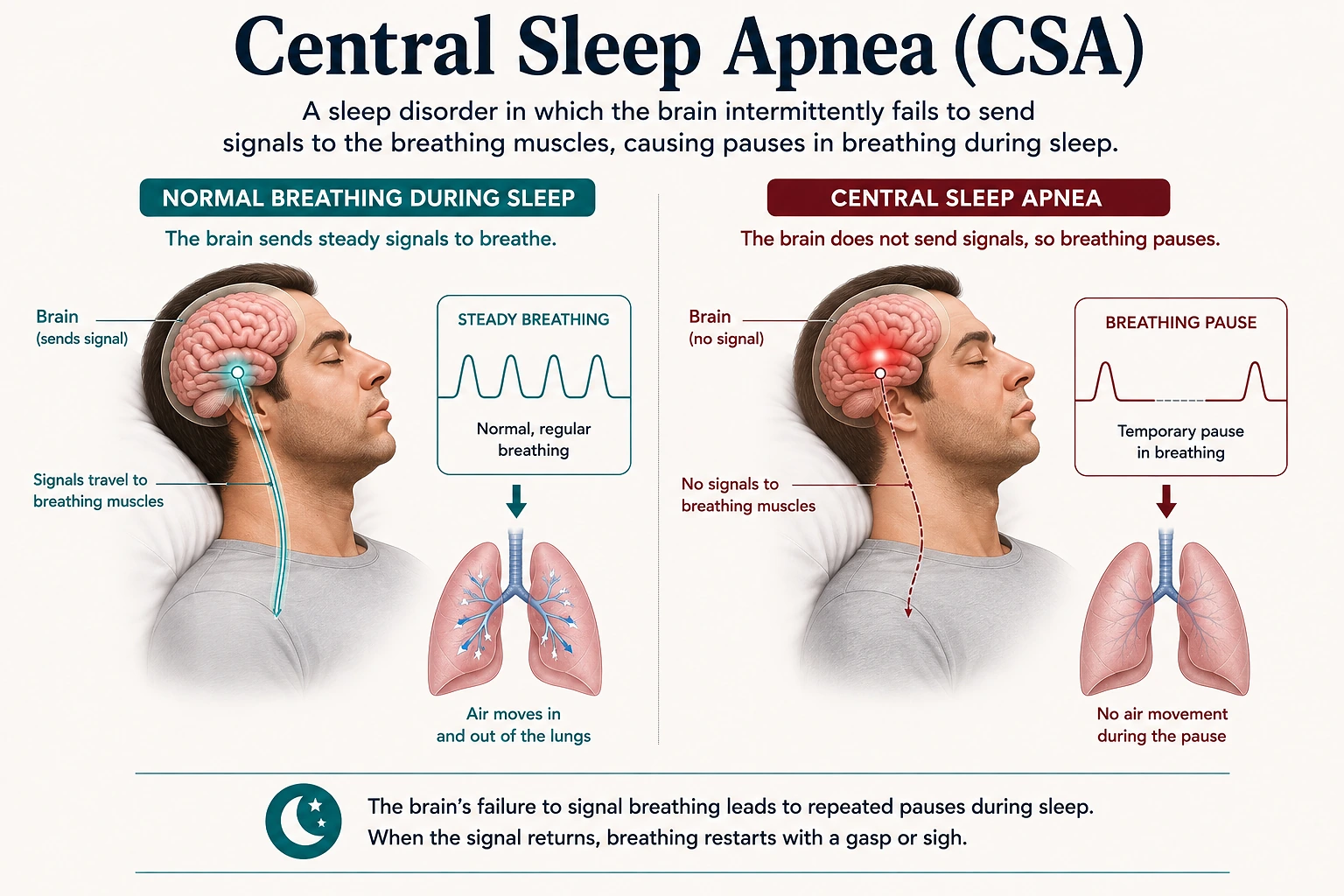
Central sleep apnea happens when the brain's signal to breathe repeatedly weakens or pauses during sleep, so breathing effort itself stops for a stretch, rather than the airway becoming physically blocked as in obstructive sleep apnea. The two can look similar to a bed partner but are physiologically distinct, and some people have both at once. Identifying the specific cause, most often a heart, medication, or altitude-related factor, is central to choosing the right treatment.
Central Sleep Apnea at a Glance
What Happens
Breathing effort itself repeatedly weakens or pauses during sleep because the brain's respiratory drive falters, rather than the airway becoming physically blocked.
Common Causes
Heart failure, opioid or other medication use, recent CPAP therapy, high altitude, and certain neurological conditions are among the most clinically important causes.
How It Is Diagnosed
An in-lab sleep study is generally preferred over a home sleep test, since it directly measures breathing effort and can reliably distinguish central from obstructive events.
How It Is Treated
Treatment depends on the underlying cause and may include treating that condition directly, PAP-based therapies, oxygen, medication, or an implanted phrenic nerve stimulator.
Key Takeaways
- Central sleep apnea is driven by a temporary lapse in the brain's own respiratory drive, not a narrowed or blocked airway.
- It is not one single disease. Heart failure, opioid or sedative use, recent CPAP therapy, high altitude, and neurological conditions are among its distinct, clinically different causes.
- Snoring is not a reliable clue. Central sleep apnea is diagnosed with a sleep study that specifically measures breathing effort, not airflow alone.
- Treatment is chosen based on the underlying cause, not applied the same way to every patient, and ranges from optimizing an underlying condition to PAP-based therapies, medication, or an implanted device.
Symptoms
During Sleep
- Repeated, brief pauses in breathing effort, often witnessed by a bed partner
- Fragmented, frequently interrupted sleep
- Frequent awakenings that may not be fully remembered
- Waking up short of breath, gasping, or feeling breathless
- Insomnia-like difficulty staying asleep
During the Day
- Excessive daytime sleepiness
- Persistent fatigue that does not improve with rest
- Difficulty concentrating
- Morning headaches, in some patients
- Symptoms that can overlap with, or be mistaken for, the underlying condition driving the CSA
Could I Have Central Sleep Apnea?
Does central sleep apnea cause snoring?
Not typically. Snoring comes from vibrating tissue in a narrowed airway, and in central sleep apnea the airway itself usually stays open. A person with central sleep apnea often does not snore at all, which is part of why it can be missed.
Can I have both central and obstructive sleep apnea?
Yes. Mixed events, and patients with both types on the same sleep study, are recognized and reasonably common, particularly in the context of heart failure.
Is central sleep apnea less common than obstructive sleep apnea?
Yes, considerably. Most people evaluated for sleep apnea have the obstructive form. Central sleep apnea is seen more often in specific clinical contexts, especially heart failure, opioid use, and recent CPAP therapy, than as an isolated, unexplained finding.
Can central sleep apnea happen without any other diagnosed condition?
It can, though it is less common. When no other cause is identified after appropriate evaluation, it is sometimes referred to as primary or idiopathic central sleep apnea.
What Causes Central Sleep Apnea?
Heart Failure-Associated
The most clinically significant cause in adults, often producing a specific pattern called Cheyne-Stokes breathing.
Medication or Substance-Related
Chronic opioid use is the most common example, directly affecting the brain's breathing control centers.
Treatment-Emergent
Central events that appear or persist once obstructive sleep apnea is treated with PAP therapy.
High-Altitude Periodic Breathing
A breathing pattern triggered by lower oxygen levels at altitude, often in otherwise healthy people.
Due to a Medical Disorder
Certain neurological conditions, including prior stroke, can directly affect the brain's respiratory control centers.
Primary or Idiopathic
A diagnosis made when no other cause is identified after appropriate evaluation. Less common than the causes above.
Risk Factors
- Heart failure, particularly with reduced pumping function (reduced ejection fraction)The single most clinically important association with central sleep apnea in adults
- Atrial fibrillation or other significant cardiovascular disease
- Chronic opioid useEffect is dose-related and grows with higher, longer-term use
- A prior stroke or another neurological condition affecting the brain's breathing control centers
- Central events that persist despite consistent, well-fitted CPAP therapyOften reported directly from PAP device data at a follow-up visit
- Recent travel to high altitudeUsually transient and related specifically to altitude exposure
- Other medical conditions known to affect ventilatory controlConfirmed through individual evaluation rather than assumed from a general list
Why Central Sleep Apnea Matters
Sleep Fragmentation & Daytime Function
Frequent breathing pauses interrupt sleep, contributing to daytime sleepiness, fatigue, and difficulty concentrating.
Oxygen Levels
In patients whose events are accompanied by meaningful oxygen drops, ongoing low oxygen during sleep is a legitimate additional concern, though not every central event causes a significant desaturation.
Heart Failure Context
Central sleep apnea, and Cheyne-Stokes breathing specifically, is associated with worse outcomes in heart failure. Whether treating it, or lowering its AHI, itself improves cardiovascular outcomes or survival is a materially different and not currently proven claim, a distinction a 2015 clinical trial illustrated directly, when a device that lowered AHI was associated with increased mortality in a specific heart failure population.
Individualized Significance
How much untreated central sleep apnea matters for a given patient depends heavily on its underlying cause, severity, and oxygen pattern, which is why interpretation is always individualized rather than treated as a single fixed risk.
When Should I Talk to a Sleep Specialist?
- Witnessed pauses in breathing effort during sleep, particularly alongside known heart failure, opioid use, or a neurological condition
- Unexplained daytime sleepiness or fatigue that hasn't been evaluated with a sleep study
- Central events flagged on PAP device data that haven't resolved after a reasonable period of consistent use
- New or worsening sleep-related symptoms while on chronic opioid therapy
- Waking up gasping, breathless, or short of breath
- A bed partner's concern about witnessed breathing pauses, even without loud snoring
What Is Central Sleep Apnea?
Breathing Control During Sleep
Breathing is normally automatic, driven by centers in the brainstem that continuously read the body’s carbon dioxide and oxygen levels and adjust the pace and depth of each breath accordingly. During sleep, the voluntary, wakeful contribution to that drive falls away, and breathing depends more heavily on this chemical feedback loop staying stable.
What a Central Event Actually Is
A central apnea is what happens when that signal itself briefly weakens or stops: the muscles that normally expand the chest and diaphragm simply stop trying to breathe for a period, typically at least ten seconds. This is the key distinction from an obstructive event, where those same muscles keep working, often working harder, against an airway that will not open.
Central Sleep Apnea vs. Obstructive Sleep Apnea
The distinction below is a genuinely important one, not a technicality: it changes how central sleep apnea is diagnosed, what causes are considered, and how it is treated. Some patients have meaningful features of both, and mixed respiratory events, a single event with a central portion followed by an obstructive portion, are also recognized.
Obstructive Sleep Apnea vs. Central Sleep Apnea
| Dimension | Obstructive Sleep Apnea | Central Sleep Apnea |
|---|---|---|
| Primary Problem | The upper airway physically narrows or closes | The brain’s signal to breathe temporarily weakens or stops |
| Breathing Effort | Continues, and often increases, against the blocked airway | Pauses along with airflow, since the drive to try is what’s missing |
| Upper Airway | Narrowed or collapsed during the event | Stays open throughout the event |
| Snoring | A common, though not universal, clue | Not a typical feature, since the airway isn’t obstructed |
| Typical Associations | Excess weight, airway anatomy, sedatives, alcohol | Heart failure, opioid or sedative use, recent CPAP therapy, high altitude, certain neurological conditions |
| Diagnostic Testing | A home sleep apnea test is often an appropriate starting point | In-lab polysomnography is generally preferred to reliably measure breathing effort |
| Treatment Strategy | Keep the airway open: PAP therapy, oral appliances, weight management, or hypoglossal nerve stimulation | Address the underlying cause first, then PAP-based therapy, oxygen, medication, or phrenic nerve stimulation as appropriate |
It is also worth being direct about overlap: having some central events on a sleep study does not automatically mean a person has a separate diagnosis to worry about, and having obstructive sleep apnea does not protect against central events appearing later, particularly once CPAP therapy begins. Distinguishing the two, and identifying when both are present, is precisely what a properly interpreted sleep study is for.
A Closer Look at the Major Causes
Central sleep apnea is not one single disease. It is a breathing pattern that can arise from several distinct underlying mechanisms (summarized above, in “What Causes Central Sleep Apnea?”), and identifying which one applies to a given patient is central to choosing the right treatment, not an academic exercise. The three most clinically important are worth explaining in more depth.
Heart failure and Cheyne-Stokes breathing. In heart failure, a combination of delayed circulation time and heightened sensitivity to carbon dioxide can make the breathing control system unstable. The result is often a distinctive pattern called Cheyne-Stokes breathing: breaths gradually build up in depth, then gradually fade away, with a central pause at the lowest point of the cycle, repeating every minute or so throughout parts of the night. Not everyone with central sleep apnea has heart failure, and not everyone with heart failure has central sleep apnea, but the two are seen together often enough that this pattern is specifically screened for in patients with reduced heart pumping function.
Opioids and other medications. Chronic opioid use can directly suppress the brainstem centers that generate breathing rhythm and blunt the body’s normal response to rising carbon dioxide. This tends to produce an irregular, rather than the smooth waxing-and-waning Cheyne-Stokes pattern, and is dose-related. It is a specific, recognized reason to evaluate breathing during sleep in a patient on long-term opioid therapy, alongside other symptoms.
High altitude. At altitude, lower oxygen levels drive faster breathing, which lowers carbon dioxide below the level needed to keep the drive to breathe stable during sleep, producing a periodic breathing pattern with central pauses. This is common even in healthy people at sufficient altitude and typically improves with acclimatization or upon returning to a lower elevation.
Treatment-Emergent Central Sleep Apnea
Treatment-emergent central sleep apnea, sometimes called complex sleep apnea, deserves its own explanation because it can be confusing for a patient who was just diagnosed with obstructive sleep apnea and started on CPAP. Central events can appear, or persist, once the obstructive events that prompted treatment are already being controlled by PAP therapy.
Why It Happens
Once the airway is no longer obstructed, an underlying instability in the breathing control system, which the obstruction may have been masking, can become apparent.
What Typically Happens Next
For many patients, this pattern improves on its own with continued, consistent PAP use over the following weeks as the system restabilizes.
A smaller number of patients have central events that remain frequent and clinically significant despite continued, well-fitted PAP therapy. That pattern is a reasonable trigger for the treating physician to reassess the approach, which may include adjusting therapy or considering an alternative such as adaptive servo-ventilation, discussed below. What a patient should not do is stop CPAP on their own because of this possibility; treatment-emergent central sleep apnea is something to bring to a follow-up visit, not a reason to discontinue therapy independently.
How Central Sleep Apnea Is Diagnosed
Starting With Clinical History
Because central sleep apnea is so often connected to another condition, the evaluation typically starts with a focused history: known heart disease, current medications, especially opioids, recent CPAP use, travel to altitude, and any neurological history. This context shapes both the choice of testing and how the results are interpreted.
Confirming With a Sleep Study
A sleep study then confirms the diagnosis by directly measuring breathing during sleep, distinguishing central from obstructive events by whether respiratory effort is present or absent, not by airflow alone.
The Diagnostic Pathway
- 01Symptoms or ConcernWitnessed breathing pauses, unexplained fatigue, or a relevant medical history prompts evaluation.
- 02Clinical HistoryA physician reviews cardiac, neurological, medication, and altitude history alongside symptoms.
- 03Testing DecisionGiven that history, your physician determines whether an in-lab study is preferred over a home test.
- 04Sleep StudyThe study measures airflow, breathing effort, oxygen levels, and, for an in-lab study, sleep stage directly.
- 05Event ClassificationA physician distinguishes central from obstructive (and mixed) events using the effort signal specifically.
- 06Cause EvaluationFindings are considered alongside your cardiac, medication, and neurological context to identify a likely cause.
- 07Personalized TreatmentTreatment is planned around that specific cause, together with you and your physician.
Can a Home Sleep Test Diagnose Central Sleep Apnea?
Generally, not reliably, and this is an important limitation to understand before scheduling one. Most home sleep apnea test devices are built to measure airflow and estimate breathing effort indirectly; they were designed and validated for straightforward obstructive sleep apnea, not for distinguishing a central event, where effort is genuinely absent, from an obstructive one, where effort continues. A home test can therefore understate or entirely miss central sleep apnea.
Current sleep medicine guidance is specific about this. Rather than home testing, in-lab polysomnography is called for when there is significant cardiorespiratory disease, suspected central sleep apnea or another non-obstructive breathing pattern, possible respiratory muscle weakness, chronic opioid use, a history of stroke, or awake hypoventilation is suspected. In practice, this means most patients with a reasonable clinical suspicion for central sleep apnea, particularly anyone with known heart failure, chronic opioid use, or a prior stroke, are better served starting with an in-lab study rather than a home test.
Understanding Your Sleep-Study Results
The Core Numbers
A sleep study summarizes breathing events using the apnea hypopnea index, or AHI, and, for central sleep apnea specifically, a central apnea index, or CAI, the average number of central events per hour of sleep on their own. The report also separates obstructive from central and mixed events, rather than lumping them into one number.
Reading Them in Context
Oxygen saturation, how far and how often it drops, sleep stage and body position when events cluster, and whether a Cheyne-Stokes or periodic-breathing pattern is present all add clinically important context beyond the index numbers alone. Two patients with a similar overall AHI can have meaningfully different central-versus-obstructive breakdowns, and therefore need different treatment plans.
These numbers are a starting point for a physician’s interpretation, not a self-contained diagnosis or treatment plan on their own; how they’re read always sits alongside your broader medical history.
How Is Central Sleep Apnea Treated?
The starting principle is straightforward to state and genuinely important in practice: treatment depends on why central sleep apnea is occurring, not on applying one default approach to every patient. A physician weighs the underlying cause, symptom burden, the sleep-study pattern, cardiovascular status, any relevant medication exposure, and, where applicable, how a patient has already responded to PAP therapy.
For heart failure-associated central sleep apnea in particular, optimizing treatment of the heart failure itself is a foundational part of the plan, not a separate track from sleep-specific therapy.
CPAP
Often a reasonable starting point across CSA causes, including heart failure-associated CSA, though central events that persist despite consistent use are a reason to consider an alternative.
Bilevel PAP With a Backup Rate
Delivers a minimum breath rate even if the patient’s own drive briefly lapses; generally considered outside heart failure-associated CSA.
Adaptive Servo-Ventilation (ASV)
A therapy purpose-built for unstable breathing patterns; patient selection, including cardiac history, matters. Discussed in its own section below.
Low-Flow Oxygen
An option particularly for heart failure-associated CSA and high-altitude periodic breathing.
Acetazolamide
An oral medication that can help stabilize breathing control; an option across several CSA causes, including altitude.
Transvenous Phrenic Nerve Stimulation
An implanted therapy considered after other approaches haven’t adequately worked. Discussed in its own section below.
One safety point is worth stating plainly: bilevel PAP used without a backup breathing rate is not an appropriate substitute for the options above. Without that backup rate, it can actually provoke or worsen central breathing pauses rather than help them, so this is specifically a device and settings decision for your physician, not something to adjust on your own.
Current guidance from the American Academy of Sleep Medicine describes every one of the treatment options above as a conditional recommendation, meaning they are reasonable, evidence-supported options for the right patient, not a single mandated protocol applied uniformly. This is a genuine reflection of the current evidence, not a gap in this summary.
Adaptive Servo-Ventilation (ASV)
Adaptive servo-ventilation is a PAP-based therapy purpose-built for central sleep apnea’s unstable breathing pattern, rather than for a physically obstructed airway.
What It Does
Continuously adjusts the level of breathing support, breath by breath, to smooth out a waxing-and-waning breathing pattern like Cheyne-Stokes breathing, aiming to stabilize overall ventilation.
How It Differs From CPAP
CPAP delivers a steady or auto-adjusting pressure mainly to keep the airway physically open. ASV instead targets a moving breathing pattern itself, delivering more support during a shallow phase and less during a fuller one.
Why patient selection, and cardiac history specifically, matters. ASV’s role in heart failure-associated central sleep apnea has a genuinely important history that is worth explaining honestly rather than glossing over. A 2015 clinical trial found that one specific ASV device was associated with increased mortality in patients with heart failure with reduced pumping function (reduced ejection fraction) and predominantly central sleep apnea; that particular device is no longer manufactured. More recent trial evidence, using a different device with a different underlying algorithm, has not reproduced that mortality signal in a similar heart failure population. Current sleep medicine guidance reflects this more nuanced picture: ASV remains a reasonable, individualized option across central sleep apnea causes, including heart failure-associated CSA, rather than a therapy that is uniformly avoided in heart failure, but it also makes clear that different ASV devices use different proprietary algorithms and that safety evidence is not equally established for every device on the market. In practice, this means ASV candidacy, and which specific device is used, is determined individually, with real attention to cardiac history, not from a blanket rule in either direction.
Phrenic Nerve Stimulation
Transvenous phrenic nerve stimulation is an implanted therapy for central sleep apnea, most often considered for heart failure-associated or primary central sleep apnea once other therapies have not adequately worked.
The Concept
A small device is implanted, similar in concept to a cardiac device, with a lead placed near the phrenic nerve, which controls the diaphragm.
How It Works
The device senses the normal breathing cycle and delivers a mild electrical stimulation at the right point in that cycle, prompting a diaphragm contraction to help restore a more regular breath during sleep.
Who May Be Considered
Patients whose central sleep apnea has not adequately responded to other therapies, ideally with few or no obstructive events, since this therapy does not address airway obstruction.
This is an implanted surgical therapy, involving a procedure, a healing period, and device follow-up, and it is considered for selected patients rather than as a routine or first-line treatment for central sleep apnea generally. It was first FDA approved in 2017, with an updated system approved more recently. VitalAir is not affiliated with any device manufacturer; candidacy is determined entirely through individual clinical evaluation.
Central Sleep Apnea Care at VitalAir
Sleep testing and a PAP therapy follow-up plan are both part of how VitalAir works through a suspected central sleep apnea evaluation; patients already on PAP therapy who are troubleshooting persistent symptoms may also find this guide to common PAP therapy issues useful for the more common, comfort-related causes of poor sleep on treatment before assuming the cause is central sleep apnea itself.
VitalAir evaluates and manages central sleep apnea for patients across Frisco, North Dallas, and the broader North Texas area. Because central sleep apnea is so often tied to another underlying condition, that evaluation typically integrates a detailed sleep history, review of any previous sleep studies, PAP download data when a patient is already on therapy, a medication review, and relevant cardiovascular or pulmonary context, alongside in-lab sleep testing when appropriate. Treatment, including PAP-based therapy or more advanced ventilation strategies, is planned individually around the specific cause identified. The clinical information on this page applies to patients everywhere; what differs locally is simply where that evaluation and follow-up care happens.
Central Sleep Apnea Care in Frisco, Texas
VitalAir Sleep & Lung Center evaluates and manages central sleep apnea for patients across Frisco, Texas, and the broader North Dallas area, including the sleep testing needed to distinguish it from obstructive sleep apnea and the workup of underlying causes. The clinical information on this page applies to patients everywhere; what differs locally is simply where that evaluation and follow-up care happens.
Patient Questions
Can central sleep apnea go away?
It depends entirely on the cause. Central sleep apnea related to recent CPAP use (treatment-emergent) often resolves on its own with continued therapy. Central sleep apnea related to high altitude typically improves with acclimatization or descent. Central sleep apnea driven by heart failure or a chronic medication tends to persist, and improve, alongside management of that underlying condition rather than resolving on its own.
Is central sleep apnea dangerous?
Its significance depends heavily on the underlying cause and how much it fragments sleep or lowers oxygen levels. Central sleep apnea associated with heart failure is taken particularly seriously because it occurs alongside a condition that already needs close management, though this is an important association to manage, not proof that the breathing pattern itself is the primary danger.
Can CPAP cause central sleep apnea?
CPAP does not cause central sleep apnea in the way heart failure or opioids do, but central events can appear or persist once obstructive events are treated with CPAP, a pattern called treatment-emergent central sleep apnea. It often improves with continued, consistent CPAP use, though a persistent case may call for a different approach.
What is complex sleep apnea?
Complex sleep apnea is another name for treatment-emergent central sleep apnea, central breathing pauses that appear or persist once obstructive sleep apnea has been treated with PAP therapy.
Can central sleep apnea occur without heart failure?
Yes. Heart failure is one of the most clinically important causes, but central sleep apnea is also seen with opioid or other medication use, recent CPAP therapy, high altitude, other neurological conditions, and, less commonly, with no identifiable cause at all.
Can opioids cause central sleep apnea?
Yes. Chronic opioid use can directly affect the brainstem centers that control breathing rhythm, producing an irregular breathing pattern with central pauses. This is dose-related and is a recognized reason to evaluate breathing during sleep in patients on long-term opioid therapy.
Does central sleep apnea cause snoring?
Not typically. The airway generally stays open in central sleep apnea, so snoring, caused by vibrating tissue in a narrowed airway, is not a reliable sign of it the way it can be for obstructive sleep apnea.
Can a home sleep test detect central sleep apnea?
A home sleep apnea test can miss or understate central sleep apnea, because most home devices do not reliably measure the breathing effort signal needed to distinguish a central event from an obstructive one. Current sleep medicine guidance calls for in-lab polysomnography, rather than a home test, when central sleep apnea is suspected or significant heart or other medical conditions are present.
What is the difference between CPAP and ASV?
CPAP delivers a steady or auto-adjusting pressure mainly to keep the airway physically open. Adaptive servo-ventilation (ASV) is a more sophisticated therapy that continuously adjusts the level of breathing support, breath by breath, to smooth out an unstable, waxing-and-waning breathing pattern. ASV is built specifically for the kind of breathing instability seen in central sleep apnea, not for airway obstruction.
Can central and obstructive sleep apnea occur together?
Yes. A single sleep study can show both types of events, and some patients, especially those with heart failure, have a genuine mix. Treatment is planned around that full picture rather than one type alone.
What is Cheyne-Stokes breathing?
Cheyne-Stokes breathing is a specific pattern of central sleep apnea in which breaths gradually build up and then fade away in a repeating, wave-like cycle, with a central pause at the lowest point of each cycle. It is most classically associated with heart failure and is one of the patterns a physician looks for specifically on a sleep study.
When is phrenic nerve stimulation considered?
Transvenous phrenic nerve stimulation is generally considered for central sleep apnea, often related to heart failure, after other therapies have not adequately worked, and for patients who have few or no obstructive events. It is an implanted therapy chosen through individual evaluation, not a first-line treatment.
Sources
Guidelines and Professional Societies
- American Academy of Sleep Medicine. Treatment of Central Sleep Apnea in Adults, An American Academy of Sleep Medicine Clinical Practice Guideline. Journal of Clinical Sleep Medicine, 2025.View source
- Kapur VK, et al. Clinical Practice Guideline for Diagnostic Testing for Adult Obstructive Sleep Apnea, An American Academy of Sleep Medicine Clinical Practice Guideline. Journal of Clinical Sleep Medicine, 2017.View source
- American Thoracic Society. Patient Education Information Series, What Is Adaptive Servo-Ventilation (ASV)?View source
- American Academy of Sleep Medicine. FDA Approves Remedē Implantable Device to Treat Central Sleep Apnea, October 2017.View source
- Mayo Clinic. Central Sleep Apnea, Symptoms and Causes.View source
Government and Regulatory Sources
- National Heart, Lung, and Blood Institute. Sleep Apnea.View source