Testing & Diagnosis
Medically reviewed by Varun Halani, MD · August 13, 2026
Home Sleep Apnea Test
A physician-ordered, unattended overnight test that measures breathing, oxygen levels, and heart rate in your own bed to help diagnose obstructive sleep apnea.
In short
A home sleep apnea test (HSAT) is a physician-ordered, unattended overnight test you take in your own bed to evaluate suspected obstructive sleep apnea. It measures breathing-related signals such as airflow, oxygen levels, and heart rate, but not brain waves, so results are reported as a respiratory event index rather than a true AHI, and a negative or inconclusive result doesn't always rule out OSA when clinical suspicion remains high.
At a Glance
What It's For
Evaluating suspected obstructive sleep apnea in adults with a moderate-to-high pretest likelihood and no significant complicating conditions.
Where It Happens
In your own bed, using a portable device you apply yourself after a clinical visit and brief instruction.
What It Measures
Airflow or an airflow surrogate, breathing effort (on many devices), blood oxygen saturation, heart rate, and often body position: the exact signal set depends on the device technology.
What It Doesn't Measure
Brain waves and sleep stages, so results are calculated per hour of recording time rather than per hour of confirmed sleep.
Key Takeaways
- A home sleep apnea test (HSAT) is a physician-ordered, unattended overnight test designed specifically to evaluate suspected obstructive sleep apnea, not sleep disorders broadly.
- Not all HSAT devices measure the same signals. Some record airflow, breathing effort, and oxygen levels directly, while others use peripheral arterial tonometry to estimate breathing events indirectly.
- Because HSAT doesn't record brain waves, it can't measure actual sleep time, so results are typically expressed as a respiratory event index calculated per hour of recording time rather than a true AHI calculated per hour of measured sleep.
- A negative or technically inadequate HSAT does not always rule out obstructive sleep apnea when clinical suspicion remains high, and an in-lab study often follows in that situation.
- HSAT is not appropriate for evaluating narcolepsy, parasomnias, periodic limb movements, or suspected central sleep apnea, hypoventilation, or significant cardiopulmonary disease.
Side-by-Side Comparison
| Dimension | Home Sleep Apnea Test | In-Lab Sleep Study |
|---|---|---|
| Where It Happens | In your own bed, sensors applied by you | At a sleep center, sensors applied by a technologist |
| Signals Measured | Airflow, oxygen, heart rate, often breathing effort and body position | Airflow, effort, and oxygen, plus brain waves, eye movements, and muscle activity |
| How Sleep Time Is Determined | Not measured directly; results reported per hour of recording time (REI) | Measured directly with EEG; results reported per hour of confirmed sleep (AHI) |
| Diagnostic Scope | Focused specifically on suspected obstructive sleep apnea | Can evaluate a much broader range of sleep disorders |
| Monitoring | Unattended; no technologist present overnight | Technician-attended and monitored overnight from a nearby station |
What a Home Sleep Apnea Test Is
A home sleep apnea test (HSAT) is a physician-ordered, unattended overnight test you take in your own bed, using a portable device that records a focused set of breathing-related signals. It’s built to answer one specific clinical question: is obstructive sleep apnea present, and if so, how severe does it appear to be?
It is not a general-purpose sleep test, and it isn’t simply a cheaper or smaller version of an in-lab study. It’s a distinct tool matched to a distinct clinical situation, most useful when the question being asked is specifically about OSA. For the fuller diagnostic picture, including how HSAT fits alongside the clinical history, exam, and screening tools that come before any test is ordered, see our guide to how sleep apnea is diagnosed.
How HSAT Differs From an In-Lab Study
What an In-Lab Study Adds
An in-lab sleep study (polysomnogram) is technician-attended and records brain waves, eye movements, and muscle activity in addition to breathing data. That additional data lets it measure actual sleep stages directly and evaluate a much broader range of sleep disorders, not just OSA.
Why HSAT Is Different by Design
HSAT is unattended: you set up and wear the device yourself, and it’s limited to breathing-focused signals. That narrower scope is precisely what makes HSAT more convenient, and precisely why it isn’t appropriate for every situation. This page focuses on HSAT itself; for a fuller side-by-side look at how the two tests compare, see our home sleep test vs. sleep study comparison.
What Home Testing Devices Actually Measure
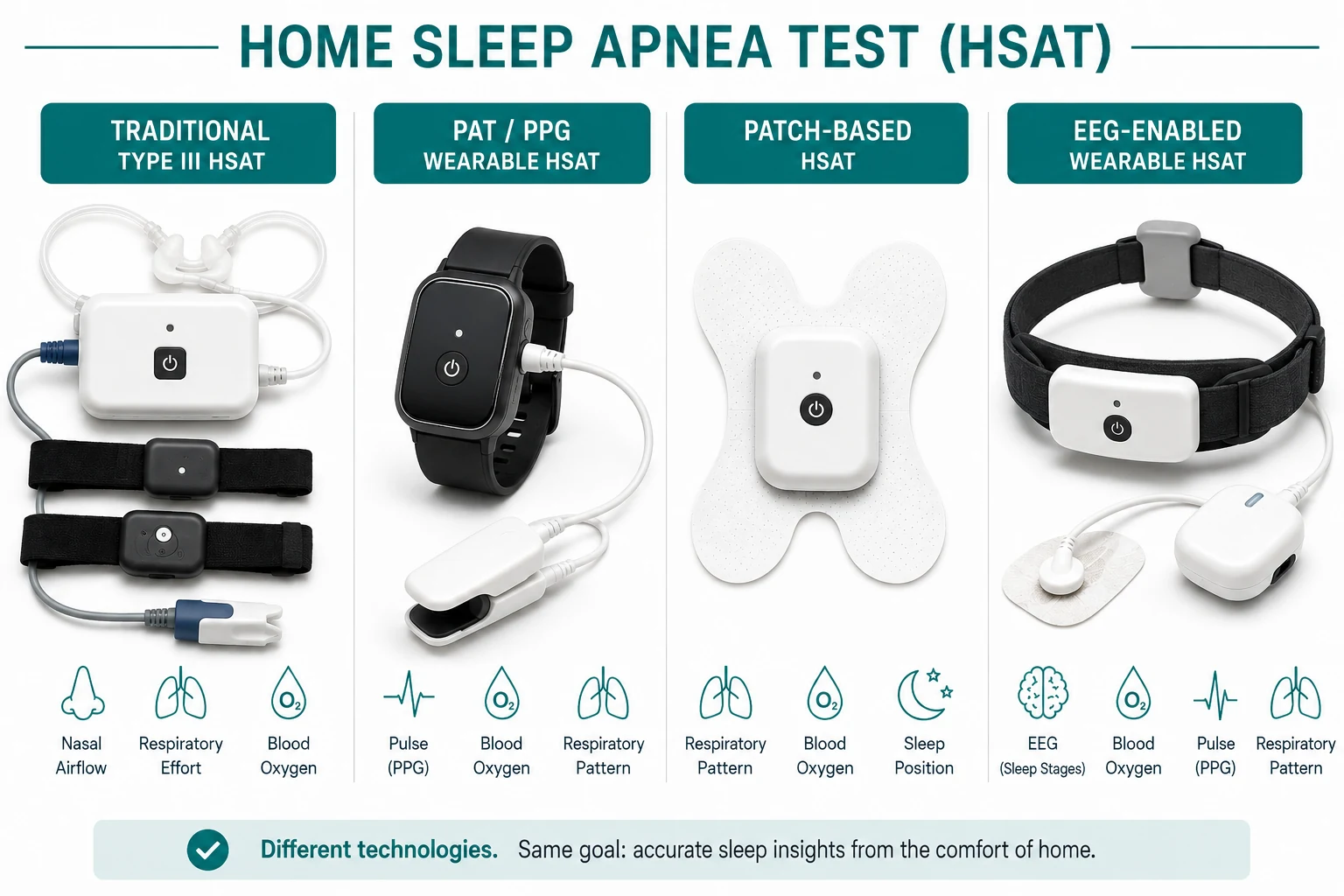
Not every HSAT device measures the same signals, and it’s worth understanding the general categories rather than assuming one specific product defines what “home sleep apnea test” means. Many devices use a fairly traditional approach, recording breathing directly through a combination of sensors.
Airflow
A nasal sensor records airflow directly, or an airflow surrogate signal.
Breathing Effort
A belt around the chest or abdomen records breathing effort on many, though not all, devices.
Oxygen & Heart Rate
A finger clip records blood oxygen saturation and heart rate throughout the night.
Body Position
A small sensor may record body position alongside the other signals.
Together, these signals let the device, and later the interpreting physician, identify pauses and reductions in airflow and correlate them with effort and oxygen drops.
Other devices use a different technology altogether, known as peripheral arterial tonometry (PAT). Rather than measuring airflow directly, a PAT-based device tracks subtle changes in blood vessel tone at the fingertip, along with oxygen saturation, heart rate, and often actigraphy (movement) data, and uses those signals to estimate the timing and frequency of respiratory events indirectly. Both approaches are used in current clinical practice and are supported by published validation studies; your clinician selects the device based on what’s available and what fits your clinical picture, not because one is universally “the” home sleep test.
What HSAT Generally Does Not Measure
This is the most important technical distinction between HSAT and an in-lab study, and it’s often overlooked.
Why HSAT Can't Measure Sleep Itself
Home devices don’t record an EEG, so they can’t directly measure sleep versus wakefulness. In an in-lab study, breathing events are counted against actual, EEG-confirmed sleep time, producing the apnea-hypopnea index (AHI). A home device has no way to confirm how much of the recording was spent asleep, so its result is instead calculated as a respiratory event index (REI): events counted against total recording time, whether or not you were actually asleep for all of it.
What That Means for Your Result
In practice, this means that if you spent a meaningful stretch of the night awake with the device on (which is fairly common with an unfamiliar device in an unfamiliar setup), that awake time still counts in the denominator. The result can be an REI that understates how frequently breathing events actually occurred during the sleep you did get. This is a genuine limitation of the technology, not a flaw specific to any one device, and it’s part of why HSAT results are always interpreted by a physician in the context of your symptoms rather than read as a number in isolation.
Who May Be a Good Candidate
General Criteria
Current AASM guideline-level criteria generally support home sleep apnea testing for adults who have a moderate-to-high pretest likelihood of straightforward, uncomplicated obstructive sleep apnea, based on their symptoms and clinical history, and who don’t have other significant medical or sleep conditions that would call for more comprehensive monitoring.
A Matter of Clinical Judgment, Not a Checklist
That’s a clinical judgment made during an evaluation, not a checklist you can complete on your own from a symptom list, because the same set of symptoms can point toward HSAT in one patient and toward an in-lab study in another, depending on the full picture. None of these criteria function as a strict cutoff: a patient with a moderate-to-high likelihood of OSA and a well-controlled, unrelated medical condition may still be a reasonable HSAT candidate, while a patient with milder symptoms but a complicating factor may not be. This is a matter of clinical judgment applied to an individual case, which is part of why the same evaluation-first approach described in our sleep apnea diagnosis guide applies here: the test is chosen to fit the patient, not the other way around.
When HSAT May Be Less Appropriate
In-lab testing is generally preferred over a home test in several situations:
- Significant cardiopulmonary disease is present.
- Central sleep apnea or hypoventilation is suspected.
- Significant neuromuscular weakness raises concern about breathing during sleep.
- Another sleep disorder that requires fuller physiologic measurement, such as periodic limb movements, a parasomnia, or narcolepsy, is also suspected.
Each of these situations calls for a depth of monitoring a home device simply isn’t built to provide, whether that’s distinguishing central from obstructive events, capturing brain-wave data, or watching for movement disorders alongside breathing. This is exactly why a clinical evaluation always comes before a test is chosen, never after: the decision about which test to order depends on what’s already known about you, not the other way around.
Preparing For and Taking the Test
Home sleep apnea testing follows a straightforward sequence, from an initial clinical visit through returning the device the next day.
How the Test Unfolds
- 01Clinical VisitA brief visit, in person or by telehealth, reviews your symptoms and history, confirms HSAT is an appropriate fit, and walks through how your specific device works and what it records.
- 02Take the Device HomeYou bring the device home along with instructions for the sensors it uses.
- 03Apply the Sensors YourselfYou apply the sensors following those instructions, with no technologist present to assist in real time.
- 04Sleep in Your Own BedMost patients wear the device for one night, though your clinician may ask for an additional night if needed to confirm the picture.
- 05Return the DeviceThe recording is downloaded and reviewed once the device is back with your clinician.
Self-application is a meaningful contrast with an in-lab study, where a technologist attaches every sensor and monitors the recording overnight from a nearby station. With HSAT, there’s no one to fix a loose sensor or troubleshoot a technical problem in real time, which is part of why applying the sensors carefully, following your instructions, matters directly to the quality of the recording.
After the Test: Interpretation
Once your recording is available, interpretation happens in two stages.
- Technical adequacy check. Before any clinical interpretation happens, the recording is checked for enough usable recording time, with stable enough signals, to support a reliable interpretation at all.
- Clinical interpretation. A physician evaluates the respiratory event index alongside how far oxygen levels dropped during recorded events, patterns in heart rate, and (where available) body position data, then weighs that recorded data against your reported symptoms and history to determine whether obstructive sleep apnea is present and, if so, how severe it appears.
Inconclusive Results and the Possibility of a False Negative
Two outcomes are worth understanding clearly:
- Technically inadequate. Too many dropped signals, or too little usable recording time, to interpret with confidence.
- Technically adequate but negative. The recording didn’t capture enough breathing events to meet the threshold for a diagnosis.
In either case, if your clinical suspicion for obstructive sleep apnea remains high, that result does not necessarily settle the question. A negative or inadequate home sleep apnea test does not always rule out OSA.
The limitations described above, including the REI-versus-AHI distinction and the possibility of a night that wasn’t representative, mean home testing can under-detect real disease. When the symptoms and history still point strongly toward OSA, the typical next step is an in-lab polysomnogram, which offers more comprehensive monitoring and a truer measure of sleep time.
What HSAT Cannot Diagnose
It’s worth being explicit about scope: a home sleep apnea test is built to evaluate suspected obstructive sleep apnea, full stop. It cannot diagnose narcolepsy, parasomnias, periodic limb movement disorder, insomnia, or other sleep disorders, because doing so requires the brain-wave and movement data that only an in-lab study records. If your symptoms suggest something beyond straightforward OSA, that’s a signal for a different kind of evaluation, not a reason to expect a home test to answer a question it isn’t designed to ask.
Convenience and Its Limits
The appeal of home testing is real: sleeping in your own bed, without travel to a lab or an unfamiliar room, tends to be more comfortable and more convenient for most patients. That convenience comes with real trade-offs, though, including a narrower set of measured signals and the REI-versus-AHI limitation described above. Neither convenience nor comprehensiveness is inherently “better”; each test is suited to a different clinical situation, which is exactly why an evaluation comes first.
Ordering and Insurance
In general U.S. practice, a home sleep apnea test requires a physician evaluation and order. It isn’t something you obtain on your own the way you might buy a consumer wearable. Insurance coverage and any prior-authorization requirements vary by plan, so our team can help confirm your specific benefits as part of scheduling; this page doesn’t make any promises about what a particular plan will or won’t cover.
Next Steps After Your Result
If Your Result Is Positive
The same visit where you review results typically also covers treatment, which for confirmed obstructive sleep apnea often starts with a discussion of CPAP therapy and other options suited to your severity and preferences.
If It's Negative or Inconclusive
If clinical suspicion remains, expect a conversation about next steps, which frequently means moving to an in-lab sleep study to get a more complete picture.
Either way, the goal of testing is the same: a clear, physician-reviewed answer that a treatment plan can actually be built around.
Patient Questions
What exactly does a home sleep apnea test measure?
Most home sleep apnea test devices record airflow at the nose (or a surrogate airflow signal), blood oxygen saturation, and heart rate throughout the night, and many also record breathing effort using a chest or abdominal belt and body position. The exact combination of sensors depends on the specific device your clinician orders, since not all HSAT technologies measure the identical set of signals.
Is a home sleep apnea test the same as an in-lab sleep study?
No. A home sleep apnea test is a focused, breathing-centered test, while an in-lab polysomnogram also records brain waves, eye movements, and muscle activity, which allows it to measure actual sleep stages and evaluate a much broader range of sleep disorders. The two tests serve different clinical purposes rather than being interchangeable versions of the same thing.
Do all home sleep apnea test devices work the same way?
No. Some HSAT devices use a fairly traditional approach, directly recording airflow, respiratory effort, and oxygen levels. Others rely on peripheral arterial tonometry, a technology that tracks subtle changes in blood vessel signals at the fingertip, along with oxygen levels and heart rate, to estimate breathing events indirectly rather than measuring airflow directly. Both approaches are used in clinical practice, and your clinician will choose the device that fits your situation.
Why doesn't a home sleep apnea test measure sleep stages?
Measuring sleep stages requires an EEG (brain-wave) recording, along with eye-movement and muscle-tone sensors, which home devices don't include. Without that data, a home test can't distinguish wakefulness from sleep, so it can't tell you how much of the night was actually spent asleep.
What is a respiratory event index, and how is it different from an AHI?
Because a home test can't confirm how much time you actually spent asleep, breathing events are counted against total recording time instead, producing a respiratory event index (REI). An in-lab study, by contrast, calculates the apnea-hypopnea index (AHI) using EEG-confirmed sleep time. If you spent part of the night awake with the device on, that time still counts in the HSAT's denominator, which can make the REI understate the true severity of breathing events during actual sleep.
Who is a good candidate for home sleep apnea testing?
Guideline-based criteria generally point to home testing for adults with a moderate-to-high likelihood of straightforward, uncomplicated obstructive sleep apnea based on their symptoms and history, and without other significant medical or sleep conditions that would call for fuller monitoring. Whether that describes your situation is something your clinician determines during an evaluation, not something to self-assess from a symptom list alone.
When is a home sleep apnea test not appropriate?
In-lab testing is generally preferred over a home test when significant heart or lung disease is present, when central sleep apnea or hypoventilation is suspected, when significant neuromuscular weakness is a concern, or when another sleep disorder that needs fuller physiologic measurement, such as narcolepsy or a parasomnia, is also suspected. These situations call for a level of monitoring a home device isn't built to provide.
Can a home sleep apnea test diagnose narcolepsy or restless legs?
No. A home sleep apnea test is specifically designed to evaluate suspected obstructive sleep apnea. It cannot diagnose narcolepsy, parasomnias, periodic limb movements, or other sleep disorders, since those require brain-wave and movement data that home devices don't record.
Can a home sleep apnea test give a false-negative result?
Yes. If a device shifts position during the night, a sensor loosens, or you spend meaningful time awake with the equipment on, the recording can under-represent how often breathing events actually occurred. A negative home test in someone with strong clinical suspicion of obstructive sleep apnea does not always rule it out, and an in-lab study is often the next step in that situation.
What happens if my home sleep apnea test is technically inadequate?
A technically inadequate recording is one with too many dropped signals, too little total recording time, or other data-quality problems to interpret reliably. When that happens, your clinician will typically recommend either repeating the home test or moving to an in-lab study, depending on why the recording fell short and how strongly obstructive sleep apnea is still suspected.
Do I need a doctor's order to get a home sleep apnea test?
Yes. A home sleep apnea test is a physician-ordered diagnostic test, not a consumer product you self-administer without medical guidance. A clinical evaluation beforehand confirms that a home test is the appropriate way to investigate your symptoms.
What happens after I get my home sleep apnea test results?
A physician reviews the recorded data, including the respiratory event index and oxygen levels, alongside your symptoms and history, then explains whether obstructive sleep apnea is present and how severe it appears. If the result is positive, that visit typically also covers treatment options; if it's negative or inconclusive but suspicion remains, the next step is often an in-lab study.
Sources
Guidelines and Professional Societies
- American Academy of Sleep Medicine. Clinical Practice Guideline for Diagnostic Testing for Adult Obstructive Sleep Apnea.View source
- American Academy of Sleep Medicine. Use of Polysomnography and Home Sleep Apnea Tests for the Longitudinal Management of Obstructive Sleep Apnea in Adults.View source
Government and Regulatory Sources
- National Heart, Lung, and Blood Institute. Sleep Apnea.View source