Treatment
Medically reviewed by Varun Halani, MD · August 12, 2026
Adaptive Servo-Ventilation (ASV) Therapy
A more advanced, breath-by-breath adaptive form of positive airway pressure therapy used to treat selected types of central and complex sleep apnea, with important patient-selection considerations in heart failure.
In short
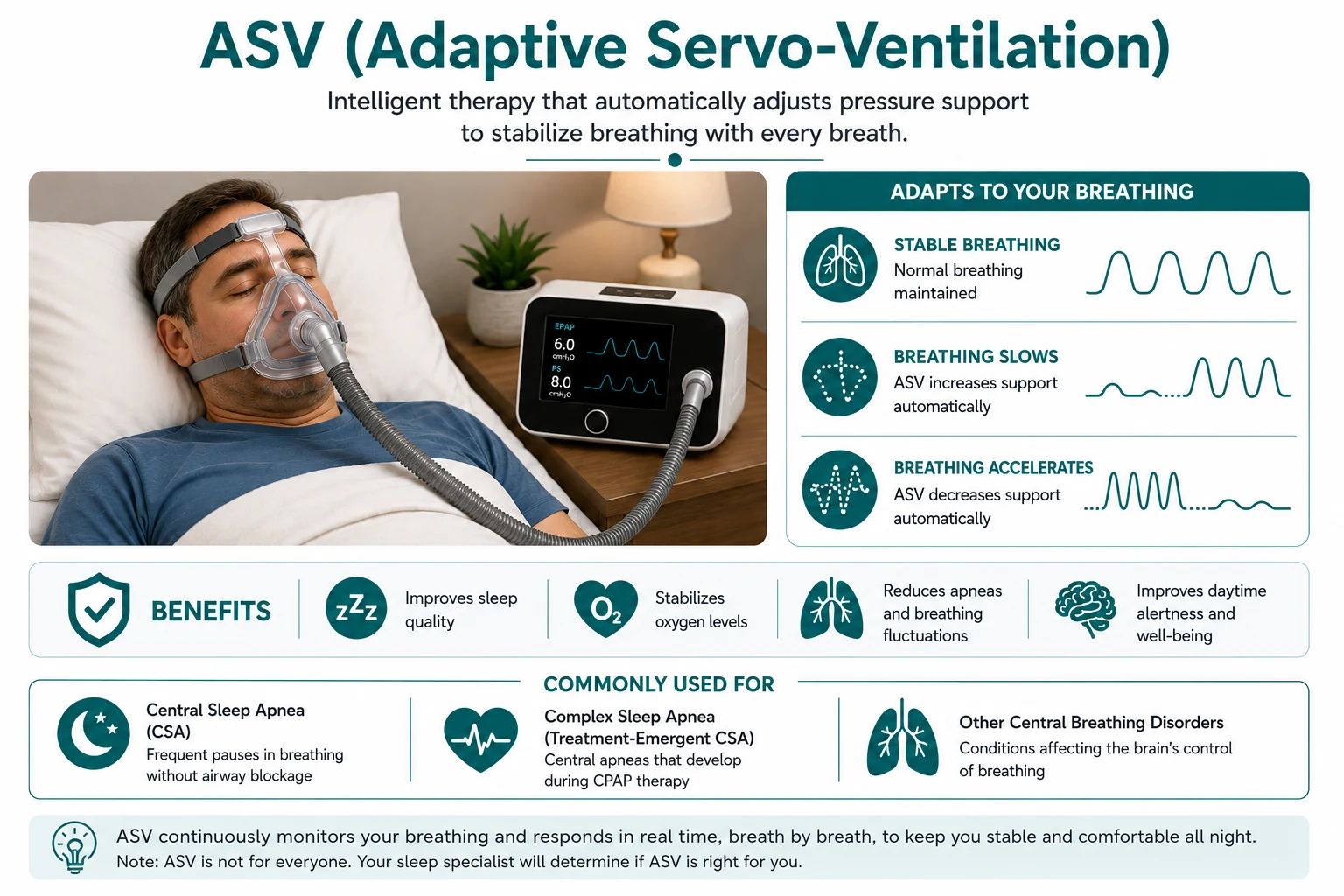
Adaptive servo-ventilation (ASV) is a more advanced form of positive airway pressure therapy that continuously and automatically adjusts the level of breathing support, breath by breath, based on a patient's own recent breathing pattern. It's built specifically to smooth out the unstable, waxing-and-waning breathing seen in certain types of central and complex sleep apnea, rather than simply keeping the airway open the way CPAP does. Because a 2015 trial linked ASV to increased cardiovascular mortality in a specific heart failure population, candidacy is always determined through individual physician evaluation, with heart failure status and ejection fraction specifically assessed beforehand.
At a Glance
Used For
Selected types of central and complex sleep apnea where breathing becomes unstable, including some cases of treatment-emergent central sleep apnea that appear after starting CPAP.
How It Works
A device tracks each patient's recent breathing pattern and automatically varies the level of support breath by breath, aiming to smooth out an unstable, cycling pattern rather than deliver one fixed setting.
How It Differs From CPAP and Bilevel
CPAP delivers one steady pressure; conventional bilevel alternates between two fixed pressures. ASV's support level adapts continuously based on an algorithm tracking recent ventilation, a different mechanism, not just a fancier bilevel.
Heart Failure Consideration
A specific safety signal was identified in symptomatic heart failure with reduced ejection fraction and predominant central sleep apnea. Ejection fraction and heart failure status are specifically evaluated before ASV is considered.
Getting Started
A physician evaluation and typically a sleep study come first, so the pattern of breathing instability and any cardiac factors are understood before therapy is chosen.
Key Takeaways
- ASV automatically adjusts breathing support breath by breath based on a patient's own recent breathing pattern: it doesn't deliver one fixed pressure (CPAP) or alternate between two fixed pressures (conventional bilevel).
- It's used for selected types of central and complex sleep apnea, including some cases of treatment-emergent central sleep apnea that appear or persist after starting CPAP for what was thought to be purely obstructive sleep apnea.
- A real, still-relevant safety consideration applies to a specific population: symptomatic chronic heart failure with reduced ejection fraction (45% or less) and predominantly central sleep apnea, identified in a 2015 clinical trial. This does not mean ASV is prohibited in every heart failure patient or every central sleep apnea phenotype.
- Ejection fraction and heart failure status are specifically assessed as part of the pre-therapy evaluation, and current sleep medicine guidance treats ASV as an individualized option chosen with careful patient selection rather than a one-size-fits-all therapy.
- ASV is typically considered only after a physician evaluation and a sleep study clarify the type and pattern of the breathing disorder.
Side-by-Side Comparison
| Dimension | CPAP | Conventional Bilevel (BiPAP) | ASV |
|---|---|---|---|
| Pressure Delivery | One steady pressure throughout the night | Two fixed pressures: higher on inhalation, lower on exhalation | Support that continuously varies, breath by breath, based on the patient's recent breathing |
| What It Responds To | Does not adapt to breath-by-breath changes in ventilation | Does not adapt to breath-by-breath changes in ventilation | An algorithm tracking recent ventilation, adjusted in near real time |
| Primary Target | Keeping the upper airway physically open | Keeping the airway open with added support for breathing effort | Smoothing out an unstable, waxing-and-waning breathing pattern |
| Typical Use | First-line therapy for obstructive sleep apnea | Selected patients needing more support than CPAP; a backup rate is needed for central events | Selected central or complex sleep apnea patterns after evaluation |
| Heart Failure Consideration | No specific device-based mortality signal identified | No specific device-based mortality signal identified | A specific safety signal was identified in symptomatic HFrEF (EF ≤45%) with predominant CSA; evaluated case by case |
What Is Adaptive Servo-Ventilation (ASV)?
How ASV Works
Adaptive servo-ventilation is a more sophisticated form of positive airway pressure therapy, delivered through the same type of mask and machine setup as other PAP therapies, but built around a fundamentally different idea.
Rather than delivering a fixed setting, an ASV device continuously tracks a patient’s own recent breathing, breath by breath, and automatically adjusts the level of support in near real time, giving more assistance during a shallow phase of breathing and easing off during a fuller one.
A Purpose-Built Therapy, Not a General Upgrade
The purpose is to smooth out an unstable, waxing-and-waning breathing pattern, the kind seen in certain types of central sleep apnea, rather than simply holding the upper airway open. This makes ASV a purpose-built therapy for specific breathing instability, not a general upgrade from CPAP that every PAP patient might eventually move to.
Central sleep apnea, the condition ASV is designed to treat, involves the brain’s own respiratory drive periodically weakening or pausing, which is a genuinely different problem than a physically narrowed airway.
How ASV Differs From CPAP
What CPAP Does
CPAP delivers one steady pressure (or, with an auto-adjusting device, a pressure that shifts gradually over the course of a night) whose job is mainly mechanical: holding the airway open so it can’t collapse. It does not track or respond to a changing breathing pattern from breath to breath.
How ASV Is Different
ASV starts from a different premise. Its algorithm continuously analyzes the patient’s recent ventilation and adjusts support accordingly, actively working to counter a cycling pattern of over-breathing and under-breathing rather than a fixed obstruction.
In practice, this means CPAP and ASV are aimed at different underlying problems: CPAP at airway obstruction, ASV at breathing-pattern instability. CPAP therapy remains the appropriate starting point for straightforward obstructive sleep apnea; ASV is not a substitute for CPAP in that setting.
How ASV Differs From Conventional Bilevel (BiPAP) Therapy
Conventional Bilevel's Fixed Two-Pressure Design
It’s a common misconception that ASV is simply “bilevel with extra features.” Conventional bilevel therapy alternates between two fixed pressures, a higher one for inhalation and a lower one for exhalation, and some bilevel devices add a backup breathing rate to deliver a breath if a patient’s own effort briefly lapses.
That is a meaningfully different mechanism from ASV, whose support level adapts continuously based on an algorithm tracking the patient’s actual recent breathing pattern, rather than switching between two preset numbers.
Why the Distinction Matters
The distinction matters clinically, not just technically: a device chosen for the wrong mechanism can be a poor fit for a patient’s specific breathing pattern.
For a closer look at how CPAP and bilevel therapy themselves compare, see our CPAP vs. bilevel comparison; ASV is a separate, third category built specifically around breath-by-breath adaptation, not a variant of either.
Treatment-Emergent Central Sleep Apnea
What It Is
Treatment-emergent central sleep apnea, sometimes called complex sleep apnea, is a specific and often confusing scenario worth understanding on its own. It describes central breathing pauses that appear, or persist, once obstructive sleep apnea has already been diagnosed and CPAP therapy has started, even though the original sleep study pointed toward a purely obstructive problem.
How It's Typically Managed
For many patients, this pattern gradually improves with continued, consistent CPAP use over the following weeks, as an underlying instability in the breathing control system, one the airway obstruction may have been masking, restabilizes on its own.
A smaller number of patients have central events that remain frequent despite good CPAP therapy, which is a reasonable reason for a physician to reassess the treatment plan, including whether ASV may be a better-suited option. This is a decision made at a follow-up visit with your physician, not something to act on by stopping or changing therapy independently.
Who May Be Considered for ASV
ASV is considered for selected types of central and complex sleep apnea where the breathing pattern itself is unstable, not for straightforward obstructive sleep apnea or for every person who has some central events noted on a study.
Because the right therapy depends heavily on why the breathing pattern is unstable, candidacy is always an individualized decision made by a physician after reviewing the full clinical picture, including cardiac history, rather than a therapy a patient can request or start on their own.
Typically Considered For
Selected central and complex sleep apnea patterns identified on a sleep study, including treatment-emergent central sleep apnea that hasn't resolved with continued CPAP use.
Not a First-Line Therapy For
Straightforward obstructive sleep apnea, where CPAP remains the standard starting point.
Important Exclusion
Symptomatic chronic heart failure with reduced ejection fraction (45% or less) and predominantly central sleep apnea, the population in which a 2015 trial found increased mortality with ASV. See Heart Failure and ASV, below.
Decision Process
Made by a physician after reviewing the full clinical picture, including cardiac history, not requested or started independently.
Heart Failure and ASV: What the Evidence Shows
ASV increased cardiovascular mortality in a specific heart failure population, according to a large 2015 clinical trial (commonly known as SERVE-HF): adults with symptomatic chronic heart failure, reduced ejection fraction (an ejection fraction of 45% or less), and predominantly central sleep apnea.
That finding led to an important safety notice at the time, advising against starting ASV in that specific group and prompting a review of patients already on therapy who fit that profile. It remains a real, still-relevant consideration in sleep medicine today, not a historical footnote to dismiss.
What that finding does not establish is a categorical rule against ASV in every heart failure patient or every central sleep apnea phenotype. The signal was specific to symptomatic heart failure with reduced ejection fraction and predominantly central events; it does not describe every combination of heart disease and sleep-disordered breathing.
Since that trial, additional research using different ASV devices and study designs has not reproduced a similar mortality signal in comparable heart failure populations.
Current sleep medicine guidance reflects a more individualized picture: ASV can be a reasonable, carefully selected option for central sleep apnea, including in some patients with heart failure, but it calls for experienced clinical oversight, specific attention to ejection fraction and heart failure symptom status, and ongoing monitoring, rather than routine or unmonitored use.
In practice, this means ejection fraction and heart failure status are specifically assessed as part of any ASV evaluation, and the decision to use, avoid, or continue ASV in a patient with heart failure is made individually, with your cardiac status weighed directly, not by a generic protocol.
Patients managing both heart failure and a sleep-breathing disorder may also find our future heart failure and sleep apnea guide useful for understanding how the two conditions intersect more broadly.
Evaluation Before Starting ASV
ASV is not started from symptoms alone. It follows a physician evaluation and, typically, a sleep study, most often an in-lab sleep study, since accurately identifying the pattern of breathing instability generally requires the direct measurement of breathing effort that in-lab testing provides.
- 01Physician EvaluationReviews cardiac history (including any known heart failure and ejection fraction), current medications, and prior PAP therapy data.
- 02Sleep StudyConfirms the specific pattern of breathing instability and distinguishes it from straightforward obstructive events.
- 03Whole-Picture ReviewFindings are weighed alongside cardiac and medication history, not the sleep study result in isolation.
- 04Therapy DecisionASV is pursued only when the full clinical picture supports it.
What to Expect With ASV Therapy
Day to day, using an ASV device looks similar to using CPAP or bilevel therapy: a mask, a bedside machine, and a nightly routine. The meaningful difference happens internally, in how the device continuously reads and responds to breathing, not in a dramatically different setup or user experience.
As with any PAP therapy, mask fit and an adjustment period are common early considerations. Settings are determined and refined by your physician based on your sleep study and clinical response, not something to configure independently, and follow-up visits with device data review confirm the therapy is working as intended and remains an appropriate fit over time.
ASV Care at VitalAir
Evaluating whether ASV is appropriate starts with the same careful process used for any central sleep apnea presentation: a detailed history, review of any prior sleep studies or PAP device data, and, when indicated, in-lab testing to confirm the breathing pattern involved. For patients with a heart failure history, that evaluation specifically incorporates cardiac status and ejection fraction before ASV is considered.
The VitalAir Sleep & Lung Center serves patients throughout Frisco, Texas and the greater North Dallas–Fort Worth area; a sleep evaluation is the starting point for determining whether ASV, CPAP, or another therapy is the right fit.
Patient Questions
What exactly does ASV do differently from other PAP therapies?
ASV continuously monitors a patient's recent breathing pattern and automatically adjusts the level of pressure support on a breath-by-breath basis, giving more support during a shallow phase of breathing and less during a fuller one. The goal is to smooth out an unstable, cycling breathing pattern, rather than simply holding the airway open with one steady or two fixed pressures.
How is ASV different from CPAP?
CPAP delivers a single steady pressure (or, with an auto-adjusting CPAP, a pressure that changes slowly over the night) mainly to keep the upper airway physically open. ASV instead targets the breathing pattern itself, varying support breath by breath in response to how a patient is currently breathing. CPAP and ASV are built for different underlying problems.
How is ASV different from regular bilevel (BiPAP) therapy?
Conventional bilevel therapy alternates between two fixed pressures, one for breathing in and one for breathing out. ASV is a different mechanism: its support level adapts continuously based on an algorithm tracking the patient's recent ventilation, rather than switching between two preset numbers. For a fuller look at how CPAP and bilevel therapy themselves differ, see our CPAP vs. bilevel comparison.
Is ASV safe for people with heart failure?
It depends on which heart failure and which central sleep apnea pattern. A 2015 clinical trial found increased cardiovascular mortality with ASV in a specific population (patients with symptomatic chronic heart failure with reduced ejection fraction (45% or less) and predominantly central sleep apnea) and that finding remains an important, actively considered caution. It does not mean ASV is prohibited in every heart failure patient or every central sleep apnea presentation. Ejection fraction and heart failure status are specifically evaluated before ASV is considered, and current guidance calls for individualized decision-making and monitoring rather than either a blanket use or a blanket avoidance of ASV in heart failure.
What is treatment-emergent central sleep apnea, and can ASV help?
Treatment-emergent central sleep apnea describes central breathing pauses that appear or persist once obstructive sleep apnea is already being treated with CPAP. Many cases improve on their own with continued, consistent CPAP use, but a pattern that remains frequent and significant despite good CPAP therapy is a reasonable trigger for a physician to reassess the approach, which may include considering ASV. Central sleep apnea is discussed in more depth in our central sleep apnea guide.
Do I need a sleep study before starting ASV?
Yes. ASV candidacy is determined after a physician evaluation and, typically, a sleep study, most often an in-lab sleep study, that identifies the specific pattern of breathing instability and rules in or out contributing causes such as heart failure. ASV is not started based on symptoms alone.
Who typically isn't a good candidate for ASV?
ASV is generally not considered appropriate for patients with symptomatic chronic heart failure with reduced ejection fraction and predominantly central sleep apnea, the population in which the 2015 mortality signal was identified. Beyond that specific group, candidacy still depends on the type of central sleep apnea, its cause, and overall cardiac status, so it's confirmed through individual evaluation rather than a general rule.
Is an ASV machine different to use night to night than a CPAP machine?
Day to day, using an ASV device is broadly similar to using CPAP or bilevel therapy: a mask, a machine, and a nightly routine. The meaningful difference is internal, in how the device continuously calculates and delivers support, not in a dramatically different user experience.
Will insurance cover ASV therapy?
Coverage varies by plan and is often tied to a confirmed diagnosis from a sleep study along with documented medical necessity for ASV specifically, rather than a simpler PAP therapy. Our team can help review your specific benefits before therapy begins.
Can I adjust my own ASV settings?
No. ASV's support parameters are determined and monitored by your physician based on your sleep study results and clinical picture, and adjusted at follow-up visits as needed. This is not a therapy intended for self-adjustment.
Sources
Guidelines and Professional Societies
- American Academy of Sleep Medicine. Treatment of Central Sleep Apnea in Adults, An American Academy of Sleep Medicine Clinical Practice Guideline. Journal of Clinical Sleep Medicine, 2025.View source
- American Academy of Sleep Medicine. Special Safety Notice, ASV Therapy for Central Sleep Apnea Patients With Heart Failure, based on findings from the SERVE-HF trial.View source
- American Thoracic Society. Patient Education Information Series, What Is Adaptive Servo-Ventilation (ASV)?View source
Government and Regulatory Sources
- National Heart, Lung, and Blood Institute. Sleep Apnea.View source
Key Evidence
- Cowie MR, et al. Adaptive Servo-Ventilation for Central Sleep Apnea in Systolic Heart Failure. New England Journal of Medicine, 2015.View source