Testing & Diagnosis
Medically reviewed by Varun Halani, MD · August 12, 2026
Multiple Sleep Latency Test (MSLT)
A daytime nap-based sleep study, performed the day after an overnight sleep study, that measures how quickly you fall asleep and whether REM sleep appears unusually early: used mainly to help evaluate suspected narcolepsy and idiopathic hypersomnia.
In short
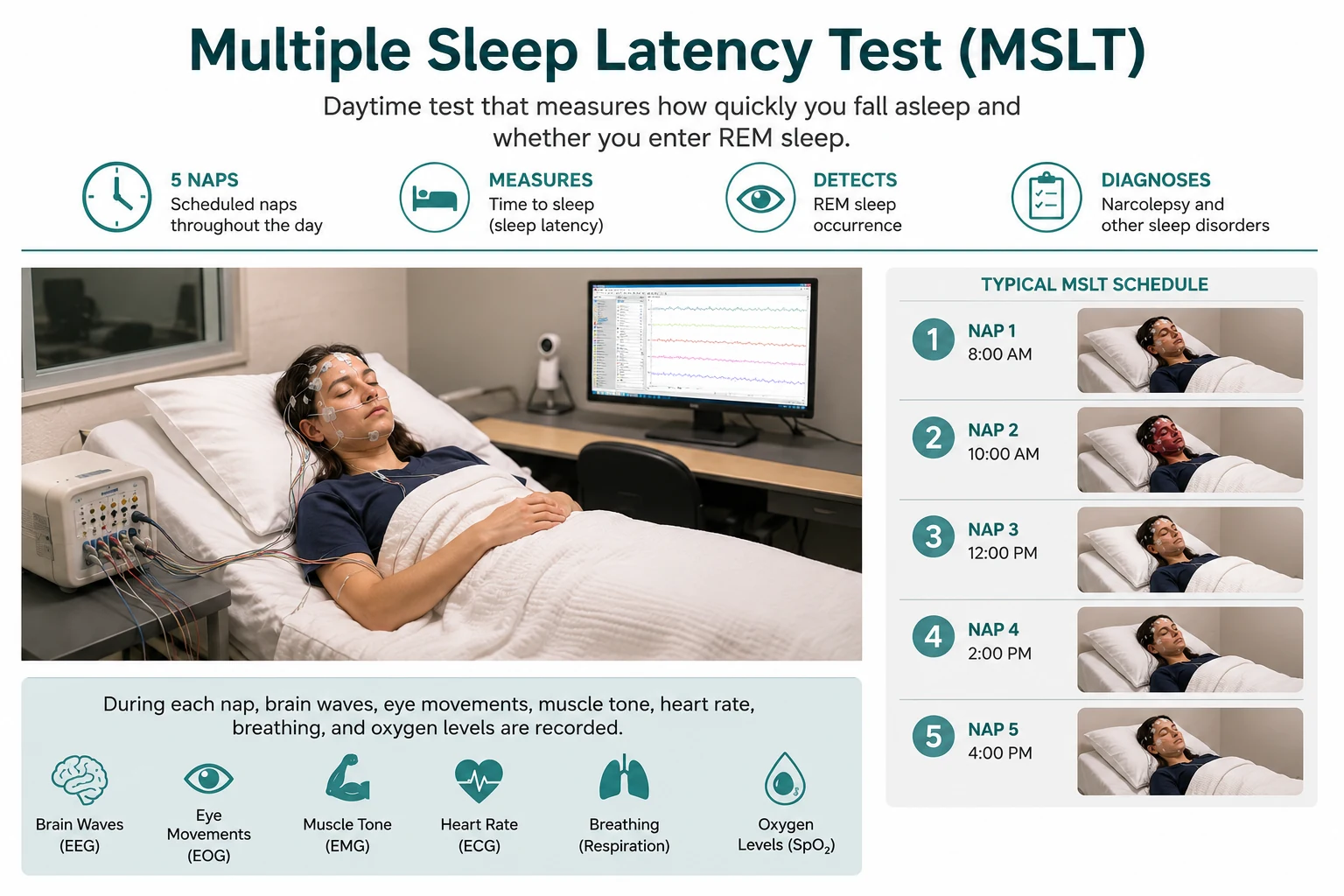
The multiple sleep latency test (MSLT) is a daytime nap study, performed the day after an overnight sleep study, that measures how quickly you fall asleep across several scheduled nap opportunities and whether REM sleep appears unusually early. It's used mainly to help evaluate suspected narcolepsy and idiopathic hypersomnia. The results (an average sleep latency and the number of sleep-onset REM periods (SOREMPs)), are always interpreted by a physician alongside your overnight study, your medications, and your full clinical picture, never read as a single number that decides a diagnosis on its own.
At a Glance
What It Is
A daytime nap-based sleep study measuring how quickly you fall asleep and whether REM sleep appears unusually early, across several scheduled nap opportunities.
When It's Used
After an overnight sleep study has confirmed adequate prior sleep and ruled out other explanations, when narcolepsy or idiopathic hypersomnia is suspected.
How It's Interpreted
Mean sleep latency and the number of SOREMPs are considered together with the overnight study, medication history, and clinical picture, not as a standalone verdict.
What It Requires
Adequate sleep in the nights beforehand, an accurate medication list, and, in some patients, addressing conditions like untreated sleep apnea first.
Key Takeaways
- An MSLT is always preceded by an overnight sleep study, which rules out other causes of sleepiness and confirms you actually had adequate sleep opportunity beforehand.
- The test itself involves several scheduled daytime nap opportunities, typically 4 to 5, spaced about 2 hours apart, measuring how quickly you fall asleep (sleep latency) and whether REM sleep appears unusually early (a SOREMP).
- A short mean sleep latency and multiple SOREMPs are part of the diagnostic criteria for narcolepsy and idiopathic hypersomnia, but no single number diagnoses either condition on its own. Results are always read alongside the overnight study, symptom history, and medication review.
- Insufficient prior sleep, an irregular schedule, untreated sleep apnea, and certain medications can all distort MSLT results in either direction, which is why careful preparation and clinician-directed medication review matter.
- Any change to your medications before an MSLT should be made only under your physician's direction: never stopped or adjusted on your own.
Side-by-Side Comparison
| Dimension | Overnight Sleep Study (the Night Before) | MSLT (the Day After) |
|---|---|---|
| Purpose | Rules out other causes of sleepiness (such as sleep apnea) and confirms you had adequate sleep opportunity that night | Measures how quickly you fall asleep and whether REM sleep appears unusually early, across several scheduled daytime naps |
| Duration | One full monitored night | A full day, typically 4 to 5 nap opportunities about 2 hours apart |
| What's Recorded | Brain waves, breathing, oxygen levels, leg movements, heart rhythm, and sleep stages overnight | Time to fall asleep at each nap, plus whether and how quickly REM sleep appears |
| Key Outputs | Confirms adequate total sleep time and identifies sleep apnea or other sleep disruptors | Mean sleep latency and number of sleep-onset REM periods (SOREMPs), interpreted together with the overnight findings |
What the MSLT Measures
The multiple sleep latency test (MSLT) is a daytime sleep study built around a simple, structured question: when you’re given a quiet, comfortable opportunity to nap, how quickly do you actually fall asleep, and what happens once you do?
Across several scheduled nap opportunities in one day, technologists measure sleep latency (the time it takes you to fall asleep) and watch for whether REM sleep, the stage most associated with dreaming, appears unusually early.
It is one of the tools used to evaluate excessive daytime sleepiness when a physician suspects a specific underlying cause, most often narcolepsy or idiopathic hypersomnia, rather than a general screening test for everyone who feels tired.
Before the MSLT: The Overnight Sleep Study Comes First
An MSLT is never done on its own. It’s always preceded by an overnight in-lab sleep study, typically performed the night immediately before, for two essential reasons.
Ruling Out Other Causes
The overnight study helps rule out other explanations for daytime sleepiness, most importantly obstructive sleep apnea, which can itself fragment nighttime sleep and produce a short daytime sleep latency that has nothing to do with narcolepsy or idiopathic hypersomnia.
Confirming Adequate Sleep
It also confirms that you actually had an adequate, reasonably uninterrupted opportunity to sleep that night, since a sleepy result the next day could otherwise simply reflect a bad night's sleep rather than an underlying disorder.
If the overnight study shows disrupted or insufficient sleep, the MSLT that follows may need to be rescheduled, or interpreted with that limitation in mind.
How the Test Works: Naps, Sleep Latency & SOREMPs
The MSLT itself typically consists of four to five scheduled nap opportunities spaced about two hours apart across the day.
How a Testing Day Unfolds
- 01Nap Opportunity BeginsYou lie down in a quiet, darkened room every two hours or so, four to five times across the day, and are simply asked to try to fall asleep.
- 02Monitoring ContinuesThe same brain-activity and eye-movement monitoring used overnight continues to record during each nap opportunity.
- 03Nap Opportunity EndsEach one ends after a set time if you don't fall asleep, or shortly after sleep onset if you do, and the pattern repeats across the day.
- 04Mean Sleep Latency CalculatedThe average number of minutes it took you to fall asleep across all the naps is calculated; a shorter average generally reflects greater physiologic sleepiness.
- 05SOREMPs CountedNaps in which REM sleep began unusually early, rather than after its typical delay, are counted as sleep-onset REM periods (SOREMPs).
A short mean sleep latency has more than one possible explanation, as discussed below, so both numbers are considered together with the overnight study when evaluating narcolepsy and idiopathic hypersomnia.
Preparing for a Reliable Result
An MSLT is only as reliable as the conditions surrounding it, which is why preparation is taken seriously rather than treated as a formality.
Consistent Sleep Schedule
Insufficient sleep in the days to weeks before testing can shorten sleep latency and distort results independent of any underlying sleep disorder, which is why your physician will typically ask you to maintain a consistent, adequate sleep schedule beforehand.
Sleep Diary or Actigraphy
Some patients are asked to keep a sleep diary, or to wear actigraphy (a wrist-worn device that tracks movement and rest patterns over one or more weeks), so that your actual sleep pattern going into the test can be objectively documented rather than estimated.
Medications & Substances
Certain medications and substances, including many antidepressants and some stimulant and wake-promoting medications, can suppress or otherwise alter REM sleep timing, which can shift both mean sleep latency and SOREMP counts and lead to a misleading result in either direction.
A Complete Medication List
Your physician needs a complete and accurate list of everything you're currently taking well before the test is scheduled, so these effects can be accounted for when your results are interpreted.
Any decision about adjusting or pausing a medication before an MSLT belongs entirely to your physician. This is never something to do on your own, since stopping or changing a medication independently can carry its own risks unrelated to the sleep test itself.
What MSLT Results Mean — and What They Don’t
Narcolepsy
A short mean sleep latency together with multiple SOREMPs is part of the formal diagnostic picture for narcolepsy, and it’s the kind of finding that genuinely supports the diagnosis when everything else lines up. But it’s exactly that: one part of a larger picture, not a standalone verdict.
Your physician weighs the MSLT findings alongside the overnight study, your reported symptoms (including whether cataplexy, sudden, brief muscle weakness triggered by strong emotion, is present, which helps distinguish Narcolepsy Type 1 from Type 2), and your medication and sleep-schedule history before arriving at a diagnosis.
The same short-latency, multiple-SOREMP pattern can, in some circumstances, arise from causes other than narcolepsy, which is exactly why an MSLT is read in full clinical context rather than as a number to interpret on your own.
Idiopathic Hypersomnia
The MSLT is also central to evaluating idiopathic hypersomnia, a separate central disorder of hypersomnolence that can produce a similarly short mean sleep latency to narcolepsy, but typically without the repeated early-REM pattern that defines a narcolepsy result.
Because idiopathic hypersomnia and narcolepsy can look alike in terms of how sleepy a person feels, distinguishing between them relies heavily on the specific SOREMP pattern, the absence of cataplexy, and, sometimes, additional testing of total sleep need, not on sleep latency alone.
Why False-Positive and False-Negative Results Happen
An MSLT can be misleading in either direction if the conditions around it aren’t accounted for.
False Positive
A narcolepsy-like pattern in someone who doesn’t have narcolepsy can occur with chronic insufficient sleep, an irregular or shift-work schedule, or untreated sleep apnea, all of which can shorten sleep latency on their own.
False Negative
Missing a real underlying disorder can happen if REM-affecting medications weren’t fully accounted for beforehand, or if a patient simply doesn’t nap normally in the testing environment despite genuine sleepiness in daily life.
This is a real, well-recognized limitation of the test, and it’s a core reason MSLT results are always interpreted by a physician within your fuller clinical picture rather than read as a self-contained answer.
Other Factors That Have to Be Considered First
Because so many things can influence a daytime sleep latency, a careful evaluation looks at several factors before an MSLT result is taken at face value.
Irregular Schedule or Shift Work
An irregular schedule or shift work can misalign your body's circadian rhythm with the testing schedule, sometimes producing results that reflect timing mismatch rather than an underlying hypersomnolence disorder.
Untreated Sleep Apnea
Untreated obstructive sleep apnea, discussed above, can itself explain daytime sleepiness and short sleep latency, which is part of why it's identified, and sometimes addressed, occasionally with a trial of PAP therapy, before an MSLT is considered a reliable test of something else.
Because of all this, your physician may ask detailed questions about your work schedule, recent travel, caffeine use, and other daily-life factors as part of preparing for and interpreting the test, not just your symptoms themselves.
After Your MSLT: What Happens Next
Once testing is complete, a physician reviews your mean sleep latency, SOREMP findings, the preceding overnight study, your symptom history, and your medication and sleep-schedule information together to determine what the results actually mean for you.
A Narcolepsy Diagnosis
With Type 1 versus Type 2 determined by the presence or absence of cataplexy.
An Idiopathic Hypersomnia Diagnosis
Based on the SOREMP pattern and clinical history described above.
Another Contributing Factor Identified
Such as insufficient sleep or untreated sleep apnea, that needs to be addressed first.
A Recommendation to Repeat Testing
Under better-controlled conditions, if the results were ambiguous or preparation wasn't ideal.
Whatever the outcome, your physician will walk you through what the findings mean in plain terms and what happens next, rather than leaving you to interpret a lab report on your own.
MSLT Testing at VitalAir
MSLT testing is coordinated through VitalAir Sleep & Lung Center in Frisco, Texas, part of the broader North Dallas–Fort Worth area we serve, always built on an overnight sleep study, a careful medication and sleep-schedule review, and physician interpretation that places the results in your full clinical context rather than treating them as a stand-alone number.
Patients working through a possible narcolepsy diagnosis may also find this overview of narcolepsy and this guide to excessive daytime sleepiness useful background before or alongside testing. The clinical information on this page applies to patients everywhere; what differs locally is simply where that evaluation and follow-up care happens.
Patient Questions
What is the multiple sleep latency test (MSLT)?
The MSLT is a daytime sleep study consisting of several scheduled nap opportunities, usually 4 to 5, spaced roughly 2 hours apart. During each nap, technologists measure how quickly you fall asleep (sleep latency) and whether REM sleep appears unusually early. It's performed the day after an overnight sleep study and is used mainly to help evaluate suspected narcolepsy and idiopathic hypersomnia.
Do I need an overnight sleep study before the MSLT?
Yes. An overnight sleep study always comes first, typically the night immediately before the MSLT. It serves two purposes: ruling out other explanations for daytime sleepiness (most importantly untreated sleep apnea) and confirming that you had adequate, uninterrupted sleep opportunity that night, since insufficient sleep beforehand can invalidate MSLT results.
How does the MSLT help diagnose narcolepsy?
It contributes two key measurements: the average time it takes you to fall asleep across the naps, and how many naps show REM sleep appearing unusually early (a sleep-onset REM period, or SOREMP). A short average latency together with multiple SOREMPs is one required part of the diagnostic picture for narcolepsy, but it is never read in isolation; your physician weighs it alongside your overnight study, your symptom history (including whether cataplexy is present) and your medication list to distinguish Narcolepsy Type 1, Narcolepsy Type 2, or another explanation entirely.
What is a SOREMP?
A sleep-onset REM period, or SOREMP, is when REM sleep (the sleep stage most associated with dreaming), begins unusually early after falling asleep, rather than following the typical delay of an hour or more. Seeing REM appear this early during a daytime nap, or on the preceding overnight study, is an unusual finding that factors into the evaluation for narcolepsy and idiopathic hypersomnia, though it is interpreted alongside the rest of the testing, not by itself.
Does a short mean sleep latency automatically mean I have narcolepsy?
No. Mean sleep latency is one measurement among several. It is genuinely useful (formal diagnostic criteria do reference specific mean-latency and SOREMP thresholds) but the same short-latency pattern can also occur with insufficient prior sleep, an irregular schedule, certain medication effects, or other sleep disorders. A physician always interprets the MSLT together with your overnight study, history, and medications rather than reading one number as a verdict.
How should I prepare for an MSLT?
Your physician will give specific instructions, which typically include getting adequate, consistent sleep in the days to weeks beforehand (sometimes tracked with a sleep diary or actigraphy (a wrist-worn activity monitor) to document your actual sleep pattern) and providing a complete, accurate list of your current medications and supplements. Follow your physician's guidance on caffeine and any other substances before testing as well.
Can medications affect MSLT results?
Yes, significantly. Certain antidepressants, stimulants, and other medications can suppress or otherwise shift REM sleep timing, which can distort both mean sleep latency and SOREMP counts in either direction. Your physician needs a complete medication history to interpret your results accurately, and any changes to your medications before testing should be made only under your physician's direction: never stopped or adjusted on your own.
Does untreated sleep apnea affect MSLT results?
It can. Untreated obstructive sleep apnea fragments nighttime sleep and can itself produce a short daytime sleep latency, which can be mistaken for narcolepsy or idiopathic hypersomnia if not accounted for. This is part of why the overnight study comes first. It's used to identify sleep apnea so it can be addressed or factored into the results before the MSLT is interpreted.
Can the MSLT diagnose idiopathic hypersomnia?
The MSLT is also used to help evaluate idiopathic hypersomnia, which can produce a similarly short mean sleep latency to narcolepsy but generally shows few or no SOREMPs. Because the two conditions can look alike on the surface, distinguishing them relies on the specific SOREMP pattern together with the clinical history, not the sleep latency number alone.
Why might an MSLT give a false-positive or false-negative result?
A false positive (a narcolepsy-like pattern in someone who doesn't have narcolepsy), can happen with chronic insufficient sleep, an irregular or shift-work schedule, or untreated sleep apnea. A false negative (missing a real underlying disorder), can happen if REM-suppressing medications weren't fully accounted for, or if anxiety, an unfamiliar environment, or other factors kept a person from napping normally on testing day. This is exactly why the test is never read as a standalone verdict.
Sources
Guidelines and Professional Societies
- American Academy of Sleep Medicine. The Multiple Sleep Latency Test and Maintenance of Wakefulness Test, Clinical Practice Guidance.View source
- Maski K, et al. Treatment of Central Disorders of Hypersomnolence, An American Academy of Sleep Medicine Clinical Practice Guideline. Journal of Clinical Sleep Medicine, 2021.
- American Academy of Sleep Medicine. International Classification of Sleep Disorders, Third Edition, Text Revision (ICSD-3-TR) — diagnostic criteria for narcolepsy and idiopathic hypersomnia.View source
- Sleep Foundation. Multiple Sleep Latency Test (MSLT): What It Is and How It Works.View source