Testing & Diagnosis
Medically reviewed by Varun Halani, MD · August 12, 2026
Pulmonary Function Testing
A group of breathing tests used to measure how well the lungs are working.
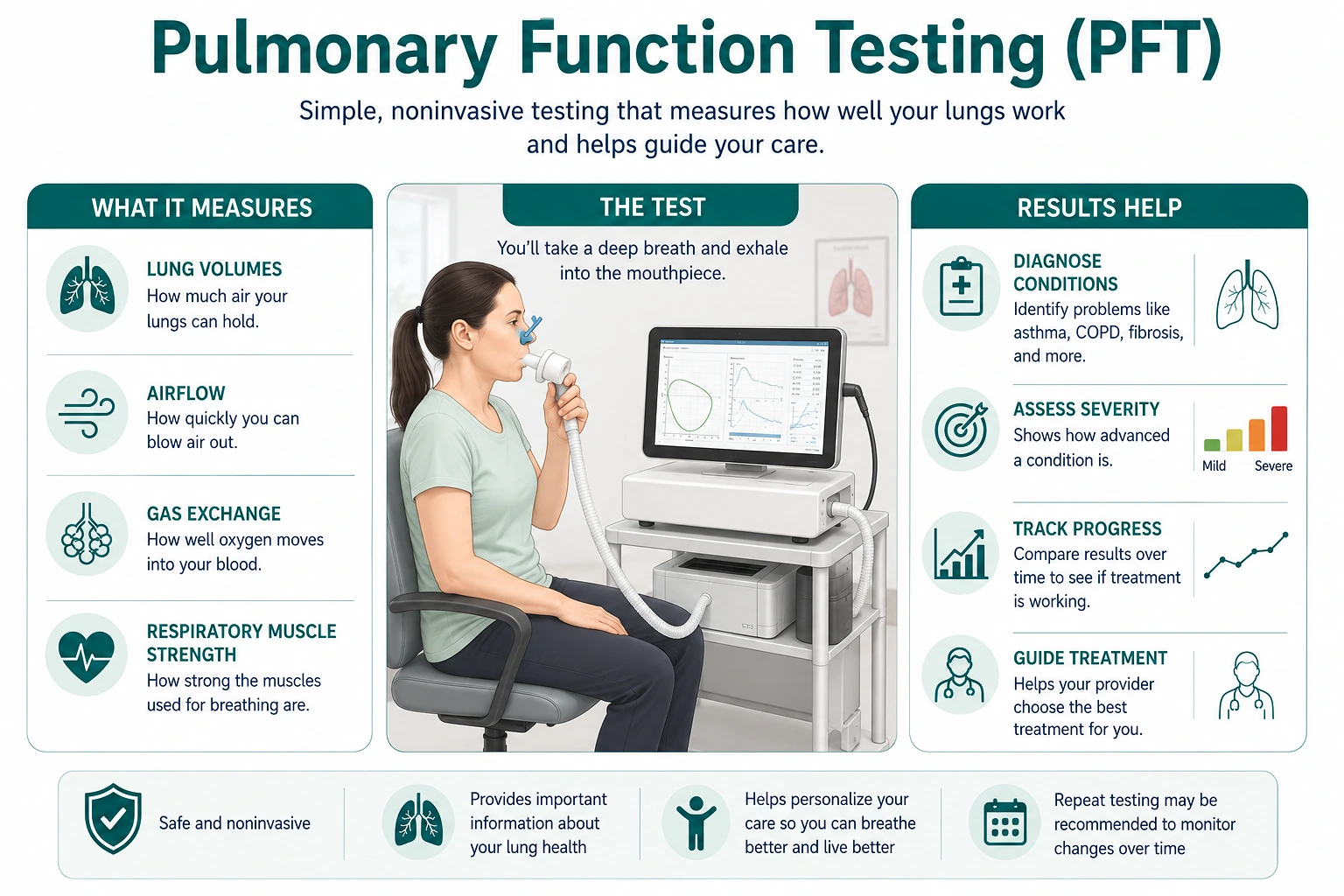
In short
Pulmonary function testing (PFT) is a group of breathing tests (including spirometry, lung volume measurement, and diffusing capacity (DLCO)) that together measure how well the lungs move air and exchange oxygen. It helps diagnose the cause of breathing symptoms and monitor known lung conditions over time.
At a Glance
What It Measures
How much air the lungs can hold, how quickly air moves in and out, and how well oxygen crosses into the bloodstream.
Why It Is Ordered
To help evaluate symptoms such as shortness of breath or cough, diagnose conditions like asthma or COPD, or monitor a known lung condition over time.
What to Expect
Breathing into a mouthpiece connected to testing equipment, following instructions from the technician, sometimes repeated after an inhaled medication.
What Results May Mean
Results are interpreted as a pattern across several measurements, together with your symptoms and medical history, not from any single number alone.
Key Takeaways
- Pulmonary function testing (PFT) is a family of breathing tests, not a single test: it typically combines spirometry, lung volumes, and sometimes diffusing capacity (DLCO).
- Results are meaningful as a pattern across multiple measurements interpreted alongside your symptoms and history: a single number should not be self-interpreted.
- Bronchodilator testing repeats spirometry after an inhaled medication to see whether airflow improves, which helps evaluate conditions like asthma and COPD.
- Obstructive patterns generally reflect difficulty getting air out, while restrictive patterns generally reflect reduced lung capacity or difficulty getting air in.
- Test quality depends on patient effort and technique, so technicians often ask for repeated efforts to confirm reproducible results.
- PFTs are used both to help diagnose the cause of respiratory symptoms and to track known lung conditions over time.
Side-by-Side Comparison
| Dimension | Component | What It Measures | Typical Use |
|---|---|---|---|
| Spirometry | Spirometry | How quickly and how much air you can forcefully exhale | Screening for airflow obstruction; most common PFT component |
| Lung Volumes | Lung Volumes | Total amount of air the lungs can hold, including air left after a full exhale | Distinguishing restrictive patterns from obstructive ones |
| DLCO (Diffusing Capacity) | DLCO (Diffusing Capacity) | How well oxygen moves from the air sacs into the bloodstream | Evaluating gas exchange, often in interstitial lung disease |
| Bronchodilator Testing | Bronchodilator Testing | Change in airflow after an inhaled bronchodilator medication | Assessing reversible airflow limitation, as in asthma or COPD |
What Pulmonary Function Testing Evaluates
Pulmonary function testing (PFT) is not a single test but a family of breathing tests that together assess how well the lungs move air and exchange gas. Rather than looking at the lungs directly the way an imaging study does, PFT measures how the lungs actually perform.
Lung Capacity
How much air the lungs can hold.
Airflow Speed
How quickly air moves in and out of the lungs.
Gas Exchange
How efficiently oxygen crosses from the air you breathe into your bloodstream.
Physicians order PFT for two broad reasons:
Diagnostic Evaluation
Helping identify the underlying cause of respiratory symptoms such as shortness of breath, chronic cough, wheeze, or reduced exercise tolerance.
A full PFT session may combine several components, each answering a different question about how the lungs are functioning. Not every patient needs every component: your physician selects which parts of the battery are appropriate based on your symptoms and history. The sections below describe what each component evaluates at a conceptual level.
Spirometry: Measuring Airflow
Spirometry is the most common and most frequently performed component of pulmonary function testing. It measures how much air you can forcefully exhale after a full breath in, and how quickly you can exhale it. Together, those measurements help assess whether anything is narrowing or obstructing the airways as air moves out of the lungs.
Also a Standalone Test
Because spirometry is so central to lung function evaluation, it is also frequently ordered and performed as its own standalone test, separate from a full PFT battery.
Full Detail on Its Own Page
How the test is measured and how specific results are classified is covered on the dedicated spirometry page. This page focuses on how spirometry fits alongside the other PFT components as part of a broader evaluation.
Lung Volumes: Measuring Lung Capacity
What It Measures
Lung volume testing measures how much air the lungs can hold in total, including the air that remains in the lungs even after you exhale as completely as possible.
How This Differs From Spirometry
This component asks a different question than spirometry does: spirometry asks how quickly air moves, while lung volume testing asks how much space the lungs have to work with in the first place. Combining the two often helps a physician tell two different clinical situations apart.
Narrowing Problem
Airflow limitation on spirometry with normal overall lung capacity.
Capacity Problem
Reduced lung capacity with relatively normal airflow speed on spirometry.
Lung volume measurement is typically performed using specialized equipment, such as a sealed chamber called a body plethysmograph, or a gas-dilution technique: the specific method used depends on the equipment available and the clinical question being asked.
DLCO: Measuring Gas Exchange
What It Measures
The diffusing capacity test, often abbreviated DLCO, evaluates how efficiently oxygen moves from the tiny air sacs in the lungs, called alveoli, into the bloodstream. This is a conceptually distinct question from either airflow or lung capacity.
Why DLCO Matters
Even when air is moving in and out of the lungs at a normal rate and volume, the lungs’ ability to actually transfer oxygen into the blood can still be reduced by certain conditions that affect the lung tissue itself or the blood vessels within it. DLCO gives physicians a window into this gas-exchange process that airflow measurements and lung volumes alone cannot provide.
It is particularly useful when evaluating conditions that primarily affect the lung tissue rather than the airways, such as interstitial lung disease, and can also provide useful information in some vascular lung conditions.
Bronchodilator Testing
Bronchodilator testing repeats spirometry after you inhale a bronchodilator medication, a type of medication that temporarily relaxes and opens the airways.
- 01Baseline SpirometryThe technician performs the initial spirometry measurements.
- 02Medication AdministeredYou inhale the bronchodilator medication.
- 03Wait PeriodThe technician waits a set period of time for the medication to take effect.
- 04Repeat SpirometryThe spirometry measurements are repeated so they can be compared with the baseline.
Comparing your breathing measurements before and after the medication helps physicians see whether airflow limitation improves significantly with treatment: a pattern often described as reversibility. This comparison is particularly relevant when evaluating conditions like asthma and COPD, since the degree of reversibility can be one factor, among several, that helps distinguish between the two or informs treatment decisions.
Obstructive vs. Restrictive Patterns
PFT results are often described using two broad conceptual categories that describe the general shape of a breathing problem:
Obstructive Patterns
Generally reflect difficulty getting air out of the lungs. Commonly associated with conditions such as asthma and COPD, where the airways are narrowed, inflamed, or partially blocked, making it harder to exhale fully and efficiently.
Restrictive Patterns
Generally reflect reduced overall lung capacity, or difficulty getting air in. Commonly associated with conditions such as interstitial lung disease, where the lungs themselves (or sometimes the chest wall or respiratory muscles) are less able to expand fully.
Some patients show a mixed pattern with features of both, and some conditions can evolve or overlap over time. This is intentionally a simplified, patient-friendly distinction meant to convey the general idea rather than a diagnosis.
The detailed technical criteria a physician uses to classify a specific spirometry result (including the specific measurements and ratios involved), belong to a physician’s clinical interpretation and are discussed in more depth on the spirometry page.
Why Results Are Read as a Pattern, Not a Single Number
Read as a Whole, Not in Isolation
This is one of the most important things to understand about pulmonary function testing: no single measurement from a PFT should be interpreted in isolation. A physician reviews the full set of results (spirometry, lung volumes, and DLCO where applicable), together, looking for a consistent pattern rather than focusing on any one number in isolation.
Combined With Your Full Clinical Picture
That pattern is then interpreted alongside your symptoms, medical history, physical examination, and sometimes imaging or additional testing. Two people can have a similar single number on one measurement and still have very different underlying conditions, depending on everything else in the picture.
Because of this, it is not accurate or safe to try to self-diagnose a lung condition from a single value on a lab printout, or to compare your own results against a general reference range without clinical context. If you have questions about what your specific results mean, that conversation belongs with the physician who ordered your testing.
How PFT Supports Asthma and COPD Evaluation
Pulmonary function testing, and spirometry with bronchodilator testing in particular, plays an important role in evaluating suspected asthma and COPD, and in monitoring both conditions once diagnosed.
In general, PFT results are one important piece of evidence among several (alongside your reported symptoms, your history of triggers or exposures, findings on physical examination, and sometimes additional testing) rather than a standalone diagnostic answer on their own.
For monitoring, periodic PFT can help a physician see whether a condition is stable on current treatment, whether lung function is declining over time in a way that warrants a change in management, or whether symptoms reported between visits correspond to measurable changes in lung function.
How to Prepare
Preparation instructions vary somewhat depending on which PFT components are being performed and why, so always follow the specific guidance given to you ahead of your appointment. In general, your technician or physician may ask you to:
- Avoid certain inhaled medications, such as short-acting or long-acting bronchodilators, for a specified period before the test if bronchodilator response is being assessed, since taking them beforehand could mask the result the test is designed to capture.
- Avoid smoking and vigorous exercise for a period before testing, since both can temporarily affect breathing measurements.
- Avoid large meals shortly before testing, since a very full stomach can make deep breathing efforts more difficult.
- Wear loose, comfortable clothing that does not restrict deep breathing.
If you take daily inhaled medications for a chronic condition, do not stop them on your own: confirm with your physician’s office which medications, if any, should be held before your specific test.
What to Expect During the Test
During testing, a technician will guide you through each portion of the PFT:
- 01SpirometrySit upright, place a clip on your nose, seal your lips around a mouthpiece, take the deepest breath you can, then exhale as forcefully and completely as possible until instructed to stop.
- 02Lung Volume TestingSit inside an enclosed chamber or breathe a small amount of a harmless tracer gas, depending on the method used.
- 03DLCOTake a single deep breath of a gas mixture, hold it briefly, and then exhale.
The effort required, especially for spirometry, can feel tiring or effortful (similar to a hard physical effort) but the test itself is not painful. A full PFT session combining multiple components typically takes somewhere between 30 and 60 minutes, depending on how many components are included and how many repeated efforts are needed to obtain quality results.
Test Quality and Reproducibility
Because results depend heavily on your effort and technique, you will typically be asked to repeat certain breathing efforts, particularly for spirometry, several times in a row. This is a normal and expected part of the test, not a sign that something went wrong.
The technician checks whether your repeated efforts are reasonably consistent with one another, a property referred to as reproducibility, before accepting the results as reliable enough to interpret.
If your early efforts are not reproducible, the technician may coach you further on technique or ask for additional attempts. This quality-control step matters because a poorly performed effort can produce a misleadingly low result that does not reflect your true lung function.
Pulmonary Function Testing in Children
Older children who are able to understand and follow the breathing instructions (including taking a maximal breath in and then exhaling forcefully and completely on cue), can often complete standard pulmonary function testing, including spirometry.
Younger children, or children who have difficulty cooperating with the specific breathing maneuvers required, may have lower-quality or less reliable results, and a physician may take that into account when interpreting them or may recommend alternative approaches to evaluation.
What Happens Next
After testing, your results are reviewed by a physician alongside your symptoms and medical history to help guide next steps, which may include starting or adjusting treatment, ordering additional testing such as imaging, or scheduling follow-up pulmonary function testing to monitor your condition over time.
How often testing is repeated for ongoing monitoring depends on the specific condition being tracked and your physician’s recommendation: ranging from routine periodic checks to more frequent testing during a change in symptoms or treatment.
Patient Questions
What is included in a pulmonary function test?
A full pulmonary function test (PFT) usually includes spirometry, lung volume measurement, and sometimes a diffusing capacity (DLCO) test. Depending on the reason for testing, it may also include bronchodilator testing, where spirometry is repeated after an inhaled medication.
How long does pulmonary function testing take?
A complete PFT session typically takes about 30 to 60 minutes, depending on how many components are included and how many repeat efforts are needed for quality results.
Does pulmonary function testing hurt?
No. The test involves breathing forcefully into a mouthpiece and can feel effortful or tiring, but it is not painful.
How should I prepare for a pulmonary function test?
Your technician or physician will give you specific pre-test instructions, which may include avoiding certain inhaled medications for a set period before the test, avoiding smoking, and wearing loose clothing that does not restrict deep breathing.
What do obstructive and restrictive results mean?
These terms describe general patterns. Obstructive patterns generally reflect difficulty getting air out of the lungs and are associated with conditions like asthma and COPD. Restrictive patterns generally reflect reduced overall lung capacity or difficulty getting air in, and are associated with conditions like interstitial lung disease.
Does one number from the test tell the whole story?
No. Pulmonary function results should be interpreted as a pattern across multiple measurements, together with your symptoms and medical history. A single isolated number should not be used to self-diagnose a lung condition.
How is pulmonary function testing different from spirometry alone?
Spirometry is one component of pulmonary function testing that measures airflow. A full PFT may add lung volume measurement and diffusing capacity (DLCO) testing to give a more complete picture of lung function.
How does pulmonary function testing relate to diagnosing asthma or COPD?
PFT results, especially spirometry and bronchodilator testing, are an important part of evaluating asthma and COPD, but they are interpreted together with your symptoms, history, and sometimes additional testing rather than as a standalone diagnosis.
What does DLCO measure?
DLCO, or diffusing capacity, measures how well oxygen moves from the air sacs in the lungs into the bloodstream. It provides information about gas exchange that spirometry and lung volumes do not capture on their own.
Can children have pulmonary function testing?
Older children who can follow breathing instructions and perform forceful, sustained breaths can often complete standard pulmonary function testing, though technique and cooperation affect result quality more in younger children.
How often is pulmonary function testing repeated for monitoring?
The frequency depends on the condition being monitored and your physician's recommendation, ranging from periodic routine checks to more frequent testing during changes in symptoms or treatment.
Will I need to repeat breathing efforts during the test?
Often, yes. Because results depend on effort and technique, technicians typically ask for several repeated efforts to confirm that the results are reproducible and reliable.
Sources
Guidelines and Professional Societies
- American Thoracic Society — clinical guidance on pulmonary function testing.
- ATS/ERS technical standards for spirometry and lung function testing.
- European Respiratory Society — standardization of lung function testing.
- American College of Chest Physicians — clinical use of pulmonary function testing.
Government and Regulatory Sources
- National Heart, Lung, and Blood Institute — patient guidance on lung function and diagnosis.