Treatment
Medically reviewed by Varun Halani, MD · August 13, 2026
Hypoglossal Nerve Stimulation for Sleep Apnea
An overview of hypoglossal nerve (upper-airway) stimulation therapy for obstructive sleep apnea, including how implanted stimulation devices work, general candidacy considerations, the pre-implant workup, and what treatment involves.
In short
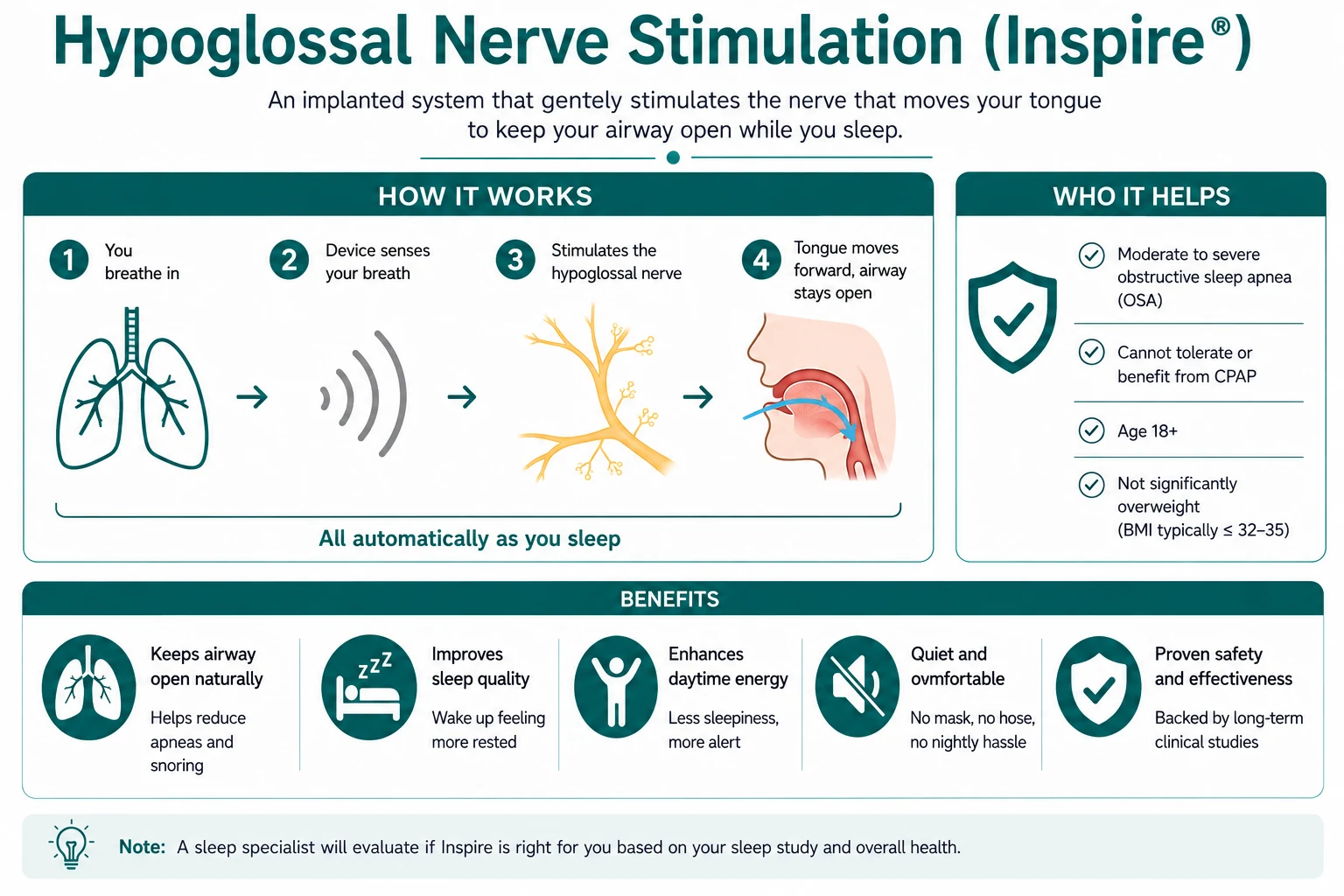
Hypoglossal nerve stimulation, also called upper airway stimulation, is an implanted device therapy for obstructive sleep apnea. A small device placed under the skin of the chest senses each breath and delivers mild, timed stimulation to the hypoglossal nerve, the nerve that controls tongue movement, so the tongue moves forward slightly during inhalation and helps keep the airway more open. It's generally considered for adults with moderate to severe obstructive sleep apnea who cannot tolerate or haven't had success with CPAP, after a confirmed sleep study diagnosis and, typically, a specific pre-implant airway evaluation. Several different device systems exist within this therapy class; this page covers the therapy class broadly rather than any single manufacturer's system.
At a Glance
What It Is
An implanted device, placed in an outpatient surgical procedure, that stimulates the hypoglossal nerve in time with breathing to reduce airway collapse during sleep.
Who It's Generally For
Adults with moderate to severe obstructive sleep apnea who have not tolerated or benefited from CPAP, evaluated individually against candidacy criteria that include weight, airway anatomy, and the pattern of airway collapse.
How It's Confirmed
A diagnosed sleep study, most often an in-lab study, comes first, and many programs also use a procedure called drug-induced sleep endoscopy to assess how the airway collapses before confirming candidacy.
The Process
Outpatient implantation, several weeks of healing, then device activation and a series of clinician-guided programming visits to find an effective, comfortable stimulation level.
Not a Universal Fix
Not everyone qualifies, and effectiveness varies by individual. It's a surgical intervention with its own risks and tradeoffs, not a risk-free substitute for CPAP.
Key Takeaways
- Hypoglossal nerve stimulation (upper airway stimulation) is an implanted device therapy that senses breathing and delivers timed stimulation to the nerve controlling tongue movement, helping keep the airway more open during sleep.
- It is generally considered for adults with moderate to severe obstructive sleep apnea who cannot tolerate or haven't improved with CPAP, not as a routine first-line therapy.
- A confirmed sleep study diagnosis is required beforehand, and many programs also use drug-induced sleep endoscopy to evaluate the specific pattern of airway collapse as part of candidacy screening.
- Several distinct device systems exist within this therapy class; a separate page covers one specific system in more device-level detail.
- The device is typically activated some weeks after surgery, and settings are adjusted by a clinician over multiple follow-up visits, often including a follow-up sleep study, to find an effective level.
- Not every person with sleep apnea is a candidate, results vary between individuals, and it remains a surgical option with its own considerations rather than a guaranteed cure.
Side-by-Side Comparison
| Dimension | CPAP | Hypoglossal Nerve Stimulation |
|---|---|---|
| How It Works | Delivers continuous air pressure through a mask to hold the airway open mechanically | An implanted device senses breathing and stimulates the tongue-movement nerve in time with inhalation |
| How Therapy Is Delivered | Worn nightly, externally, through a mask and tubing connected to a bedside machine | Implanted surgically; turned on nightly with a small external controller/remote, no mask |
| Getting Started | Typically first-line; often started soon after a confirmed diagnosis | Generally considered after CPAP has failed or proven intolerable, and after a specific candidacy evaluation |
| Pre-Treatment Workup | Sleep study confirming OSA diagnosis and severity | Sleep study confirming OSA, plus (for many programs) drug-induced sleep endoscopy to assess airway collapse pattern |
| Adjustability | Pressure settings can be changed relatively easily at any follow-up visit | Settings are adjusted at clinician visits after implantation; not a same-night change like a CPAP pressure tweak |
| Reversibility | Fully non-invasive; therapy can be stopped or paused at any time | Involves a surgical implant; discontinuing therapy means simply not using the device, though the implant itself remains unless surgically removed |
What Is Hypoglossal Nerve Stimulation?
Hypoglossal nerve stimulation, also called upper airway stimulation, is a therapy class for obstructive sleep apnea built around an implanted device rather than a mask and machine. The system has three working parts, each with a distinct job:
The Generator
A small pulse generator, placed under the skin near the upper chest, powers the system and connects to both leads.
The Sensing Lead
Detects the rhythm of breathing throughout the night, giving the device the timing signal it needs.
The Stimulation Lead
Placed near the hypoglossal nerve, the nerve that controls tongue movement. It delivers mild, timed stimulation coordinated with inhalation, so the tongue moves forward slightly at the moment it would otherwise fall back and narrow the airway.
It’s worth being clear from the outset that this is a therapy class, not one single product. Several distinct device systems exist within this space, each from a different manufacturer, with its own design, candidacy criteria, and programming approach.
This page covers the concepts shared across systems. A device-specific overview of one such system is covered separately for readers who want more detail on a particular manufacturer’s approach.
How It Works
The Core Mechanism
Airway collapse in obstructive sleep apnea often involves the tongue and surrounding soft tissue falling backward during sleep, particularly during inhalation when airway pressure naturally drops.
Hypoglossal nerve stimulation counters this directly: a sensing lead detects the pattern of breathing, and when inhalation begins, the device delivers a mild pulse of stimulation to the hypoglossal nerve. That pulse causes a subtle, coordinated contraction that moves the tongue forward and helps keep the airway space open.
How This Differs From CPAP
CPAP therapy works mechanically, using continuous air pressure delivered through a mask to physically splint the airway open regardless of muscle activity. Hypoglossal nerve stimulation instead works by prompting the airway’s own musculature to behave differently at the moment it matters most, without a mask, tubing, or external air pressure.
Who Is Generally Considered a Candidate
Hypoglossal nerve stimulation is not a first-line therapy and is not appropriate for everyone with obstructive sleep apnea. In general terms, it’s considered for adults with moderate to severe OSA who have been unable to tolerate CPAP, despite reasonable attempts and troubleshooting, or who haven’t had adequate improvement with it.
Beyond that starting point, candidacy evaluation typically looks at several additional factors together, rather than any single number in isolation:
Body Weight and BMI
Higher body weight is associated with a different pattern of airway collapse and can affect how well this therapy works, so weight and BMI are commonly reviewed, though specific thresholds vary between device systems and evolve as evidence accumulates.
The Pattern of Airway Collapse
Not every anatomic pattern of airway narrowing responds equally well to hypoglossal nerve stimulation. A specific pre-implant airway evaluation, described below, helps identify whether a person's collapse pattern is a good fit.
Anatomic and Medical Factors
Some anatomic characteristics and coexisting health conditions are also part of a full evaluation, since they can influence both surgical candidacy and expected therapy response.
Because these factors interact and because criteria can differ somewhat between specific device systems, the only reliable way to know whether someone qualifies is an individualized evaluation with a physician familiar with this therapy, not a self-assessment against a general checklist.
From Diagnosis to Therapy: The Treatment Pathway
Getting from a suspected sleep apnea problem to an active, programmed device follows a consistent sequence, even though the pace and specifics vary by program and device system.
- 01Confirmed Sleep StudyAn in-lab sleep study establishes the OSA diagnosis and its severity, a required starting point.
- 02Drug-Induced Sleep EndoscopyA sedated airway exam confirms the pattern of collapse is a good fit for this therapy.
- 03ImplantationAn outpatient surgical procedure places the device generator and its leads.
- 04ActivationThe device is turned on several weeks later, once the surgical sites have healed.
- 05Programming and Follow-UpA clinician adjusts settings over visits, often confirmed with a follow-up sleep study.
The sections below walk through each of these steps in more detail.
Why a Confirmed Sleep Study Diagnosis Comes First
Diagnosis Comes First
Hypoglossal nerve stimulation is never started based on symptoms alone. A confirmed diagnosis of obstructive sleep apnea, along with its severity, is a prerequisite, established through an in-lab sleep study.
What the Study Establishes
That result does more than confirm OSA is present. It documents severity and, together with the rest of the clinical picture, helps determine whether this therapy is an appropriate next step after CPAP has not worked.
Drug-Induced Sleep Endoscopy: Evaluating the Airway Directly
What the Procedure Involves
A specific procedure, drug-induced sleep endoscopy, is used by many hypoglossal nerve stimulation programs as part of the candidacy workup. In this brief outpatient procedure, a patient receives sedating medication intended to simulate the muscle relaxation of natural sleep, while a physician passes a small, flexible camera through the nose to directly observe how the airway narrows and collapses in real time.
Why It Matters for Candidacy
Not every pattern of airway collapse responds the same way to hypoglossal nerve stimulation. Certain patterns identified on this procedure are considered more favorable candidates for this therapy, while others may point a physician toward a different treatment approach. Rather than an optional extra, drug-induced sleep endoscopy is, for many programs, a core part of confirming candidacy before proceeding to implantation.
The Implantation Procedure
Placing the device is an outpatient surgical procedure, performed under anesthesia. In general terms, it involves one or more small incisions to position the device’s generator, along with its sensing and stimulation leads, in their intended locations. Most patients return home the same day rather than staying overnight.
As with any surgical procedure, there are real considerations to discuss beforehand:
Anesthesia Risk
As with any procedure performed under anesthesia, there is inherent anesthesia-related risk to review beforehand with the surgical team.
Recovery Period
Expect some discomfort and activity restrictions during a defined recovery period after surgery.
Implant-Related Risks
The general risks of any implanted device apply here too, such as infection or lead-related issues.
This is a genuine surgical intervention, approached as one, with a dedicated conversation about risks and recovery specific to the patient’s health history rather than treated as a minor or routine add-on procedure.
Activation and Programming
Timing of Activation
The device isn’t turned on right away. Most programs wait several weeks after implantation before activation, allowing the surgical sites time to heal properly.
How Settings Are Adjusted
Once activation occurs, stimulation levels are adjusted gradually over a series of follow-up visits, as a clinician works to find a level that’s both effective, meaningfully reducing airway collapse, and comfortable enough to sleep through.
This programming process is clinician-directed, not something a patient adjusts on their own. Many device systems do provide a small handheld controller that lets a patient turn nightly therapy on and off, or make limited adjustments within a range their physician has already set.
Optimization and Follow-Up Sleep Testing
Confirming It's Working
Once programming has stabilized, many programs schedule a follow-up sleep study to directly confirm the therapy is working as intended, rather than relying only on how a patient feels. In some cases, device settings are adjusted during that follow-up study itself as data comes in overnight, conceptually similar to how a CPAP titration study fine-tunes pressure levels during a monitored night of sleep.
Why This Step Matters
This step matters because symptom improvement and objective reduction in OSA severity don’t always move in perfect lockstep. Confirming the therapy’s actual effect on breathing during sleep, not just perceived rest quality, is part of responsible long-term management for any OSA treatment, hypoglossal nerve stimulation included.
What to Realistically Expect
For appropriately selected candidates, clinical evidence generally supports a meaningful reduction in OSA severity and improvement in associated symptoms such as daytime sleepiness with hypoglossal nerve stimulation. That said, a few honest limitations are worth stating plainly:
- Not everyone qualifies. Candidacy depends on OSA severity, prior CPAP experience, body weight, and the specific pattern of airway collapse found on evaluation. Many people with OSA will not meet criteria for this therapy.
- Effectiveness varies between individuals. Even among confirmed candidates, the degree of improvement differs from person to person, which is a core reason follow-up sleep testing matters rather than assuming success.
- It is a surgical intervention with its own tradeoffs. Implantation carries real procedural risks and a recovery period, and it is not a risk-free swap for CPAP simply because it avoids a mask.
- It is not marketed accurately as a guaranteed cure. Like most OSA treatments, the realistic goal is meaningful, measurable improvement in breathing during sleep and daytime symptoms, evaluated and confirmed individually, not a promise of complete elimination of every apnea event for every patient.
Hypoglossal Nerve Stimulation Care at VitalAir
Evaluating whether hypoglossal nerve stimulation may be appropriate starts with confirming an OSA diagnosis and severity, reviewing prior CPAP experience in detail, and, when the clinical picture supports it, coordinating the airway evaluation used to assess candidacy.
The VitalAir Sleep & Lung Center serves patients throughout Frisco, Texas and the greater North Dallas–Fort Worth area. A sleep evaluation is the starting point for understanding whether this therapy, continued CPAP troubleshooting, or another approach is the right fit for your specific situation.
Patient Questions
What is hypoglossal nerve stimulation?
Hypoglossal nerve stimulation, also called upper airway stimulation, is an implanted device therapy for obstructive sleep apnea. A small generator, placed under the skin of the upper chest during an outpatient procedure, connects to a sensing lead that detects breathing effort and a stimulation lead placed near the hypoglossal nerve, the nerve that controls tongue movement. During sleep, the device delivers mild, timed stimulation in coordination with inhalation, moving the tongue forward slightly to help keep the upper airway from collapsing.
How is this different from CPAP?
CPAP is a mask-based therapy that mechanically holds the airway open with continuous air pressure, worn externally every night. Hypoglossal nerve stimulation is a surgically implanted device that works through nerve stimulation and muscle movement rather than air pressure, and it doesn't require a mask. The two therapies work through fundamentally different mechanisms, and hypoglossal nerve stimulation is generally considered for people for whom CPAP hasn't been a workable option, not as an interchangeable alternative for everyone.
Who is generally a candidate for hypoglossal nerve stimulation?
Candidacy is determined individually, but in general terms, this therapy is considered for adults with moderate to severe obstructive sleep apnea who have been unable to tolerate or haven't had adequate success with CPAP. Additional factors that are typically evaluated include body weight and BMI, certain anatomic considerations, and the specific pattern of airway collapse identified on a pre-implant airway evaluation. These factors and their exact thresholds are assessed and can vary by device system and by individual clinical judgment, so a specific evaluation is the only way to know if someone qualifies.
Do I need a sleep study before this can be considered?
Yes. A confirmed diagnosis of obstructive sleep apnea, typically from an in-lab sleep study, is a prerequisite for hypoglossal nerve stimulation. The sleep study establishes the diagnosis and severity, both of which factor directly into whether this therapy is an appropriate option.
What is drug-induced sleep endoscopy, and why is it part of the workup?
Drug-induced sleep endoscopy is a brief outpatient procedure in which a patient is given sedating medication to simulate sleep while a physician uses a small camera to directly observe how the upper airway behaves and collapses. Many hypoglossal nerve stimulation programs use this procedure because certain patterns of airway collapse respond better to this therapy than others, and identifying that pattern beforehand helps confirm whether someone is a good candidate.
What does the implantation procedure involve?
Implantation is an outpatient surgical procedure performed under anesthesia, generally involving one or more small incisions to place the device's generator and leads. Most patients go home the same day. As with any surgery, there are procedural risks and a recovery period to plan for, and your surgical team will walk through what to expect specific to your situation.
When does the device get turned on after surgery?
The device is typically not activated immediately. Most programs wait several weeks after implantation to allow the surgical sites to heal before turning the device on and beginning the programming process.
How does programming work, and can I adjust my own settings?
After activation, stimulation settings are adjusted by your clinician over a series of follow-up visits, gradually finding a level that's both effective at reducing airway collapse and comfortable to sleep with. This is a clinician-guided process, not something patients titrate on their own, though many devices let you turn nightly use on and off with a small handheld controller within the range your clinician sets.
Will I need another sleep study after starting therapy?
Often, yes. Many programs schedule a follow-up sleep study after programming has stabilized to confirm the therapy is effectively reducing OSA severity, sometimes with settings adjusted during the study itself, conceptually similar to how a CPAP titration study fine-tunes pressure. This step confirms effectiveness rather than assuming it from symptom improvement alone.
How effective is hypoglossal nerve stimulation?
For appropriately selected candidates, clinical studies have generally shown meaningful reductions in OSA severity and improvement in symptoms such as daytime sleepiness. Results vary between individuals, and it is not accurate to describe this therapy as a guaranteed cure or as working equally well for everyone. Your own expected response is best discussed with your treating physician based on your specific airway findings and health profile.
Are there different hypoglossal nerve stimulation systems available?
Yes. This is a therapy class, not a single product, and more than one manufacturer produces a hypoglossal nerve stimulation device with its own specific design, candidacy criteria, and programming approach. This page describes the therapy class broadly; a device-specific overview of one such system is covered separately for readers who want more detail on a particular device.
Is hypoglossal nerve stimulation covered by insurance?
Coverage varies by insurer and plan, and typically requires documentation of a confirmed OSA diagnosis, a prior trial of CPAP that was not tolerated or effective, and results from the candidacy workup, including imaging or endoscopy findings where applicable. Our team can help review what documentation your specific plan requires before pursuing this therapy.
Sources
Guidelines and Professional Societies
- American Academy of Sleep Medicine. Hypoglossal Nerve Stimulation for the Treatment of Obstructive Sleep Apnea.View source
- American Academy of Sleep Medicine. Clinical Practice Guideline for Diagnostic Testing and Treatment of Obstructive Sleep Apnea, Journal of Clinical Sleep Medicine, 2025.View source
Government and Regulatory Sources
- U.S. Food and Drug Administration. Hypoglossal Nerve Stimulator for Obstructive Sleep Apnea, Premarket Approval and Device Safety Communications.View source
- Centers for Medicare & Medicaid Services. Local Coverage Determination, Hypoglossal Nerve Stimulation for the Treatment of Obstructive Sleep Apnea.View source
Key Evidence
- Strollo PJ, et al. Upper-Airway Stimulation for Obstructive Sleep Apnea. New England Journal of Medicine, 2014.View source