Sleep Medicine
Medically reviewed by Varun Halani, MD · August 12, 2026
Narcolepsy
A chronic neurological sleep disorder that disrupts the brain's normal regulation of sleep and wakefulness, causing persistent excessive daytime sleepiness and, in some patients, cataplexy and other distinctive REM-related symptoms.
In short
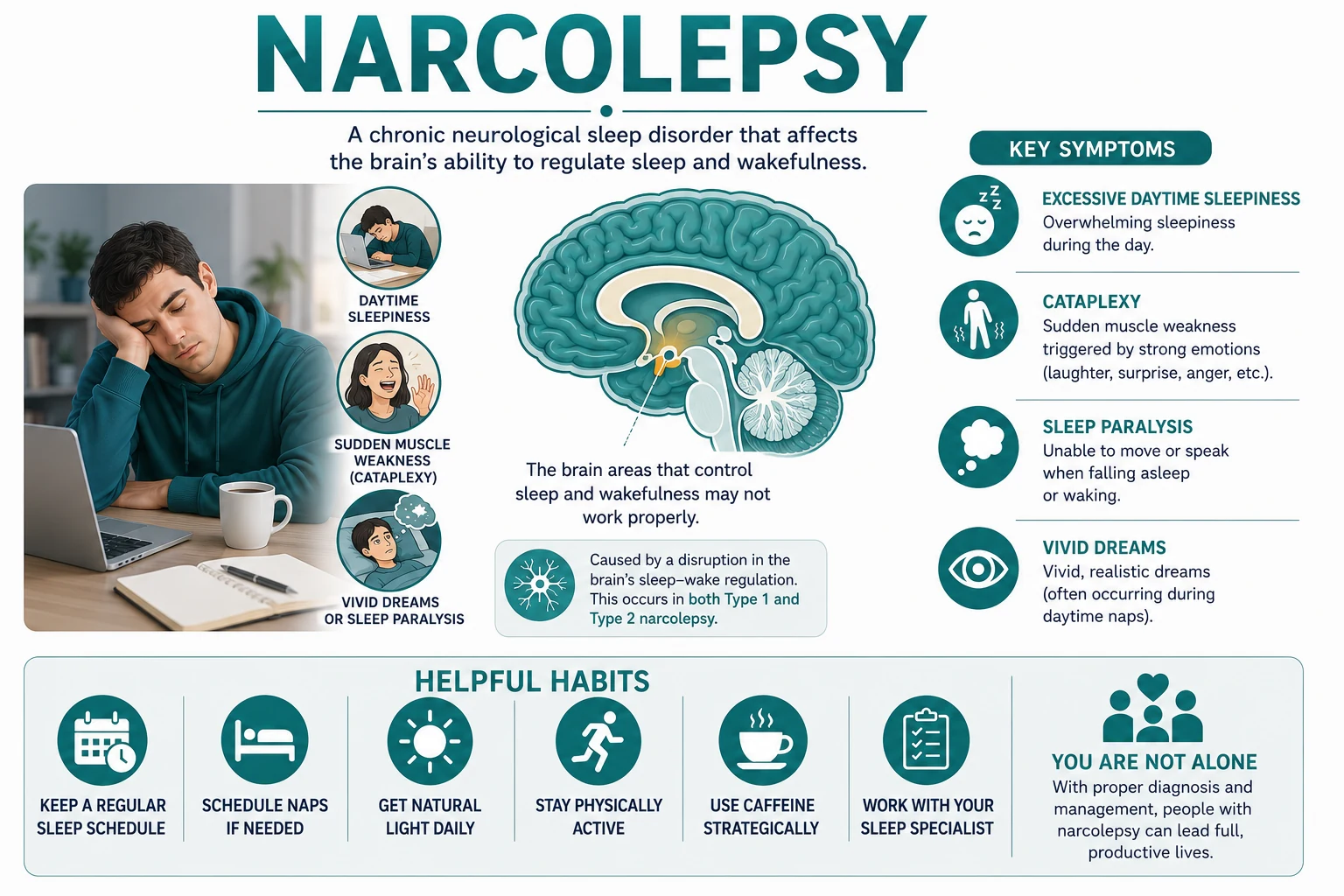
Narcolepsy is a chronic neurological disorder that disrupts the brain's normal regulation of sleep and wakefulness, causing persistent, often severe daytime sleepiness. Narcolepsy Type 1 also involves cataplexy, sudden, brief muscle weakness triggered by strong emotion, and is linked to a loss of orexin (hypocretin), a brain chemical that helps stabilize wakefulness. Narcolepsy Type 2 causes the same core sleepiness without cataplexy. Not everyone with narcolepsy has cataplexy, and not everyone collapses without warning; the pattern varies meaningfully from person to person.
Narcolepsy at a Glance
What Happens
The brain's normal boundaries between sleep and wakefulness break down, producing persistent daytime sleepiness and, in Type 1, cataplexy and other REM-related symptoms.
Type 1 vs. Type 2
Type 1 includes cataplexy and is linked to low orexin (hypocretin); Type 2 causes the same core sleepiness without cataplexy.
How It Is Diagnosed
An overnight sleep study followed by a multiple sleep latency test (MSLT), interpreted alongside a careful history and medication review.
How It Is Treated
A combination of wake-promoting medication, cataplexy-directed therapy when relevant, and lifestyle strategies, individualized to the type and symptom pattern.
Key Takeaways
- Narcolepsy Type 1 and Type 2 are distinct diagnoses, distinguished primarily by the presence of cataplexy and, when measured, orexin (hypocretin) levels.
- Cataplexy does not occur in all narcolepsy, and when it does, it ranges from subtle to dramatic; narcolepsy is not defined by suddenly collapsing without warning.
- Diagnosis relies on an overnight sleep study followed by a multiple sleep latency test (MSLT), which requires adequate prior sleep and a careful medication review to be interpreted reliably.
- Current treatment includes wake-promoting medications, oxybate therapies, and, as of August 2026, a newly FDA-approved orexin receptor agonist for Narcolepsy Type 1 specifically, alongside longstanding non-pharmacologic strategies.
Symptoms
Core Symptoms
- Persistent, often severe excessive daytime sleepiness
- Sudden, brief episodes of muscle weakness triggered by strong emotion (cataplexy), in Type 1
- Fragmented, frequently interrupted nighttime sleep, despite the daytime sleepiness
- Sleep paralysis, a brief inability to move while falling asleep or waking
- Hypnagogic or hypnopompic hallucinations, vivid, sometimes frightening sensory experiences while falling asleep or waking
Less Widely Known Features
- Automatic behavior, continuing a routine activity with reduced awareness or memory of it during a brief sleep intrusion
- Blurred vision, drooping eyelids, or a slack jaw during a milder cataplexy episode, rather than a dramatic full-body collapse
- Difficulty with sustained attention and memory, related to fragmented sleep and sleepiness rather than a separate cognitive disorder
Could This Be Narcolepsy?
Do I have to collapse suddenly to have narcolepsy?
No. Many people with narcolepsy never experience cataplexy at all (Narcolepsy Type 2), and when cataplexy does occur, it is often subtle, brief muscle weakness in the face, neck, or knees, rather than a dramatic full-body collapse. Narcolepsy is defined by its overall symptom and testing pattern, not by one dramatic moment.
What's the difference between narcolepsy and just being really sleepy?
The severity and persistence are different, and narcolepsy has a specific diagnostic pattern confirmed by an overnight sleep study and an MSLT the next day. Ordinary tiredness, even significant excessive daytime sleepiness from another cause, doesn't typically produce that same testing pattern, along with features like cataplexy or sleep paralysis.
Can narcolepsy start suddenly, or does it always develop slowly?
Both patterns occur. Some people notice a fairly rapid onset of symptoms, particularly cataplexy in Type 1, while others have a more gradual, harder-to-pinpoint development, which is part of why narcolepsy is sometimes not diagnosed until years after symptoms begin.
Is narcolepsy the same as idiopathic hypersomnia?
No, though the two can look similar on the surface. Both cause excessive daytime sleepiness, but they differ in testing results, associated features like cataplexy, and typical nighttime sleep patterns. A physician evaluation, informed by MSLT results, helps distinguish them.
What Causes Narcolepsy?
Loss of Orexin (Hypocretin)-Producing Brain Cells
In Narcolepsy Type 1, the brain cells that produce orexin, a chemical that helps stabilize wakefulness and regulate REM sleep, are lost, most likely through an autoimmune process. This loss is strongly linked to cataplexy.
An Autoimmune Process
The leading current understanding is that the immune system mistakenly targets orexin-producing cells in genetically susceptible individuals, though the exact trigger is still being researched.
Genetic Susceptibility
A specific HLA genetic marker is strongly associated with Narcolepsy Type 1, though carrying it does not mean a person will develop narcolepsy.
Narcolepsy Type 2's Mechanism
Less well understood than Type 1. Orexin levels are typically normal or not significantly reduced, and the underlying cause is an active area of research.
Secondary Narcolepsy
Rarely, narcolepsy-like symptoms occur due to a separate brain injury, tumor, or neurological condition affecting the same regulatory brain regions, distinct from typical Type 1 or Type 2 narcolepsy.
Risk Factors
- Onset typically in adolescence or young adulthoodThough narcolepsy can be diagnosed at any age, including later in life
- A family history of narcolepsyA modest increase in risk; most cases are not clearly inherited
- Certain genetic markers (HLA subtype)Associated with, but not diagnostic of, Narcolepsy Type 1 on its own
- An autoimmune process affecting orexin-producing brain cellsThe leading understanding for Type 1's underlying mechanism, an area of active research
- A preceding infection, in some documented casesAn area of ongoing research rather than an established cause for most patients
Why Narcolepsy Matters
Safety
Persistent sleepiness and, in Type 1, cataplexy triggered by emotion, both carry real safety implications for driving and other alertness-dependent activities.
Daily & Social Function
Unpredictable sleepiness and, for some, cataplexy can affect school, work, and relationships, and living with narcolepsy often involves adjustments most people never have to think about.
Underdiagnosis & Delay
Narcolepsy is frequently misattributed to laziness, poor sleep habits, or another condition for years before diagnosis, which is part of why recognizing its actual symptom pattern matters.
A Treatable Chronic Condition
Narcolepsy is a lifelong condition, but its symptoms are, for most patients, substantially manageable with the right individualized treatment plan.
When Should I Talk to a Sleep Specialist?
- Persistent, severe daytime sleepiness that hasn't improved with adequate sleep opportunity
- Sudden, brief muscle weakness triggered by laughter, surprise, or other strong emotion
- Vivid hallucinations or a brief inability to move while falling asleep or waking
- Fragmented nighttime sleep despite overwhelming daytime sleepiness
- Falling asleep unintentionally during routine daytime activities, including driving
- Daytime sleepiness that started or worsened noticeably over weeks to months
What Is Narcolepsy?
A Disorder of Sleep-Wake Regulation
Narcolepsy is a chronic neurological disorder in which the brain has difficulty maintaining stable boundaries between sleep and wakefulness. The result is persistent, often severe excessive daytime sleepiness, along with, in some patients, features that intrude from REM sleep into wakefulness: cataplexy, sleep paralysis, and vivid hallucinations while falling asleep or waking.
Not a Single, Uniform Experience
Narcolepsy is genuinely variable from person to person. Some patients have prominent, frequent cataplexy; many have none at all. Some notice a fairly sudden onset; others develop symptoms gradually over months or years. Understanding which pattern applies to a given patient, rather than assuming a single stereotyped presentation, is central to accurate diagnosis.
Narcolepsy Type 1 vs. Type 2
This distinction shapes diagnosis, prognosis, and treatment, and is worth understanding clearly.
| Dimension | Narcolepsy Type 1 | Narcolepsy Type 2 |
|---|---|---|
| Cataplexy | Present, by definition, though frequency and severity vary widely | Absent, by definition |
| Orexin (Hypocretin) Levels | Typically low, when measured | Typically normal or not significantly reduced |
| Underlying Mechanism | Loss of orexin-producing brain cells, most likely autoimmune | Less well understood; an active area of research |
| MSLT Pattern | Meets narcolepsy criteria on MSLT, alongside the clinical history of cataplexy | Meets narcolepsy criteria on MSLT, without cataplexy |
| Core Daytime Sleepiness | Present and often severe | Present and often severe, the same core symptom as Type 1 |
Cataplexy, Sleep Paralysis & Hallucinations
These three features are grouped together because they share a common underlying mechanism, elements of REM sleep intruding into wakefulness, though only cataplexy is specific to Narcolepsy Type 1.
Cataplexy
Sudden, brief muscle weakness triggered by strong emotion, most classically laughter or surprise. Ranges from subtle facial or knee weakness to more pronounced episodes. Consciousness is preserved throughout.
Sleep Paralysis
A brief inability to move or speak while falling asleep or waking, with full awareness of the surroundings. Can occur in narcolepsy or, less commonly, on its own in people without narcolepsy.
Hypnagogic & Hypnopompic Hallucinations
Vivid, sometimes frightening sensory experiences occurring while falling asleep or waking, distinct from a dream recalled after fully waking.
It bears repeating: narcolepsy does not require dramatic collapse, and many patients, particularly with Narcolepsy Type 2, experience none of these three features at all. The core symptom present in every case is persistent excessive daytime sleepiness.
How Narcolepsy Is Diagnosed
Starting With History
Diagnosis starts with a detailed history of sleepiness, cataplexy or its absence, sleep paralysis, hallucinations, nighttime sleep quality, and how symptoms developed over time. Other causes of excessive daytime sleepiness, insufficient sleep, sleep apnea, insomnia, and certain medications, are considered and, where relevant, addressed or ruled out first.
Confirming With Testing
Confirmation relies on an overnight in-lab sleep study followed by a multiple sleep latency test (MSLT) the next day, a series of scheduled daytime nap opportunities that measure how quickly you fall asleep and whether REM sleep appears unusually early.
The Diagnostic Pathway
- 01Clinical HistorySleepiness pattern, cataplexy, sleep paralysis, hallucinations, and nighttime sleep are reviewed in detail.
- 02Ruling Out Other CausesInsufficient sleep, sleep apnea, insomnia, and medication effects are considered and addressed first.
- 03Sleep Adequacy ConfirmationAdequate sleep in the days beforehand, sometimes tracked with a sleep diary or actigraphy, is confirmed before testing.
- 04Medication ReviewCertain medications, including some antidepressants, can suppress REM sleep and distort results, so they are reviewed before testing.
- 05Overnight Sleep StudyRules out other causes of sleepiness and confirms adequate sleep the night before the MSLT.
- 06Multiple Sleep Latency Test (MSLT)Measures sleep onset speed and REM timing across several scheduled daytime naps.
- 07Type Determination & TreatmentResults, alongside the clinical history, distinguish Type 1 from Type 2 and guide an individualized treatment plan.
Why Preparation Matters for Accurate Results
An MSLT is only as reliable as the conditions around it. Insufficient sleep in the nights before the test, an inconsistent schedule, or REM-suppressing medications, including many antidepressants and some stimulants, can all distort results, either producing a false-positive pattern or masking a true one. This is why your physician reviews your medications and typical sleep pattern carefully before scheduling the test, and why any medication changes before testing should be made under medical guidance rather than on your own.
How Is Narcolepsy Treated?
Treatment is individualized to the type, symptom pattern, and severity, generally combining medication with supportive strategies.
For Daytime Sleepiness
Wake-promoting medications, oxybate therapies, or, for Narcolepsy Type 1, the newly approved orexin receptor agonist discussed below, are the main pharmacologic options, chosen individually.
For Cataplexy
Oxybate therapies and pitolisant, along with certain other medication classes, can specifically reduce cataplexy frequency and severity when present.
A Newly Approved Treatment for Narcolepsy Type 1
In August 2026, the FDA approved oveporexton, an oral orexin receptor agonist, specifically for Narcolepsy Type 1 in adults. Because Type 1 involves a loss of the brain’s own orexin signaling, this medication is notable for working through that underlying mechanism directly, rather than only relieving sleepiness symptomatically the way earlier medication classes do. Clinical trials showed improvement across sleepiness, cataplexy, and quality-of-life measures compared to placebo. It is approved for Narcolepsy Type 1 only, not Type 2, since Type 2 does not involve the same orexin deficiency. As a very recently approved medication, availability was still becoming established at the time of approval, and it involves its own specific safety and monitoring considerations; whether and when it’s an appropriate option is a conversation to have directly with your physician, not something to assume from general information alone.
Distinguishing Narcolepsy From Other Causes of Sleepiness
Because persistent daytime sleepiness has many possible causes, part of a careful narcolepsy evaluation is confirming that other, more common explanations don’t better fit the picture first. Insufficient sleep opportunity is ruled out by reviewing actual sleep schedule and duration, often with a sleep diary or actigraphy in the weeks before testing. Obstructive sleep apnea and other causes of fragmented nighttime sleep are evaluated with an overnight sleep study, the same study used as the first half of narcolepsy testing itself. Idiopathic hypersomnia, a related but distinct central disorder of hypersomnolence, is distinguished largely through MSLT findings and the absence of cataplexy or a positive orexin/HLA picture associated with Type 1. This layered approach, ruling out simpler explanations before concluding narcolepsy, is part of why an accurate narcolepsy diagnosis can take real clinical time and more than one visit, rather than being apparent from symptoms alone.
Living With Narcolepsy
Alongside medication, many patients find that a few practical strategies meaningfully help day to day: short, strategically timed naps, often 15 to 20 minutes, placed before activities that demand sustained attention; a consistent sleep and wake schedule, even on weekends; and, for cataplexy specifically, learning to recognize personal triggers and, where reasonable, planning around them, though the goal is managing cataplexy through treatment rather than avoiding all strong emotion. Many patients also find real value in connecting with a narcolepsy-specific patient organization, both for practical tips and for the experience of feeling understood by people who live with the same condition. Employers, schools, and driving authorities may also need to be part of the conversation depending on symptom severity, and your physician can help provide the documentation and guidance that conversation often requires.
Narcolepsy Care at VitalAir
Sleep testing is the starting point for a narcolepsy evaluation at VitalAir, ruling out and addressing other causes of daytime sleepiness before moving toward MSLT-based confirmation when the history supports it; patients wondering whether their daytime sleepiness reflects narcolepsy specifically, versus a more common cause, may also find this guide on unexplained daytime tiredness a useful starting point.
VitalAir evaluates and manages narcolepsy for patients across Frisco, North Dallas, and the broader North Texas area, including coordinating overnight sleep studies and MSLT testing and building an individualized, current treatment plan once a diagnosis is confirmed. The clinical information on this page applies to patients everywhere; what differs locally is simply where that evaluation and follow-up care happens.
Narcolepsy Care in Frisco, Texas
VitalAir Sleep & Lung Center evaluates and manages narcolepsy for patients across Frisco, Texas, and the broader North Dallas area, including the MSLT testing used to confirm the diagnosis and distinguish Type 1 from Type 2. The clinical information on this page applies to patients everywhere; what differs locally is simply where that evaluation and follow-up care happens.
Patient Questions
What is the difference between Narcolepsy Type 1 and Type 2?
Narcolepsy Type 1 includes cataplexy, sudden muscle weakness triggered by strong emotion, and is associated with low orexin (hypocretin) levels, a brain chemical that helps stabilize wakefulness. Narcolepsy Type 2 causes the same core excessive daytime sleepiness without cataplexy, and orexin levels are typically normal or not significantly reduced. Both are diagnosed with an overnight sleep study followed by a multiple sleep latency test.
Does everyone with narcolepsy have cataplexy?
No. Cataplexy is specific to Narcolepsy Type 1, and even within Type 1, its frequency and severity vary widely between people, from occasional mild jaw or knee weakness to more pronounced episodes. Narcolepsy Type 2, by definition, does not include cataplexy.
What triggers cataplexy?
Strong emotion, most classically laughter or surprise, but also anger or excitement, is the typical trigger. Episodes are brief, usually seconds to a couple of minutes, and consciousness is preserved throughout, even though the person cannot move or speak normally during the episode.
What is orexin (hypocretin) and why does it matter for narcolepsy?
Orexin, also called hypocretin, is a brain chemical produced by a small group of neurons that helps stabilize wakefulness and regulate the transitions into and out of REM sleep. In Narcolepsy Type 1, these orexin-producing cells are lost, most likely through an autoimmune process, which is central to both the sleepiness and cataplexy seen in Type 1.
How does the MSLT diagnose narcolepsy?
The multiple sleep latency test measures how quickly you fall asleep during several scheduled daytime nap opportunities, and whether REM sleep appears unusually early in those naps. It's performed the day after an overnight sleep study confirms you had adequate sleep beforehand, since insufficient prior sleep or certain medications can distort the results, which is why both are carefully reviewed before the test.
Can medications affect narcolepsy testing results?
Yes, significantly. Certain antidepressants, stimulants, and other medications can suppress REM sleep or otherwise distort MSLT results, so your physician will typically review your medications and may recommend tapering certain ones before testing, under medical guidance, never stopped abruptly on your own.
Is narcolepsy the same as always feeling tired?
No. Ordinary tiredness or fatigue generally improves with adequate sleep. Narcolepsy causes persistent, often severe sleepiness and sleep-wake regulation problems that don't resolve with more sleep opportunity alone, and it has a specific diagnostic pattern on testing that ordinary tiredness does not.
What is automatic behavior in narcolepsy?
It's continuing a routine task, like writing or driving a familiar route, with reduced awareness during a brief sleep intrusion, sometimes producing errors or gaps in memory for that period. It reflects how narcolepsy blurs the boundary between sleep and wakefulness, rather than a separate condition.
Is the new narcolepsy medication approved in August 2026 available to everyone with narcolepsy?
No. It's specifically approved for Narcolepsy Type 1 in adults, since it addresses the orexin deficiency characteristic of that type, and it is not approved for Narcolepsy Type 2. As a very recently approved medication, broader pharmacy availability was still becoming established at the time of approval; ask your physician about current status and whether it may be appropriate for you.
Can narcolepsy be cured?
Not currently. Narcolepsy is a chronic, lifelong condition, but current treatment, medication and non-pharmacologic strategies together, can substantially manage symptoms for most patients, and ongoing research continues to expand available options.
Sources
Guidelines and Professional Societies
- Maski K, et al. Treatment of Central Disorders of Hypersomnolence, An American Academy of Sleep Medicine Clinical Practice Guideline. Journal of Clinical Sleep Medicine, 2021.
- American Academy of Sleep Medicine. The Multiple Sleep Latency Test and Maintenance of Wakefulness Test, Clinical Practice Guidance.View source
- Mayo Clinic. Narcolepsy, Symptoms and Causes.View source
Government and Regulatory Sources
- Takeda. FDA Approves Orzeyful (oveporexton), the First Orexin Receptor Agonist for the Treatment of Narcolepsy Type 1, August 2026.View source