Sleep Medicine
Medically reviewed by Varun Halani, MD · August 12, 2026
Restless Legs Syndrome
A neurological condition causing an uncomfortable, often hard-to-describe urge to move the legs, typically worse at rest and in the evening, and typically relieved, at least temporarily, by movement.
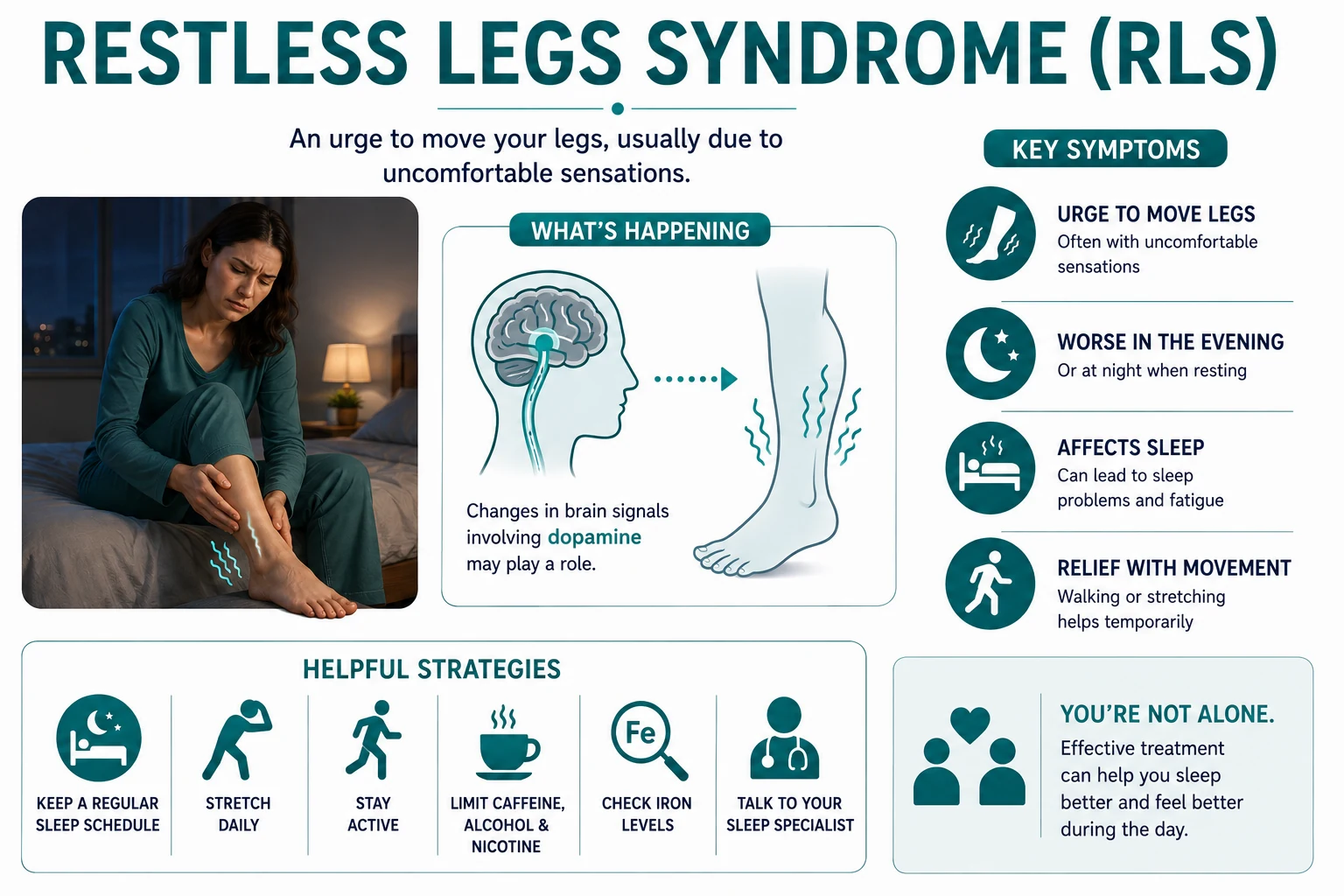
In short
Restless legs syndrome (RLS) is a neurological condition causing an uncomfortable, often hard-to-describe urge to move the legs, typically worse in the evening or at rest, and typically relieved, at least temporarily, by movement. Low brain iron is thought to be an important underlying factor for many patients, which is why current guidance emphasizes iron testing and, when appropriate, iron replacement. Current sleep medicine guidance has also shifted away from dopamine agonists as the default long-term medication, favoring alpha-2-delta ligand medications first, largely because of a slow-developing complication called augmentation.
Restless Legs Syndrome at a Glance
What Happens
An uncomfortable urge to move the legs, typically worse in the evening or at rest, and typically relieved, at least temporarily, by movement.
Common Causes
Low brain iron is a major underlying factor for many patients; pregnancy, kidney disease, certain medications, and genetics also contribute.
How It Is Diagnosed
Primarily a clinical diagnosis based on symptom pattern, supported by iron studies; a sleep study is not routinely needed to diagnose RLS itself.
How It Is Treated
Iron assessment and replacement when indicated, exacerbating-factor review, and, for persistent symptoms, alpha-2-delta ligand medication as the modern first-line pharmacologic option.
Key Takeaways
- RLS is defined by an urge to move the legs with an uncomfortable sensation, worse at rest and in the evening, and relieved by movement, not simply "leg discomfort" in general.
- Iron assessment, and treatment when levels are low, is now emphasized as a foundational, evidence-based part of RLS management, not an afterthought.
- Current AASM guidance favors alpha-2-delta ligand medications (like gabapentin enacarbil) over dopamine agonists as the modern first-line pharmacologic approach, a meaningful shift from older guidance.
- Augmentation, a specific worsening pattern linked to long-term dopamine agonist use, is a key reason for this shift and is worth understanding before starting that medication class.
Symptoms
Core Symptoms
- An urge to move the legs, usually with an uncomfortable, hard-to-describe sensation (crawling, aching, pulling, or itching under the skin)
- Symptoms that begin or worsen during rest or inactivity, such as sitting or lying down
- Symptoms that are partially or fully relieved by movement, at least temporarily
- Symptoms that are worse in the evening or at night than earlier in the day
Related Nighttime Features
- Difficulty falling asleep because of leg discomfort
- Periodic limb movements during sleep, involuntary leg twitching, which a bed partner may notice even if the patient does not
Could This Be Restless Legs Syndrome?
Is this RLS or just leg cramps?
They're different. A leg cramp is a sudden, often painful muscle contraction, usually brief and not specifically tied to rest or relieved by movement in the same way. RLS is an urge to move with an uncomfortable sensation, worse at rest, and relieved, at least temporarily, by movement. The pattern, not just the discomfort itself, is what distinguishes them.
Could this be neuropathy instead of RLS?
Possibly, and the two can coexist. Neuropathy typically causes more constant numbness, tingling, or burning that isn't specifically tied to rest and isn't reliably relieved by movement, whereas RLS has that characteristic rest-triggered, movement-relieved pattern. A physician evaluation can help sort out which, or both, applies.
Do I have RLS or PLMD?
These are related but distinct. RLS is a symptom-based diagnosis, the urge to move with discomfort, that you can describe. Periodic limb movement disorder (PLMD) refers to limb movements during sleep identified on a sleep study, movements a patient often isn't aware of. Many people with RLS also have periodic limb movements, but the two are not the same diagnosis and PLMD guidance remains far less developed.
Is it just restlessness, or could it be RLS?
General restlessness or fidgeting isn't the same as RLS, which specifically involves an urge to move paired with an uncomfortable sensation, following the rest-triggered, evening-worse, movement-relieved pattern. If that specific pattern fits, it's worth discussing with a physician.
What Causes Restless Legs Syndrome?
Low Brain Iron
Even without anemia on a standard blood count, reduced iron availability in specific brain regions is thought to be an important underlying mechanism in many patients, which is why iron studies are a standard part of evaluation.
Genetics
A family history is common, particularly with earlier-onset RLS, and specific genetic variants have been associated with increased risk.
Pregnancy
RLS is common during pregnancy, especially the third trimester, related in part to iron demands and hormonal changes, and typically improves after delivery.
Chronic Kidney Disease
RLS is more common in patients with chronic kidney disease, particularly those on dialysis.
Medications
Certain antihistamines, antidepressants, and anti-nausea medications can trigger or worsen RLS symptoms in susceptible individuals, and a medication review is a standard part of evaluation.
Other Neurological Conditions
Peripheral neuropathy and certain other neurological conditions are associated with RLS in some patients, though RLS also occurs without any of these.
Risk Factors
- Low iron stores, even without full-blown iron-deficiency anemiaAn important, treatable contributor for many patients
- Pregnancy, particularly in the third trimesterOften improves after delivery
- Chronic kidney disease
- A family history of RLSA genetic component is well recognized, especially in earlier-onset cases
- Certain medications, including some antihistamines, antidepressants, and anti-nausea medicationsA reviewable, sometimes reversible contributor
- Older age
- Peripheral neuropathy or other underlying neurological conditions, in some patients
Why Restless Legs Syndrome Matters
Sleep Disruption
Evening and nighttime symptoms commonly delay sleep onset and fragment sleep, which can lead to daytime fatigue and reduced quality of life.
Quality of Life
Beyond sleep, RLS can affect the ability to sit through long car rides, flights, meetings, or movies, situations that require prolonged stillness.
A Treatable, Not Just "Manageable," Condition
With current, evidence-based treatment, most patients see meaningful symptom improvement, which is part of why accurate diagnosis and an up-to-date treatment approach both matter.
Medication Choice Matters Long-Term
Because certain RLS medications carry a real risk of a slow-developing complication (augmentation, discussed below) with long-term use, the choice of first medication has consequences well beyond initial symptom relief.
When Should I Talk to a Sleep Specialist?
- An urge to move the legs with an uncomfortable sensation, worse at rest and in the evening, relieved by movement
- RLS symptoms that are disrupting sleep onset or overall sleep quality
- New or worsening RLS symptoms during pregnancy
- RLS symptoms alongside a known iron deficiency, kidney disease, or a medication recently started
- Currently on a dopamine agonist for RLS with symptoms that have started earlier in the day, spread to new body areas, or intensified
- RLS symptoms significant enough to affect long car rides, flights, or the ability to sit through routine activities
What Is Restless Legs Syndrome?
A Specific Symptom Pattern
Restless legs syndrome (RLS), also called Willis-Ekbom disease, is a neurological condition causing an urge to move the legs, usually paired with an uncomfortable, often hard-to-describe sensation, crawling, aching, pulling, or itching underneath the skin rather than on its surface.
Not the Same as General Leg Discomfort
Four features define RLS together, not any one alone: the urge to move with discomfort, symptoms that begin or worsen with rest, symptoms that are worse in the evening or at night, and symptoms that are relieved, at least temporarily, by movement. This specific combination is what distinguishes RLS from other causes of leg discomfort.
Distinguishing RLS From Look-Alikes
Several conditions can resemble RLS on the surface, and getting the distinction right meaningfully changes both diagnosis and treatment.
| Dimension | Restless Legs Syndrome | Leg Cramps | Peripheral Neuropathy |
|---|---|---|---|
| Core Sensation | An urge to move, with crawling, aching, or pulling discomfort | A sudden, often painful muscle contraction | Numbness, tingling, or burning |
| Relationship to Rest | Begins or worsens specifically during rest or inactivity | Not specifically tied to rest; often sudden | Often fairly constant, not specifically rest-triggered |
| Relieved By Movement? | Yes, at least temporarily | Stretching the specific muscle typically helps | Not reliably; movement doesn’t specifically relieve it |
| Timing Pattern | Characteristically worse in the evening and at night | Can occur at any time, often during or after activity or at night | Often fairly constant throughout the day |
It’s also worth being direct that RLS and periodic limb movements during sleep (PLMS), including the related diagnosis periodic limb movement disorder (PLMD), are not the same thing. RLS is a symptom you experience while awake; PLMS/PLMD are movements identified on a sleep study, often unnoticed by the patient. The two commonly occur together, but current guidance treats them as genuinely distinct conditions.
How Restless Legs Syndrome Is Diagnosed
Primarily a Clinical Diagnosis
RLS is diagnosed based on the specific symptom pattern described above, through a detailed history. A sleep study is not routinely needed to diagnose RLS itself, though one may be added if another sleep disorder, such as sleep apnea, is also suspected.
Confirmed With Iron Studies
Iron studies, ferritin and transferrin saturation specifically, are a standard part of evaluation, using RLS-specific thresholds rather than general population reference ranges, since even “normal” iron levels by standard cutoffs may be low enough to matter for RLS.
The Evaluation Pathway
- 01Symptom HistoryThe four-part pattern, urge to move, rest-triggered, evening-worse, movement-relieved, is reviewed in detail.
- 02Ruling Out MimicsLeg cramps, neuropathy, and positional discomfort are distinguished based on the specific pattern present.
- 03Iron StudiesFerritin and transferrin saturation are checked using RLS-specific thresholds.
- 04Exacerbating-Factor ReviewCurrent medications, caffeine, alcohol, and sleep habits are reviewed for contributing factors.
- 05Personalized TreatmentIron replacement when indicated, exacerbating-factor changes, and medication, when needed, are planned individually.
How Is Restless Legs Syndrome Treated?
Iron Correction
A foundational, evidence-based step when iron studies indicate low levels, using oral or, in appropriate cases, intravenous iron.
Exacerbating-Factor Review
Adjusting contributing medications, caffeine, alcohol, and sleep habits where reasonable and appropriate.
The Modern Role of Medication
Current AASM guidance reflects a genuinely important shift in how RLS medication is chosen, worth explaining honestly rather than defaulting to older, more familiar advice. Alpha-2-delta ligand medications, gabapentin, pregabalin, and gabapentin enacarbil among them, are now strongly recommended as the first-line pharmacologic option for most patients needing medication beyond iron correction.
Dopamine agonists, pramipexole, ropinirole, and rotigotine, previously considered strong first-line options, are now conditionally recommended against for long-term use. This isn’t because they don’t work initially, many patients do get real short-term relief, but because of augmentation, discussed in detail below, a complication current guidance now weighs heavily in this recommendation.
Understanding Augmentation
Augmentation is worth explaining clearly, in plain language, because it’s central to why RLS treatment guidance has changed. When someone takes a dopamine agonist for RLS over months to years, symptoms can gradually worsen in a specific pattern.
Starts Earlier in the Day
Symptoms that previously appeared only in the evening begin showing up earlier in the day than before.
Spreads to New Areas
Discomfort spreads to body parts that weren’t previously affected, such as the arms.
Becomes More Intense
Symptoms become more intense overall, sometimes even as the dose is increased to try to compensate.
Because this develops slowly, it can be mistaken for the underlying RLS simply getting worse on its own, rather than recognized as a medication-related complication, exactly what happened in earlier research before augmentation was well characterized.
If you are on a dopamine agonist and notice symptoms starting earlier, spreading, or intensifying, bring this to your physician rather than increasing the dose yourself; managing augmentation typically involves a supervised, gradual transition to a different treatment approach, not simply taking more of the same medication.
Restless Legs Syndrome in Special Situations
Pregnancy
Common, especially in the third trimester, and typically improves or resolves after delivery. Iron status is checked as it would be otherwise, and medication decisions are made carefully and individually with your physician rather than defaulting to a standard non-pregnancy approach.
Chronic Kidney Disease
More common, particularly in patients on dialysis, and can be harder to control. Iron and mineral status are managed in close coordination with the patient’s kidney care team given the overlapping considerations.
Children
RLS exists in children, though it is less commonly recognized than in adults, and can be mistaken for "growing pains" or attention difficulties, especially when it disrupts sleep enough to affect daytime behavior.
Across all of these situations, the same core evaluation, symptom pattern and iron status, still applies; what changes is how treatment decisions are weighed against the broader clinical picture.
Follow-Up and Monitoring
RLS is not a diagnose-once, treat-forever condition. Iron status can change over time and is reasonably reassessed periodically, especially if symptoms return after a period of good control. Anyone on a dopamine agonist benefits from an ongoing, specific conversation about augmentation at follow-up visits, not just a general symptom check, since augmentation’s early signs are easy to miss if not asked about directly.
Those early signs, symptoms starting earlier in the day or spreading to new areas, are exactly what that follow-up conversation should cover. And because exacerbating factors like medications or alcohol use can change, periodically revisiting that list, rather than treating it as a one-time review, helps keep a treatment plan working well over the long term.
Restless Legs Syndrome Care at VitalAir
Patients whose restless legs syndrome is affecting sleep onset or overall sleep quality may also find this guide on unexplained daytime tiredness useful context, since disrupted sleep from RLS can itself contribute to daytime fatigue.
VitalAir evaluates and manages restless legs syndrome for patients across Frisco, North Dallas, and the broader North Texas area, with a detailed symptom history, iron studies, and a review of current medications and habits, followed by an individualized, evidence-based treatment plan, including thoughtful medication selection. This information applies everywhere; what differs locally is where that care happens.
Restless Legs Syndrome Care in Frisco, Texas
VitalAir Sleep & Lung Center evaluates and manages restless legs syndrome for patients across Frisco, Texas, and the broader North Dallas area, including iron studies and a treatment plan built around current AASM guidance. The clinical information on this page applies to patients everywhere; what differs locally is simply where that evaluation and follow-up care happens.
Patient Questions
What is the difference between RLS and periodic limb movement disorder (PLMD)?
RLS is a symptom-based diagnosis defined by an urge to move the legs with an uncomfortable sensation that you can describe. PLMD refers to repetitive limb movements identified on a sleep study, which a patient is often unaware of. Many people with RLS also have periodic limb movements, but the two are separate diagnoses, and current guidance treats them as distinct entities, with far less developed treatment evidence for PLMD specifically.
Why does iron matter so much for restless legs syndrome?
Low iron availability in specific brain regions is thought to be an important underlying mechanism in RLS, even in patients whose standard blood counts look normal. Current guidance recommends checking iron studies, including ferritin and transferrin saturation, using RLS-specific thresholds that are often higher than general population reference ranges, and treating with iron replacement when appropriate.
Is my restless legs syndrome caused by iron deficiency?
For many patients, low brain iron plays a meaningful role, though RLS also has genetic, pregnancy-related, kidney disease-related, and medication-related contributors. Iron testing helps determine whether replacement is likely to help in your specific case, rather than assuming iron is or isn't the cause.
What is augmentation?
Augmentation is a specific, insidious worsening of RLS that can develop after months to years of dopamine agonist medication use. Symptoms tend to start earlier in the day, spread to new body areas (such as the arms), and become more intense, sometimes despite an unchanged or even increased dose. It develops slowly and can be missed in short-term evaluation, which is part of why current guidance now favors other medication classes first.
Should I be on a dopamine agonist for my restless legs syndrome?
Current AASM guidance has shifted away from dopamine agonists as the routine first choice, mainly because of augmentation risk with long-term use, and now recommends alpha-2-delta ligand medications first for most patients. If you're currently on a dopamine agonist and it's working well without signs of augmentation, this is a conversation to have with your physician rather than a reason to stop on your own.
What is the current first-line medication for RLS?
For most patients needing medication beyond iron correction and exacerbating-factor review, current AASM guidance strongly recommends alpha-2-delta ligand medications, such as gabapentin enacarbil, gabapentin, or pregabalin, as the first-line pharmacologic option.
Is restless legs syndrome the same as leg cramps?
No. A leg cramp is a sudden, often painful muscle contraction, typically brief and not specifically triggered by rest. RLS is an urge to move paired with an uncomfortable sensation, specifically worse during rest or inactivity and relieved, at least temporarily, by movement.
Can restless legs syndrome be cured?
RLS is generally a long-term condition, though its course varies, some people have mild, intermittent symptoms, and others have more persistent, significant symptoms. With current, evidence-based treatment, iron correction when indicated, exacerbating-factor review, and appropriate medication when needed, most patients see meaningful improvement.
Does restless legs syndrome get worse with age?
It can, though the pattern varies considerably. Some people have mild, stable symptoms for years; others notice gradual worsening, particularly if an underlying contributor like declining iron stores or kidney function changes over time. Regular follow-up allows treatment to be adjusted as needed.
What should I avoid if I have restless legs syndrome?
Common, individually variable triggers include certain antihistamines, some antidepressants, caffeine, alcohol, and sleep deprivation. Not everyone is affected by every trigger, so a physician can help you identify which factors specifically matter for your own symptoms rather than eliminating everything at once.
Sources
Guidelines and Professional Societies
- American Academy of Sleep Medicine. Treatment of Restless Legs Syndrome and Periodic Limb Movement Disorder, An American Academy of Sleep Medicine Clinical Practice Guideline. Journal of Clinical Sleep Medicine, 2024.View source
- Mayo Clinic. Restless Legs Syndrome, Symptoms and Causes.View source
Government and Regulatory Sources
- National Heart, Lung, and Blood Institute. Restless Legs Syndrome.View source